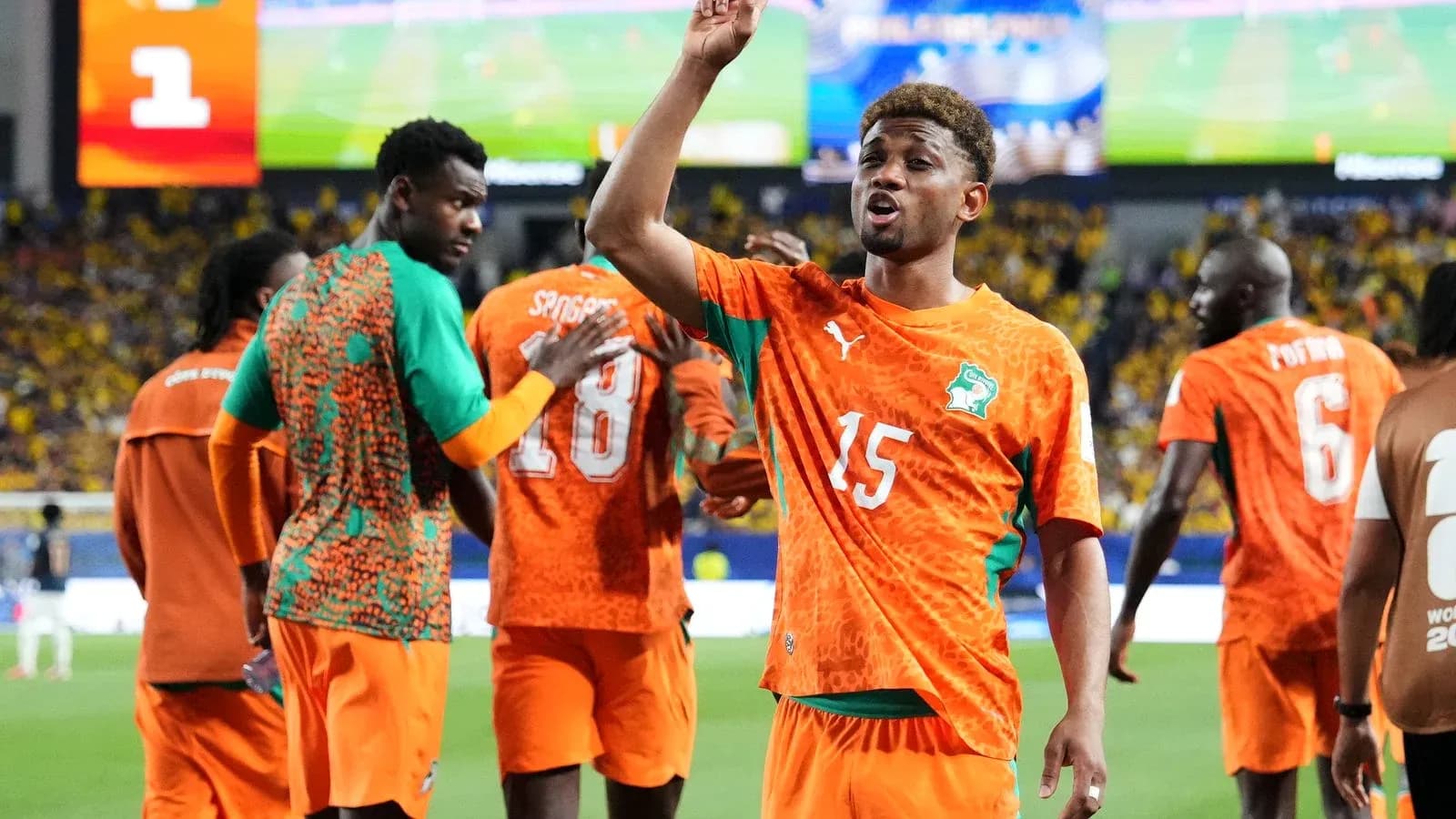
Ivory Coast Defeats Ecuador 1-0 in Tactical Showcase
Ivory Coast’s 1-0 win over Ecuador at Lincoln Financial Field was a controlled, methodical Group Stage performance built on structure rather than dominance of the ball. Despite trailing 48–52 in possession, Emerse Fae’s side created the higher quality chances, generated 1.52 xG to Ecuador’s 1.01 and found the decisive breakthrough late. Both teams lined up in a 4-4-2, but Ivory Coast’s version was more vertical and direct, using the athletic front two and aggressive full-backs to stretch Ecuador’s block. Ecuador, under Sebastian Beccacece, had more of the ball and a marginal edge in passing accuracy (492 passes, 419 accurate, 85%), yet struggled to convert territory into clear chances, managing only one shot on goal all night.
Tactical Setup
Tactically, Ivory Coast’s 4-4-2 had a clear spine. Yahia Fofana anchored the side in goal behind a back four of Guéla Doué, Wilfried Singo, Emmanuel Agbadou and Ghislain Konan. In midfield, Bazoumana Touré and Yan Diomande operated from the flanks, with Franck Kessié and Seko Fofana as the double pivot. Nicolas Pépé and Elye Wahi led the line. The structure without the ball was compact: the two forwards screened Ecuador’s pivots, while the wide midfielders dropped into a narrow line of four, forcing Ecuador wide and away from central combination zones.
Ecuador mirrored the 4-4-2 on paper, with Hernán Galíndez in goal, a back four of Alan Franco, Joel Ordóñez, Willian Pacho and Piero Hincapié, and a midfield band of John Yeboah, Moisés Caicedo, Pedro Vite and Alan Minda behind Gonzalo Plata and Enner Valencia. In practice, Ecuador often morphed into a 4-2-3-1 in possession, with Vite stepping higher between the lines and Caicedo staying as the single pivot. However, Ivory Coast’s central compactness, particularly the work rate and positioning of Kessié and Seko Fofana, limited Ecuador’s ability to play through the middle.
First Half
The first half was defined by Ivory Coast’s superior shot volume and territorial control in key moments, even without majority possession. They finished with 15 total shots to Ecuador’s 12, and crucially 4 shots on goal to Ecuador’s 1. The Ivorians were willing to shoot from both ranges (8 shots inside the box, 7 outside), reflecting a balanced threat. Ecuador matched them with 5 shots inside the box and 7 from distance, but many of these were low-quality efforts under pressure, as indicated by the lower xG.
Defensively, Ivory Coast’s back line was aggressive in stepping out, which is reflected in the disciplinary profile. Three first-half yellow cards – Seko Fofana for “Roughing” at 28', Franck Kessié for “Tripping” at 38', and Guéla Doué for “Tripping” at 40' – showed a midfield and right side prepared to break up Ecuadorian transitions at source. These were tactical fouls more than lapses in control, used to prevent Ecuador from exploiting space when Ivory Coast’s full-backs had advanced.
Goalkeeping Performance
In goal, Yahia Fofana (Ivory Coast) was rarely called into dramatic action, officially making 1 save. The underlying numbers suggest he handled Ecuador’s limited on-target threat cleanly, with 0.22 goals prevented, indicating that the one serious effort he faced carried some danger. At the other end, Hernán Galíndez (Ecuador) made 3 saves and also posted 0.22 goals prevented, reflecting that Ivory Coast’s 4 shots on goal included at least one high-quality chance that he managed to repel before the late winner. Both goalkeepers were efficient rather than spectacular, but the shot volume and xG profile underline that Galíndez was the busier of the two.
Passing and Possession
The passing battle underpinned the stylistic contrast. Ivory Coast completed 470 passes, 397 accurate (84%), slightly behind Ecuador’s 492 and 419 accurate (85%). Ecuador’s extra possession (52%) and marginally better passing accuracy came largely in their own half and the middle third, as Ivory Coast were content to let the Ecuadorian centre-backs and Caicedo circulate the ball, then spring forward quickly once a turnover was forced. Ivory Coast’s 3 corner kicks to Ecuador’s 5 show that Ecuador did manage to push the game into the Ivorian third in phases, but without the penetration or final-ball quality to really stretch the Ivorian defence.
Second Half Substitutions
The second-half substitutions shifted the tactical balance in Ivory Coast’s favour. At 56', Ecuador introduced Nilson Angulo (IN) for Alan Minda (OUT), looking for more direct running from the left. Simultaneously, Ivory Coast made a double attacking adjustment: Ange-Yoan Bonny (IN) came on for Elye Wahi (OUT), and Amad Diallo (IN) came on for Bazoumana Touré (OUT). These changes effectively converted Ivory Coast’s shape into a more flexible 4-2-3-1/4-2-4 hybrid, with Diallo operating between the lines and Bonny offering fresh depth in behind.
Ecuador responded at 62' by reinforcing the back line: Jackson Porozo (IN) replaced Alan Franco (OUT), and Ángelo Preciado (IN) came on for John Yeboah (OUT), pushing the full-back profile towards more physicality and defensive security. However, this also blunted some of their wide attacking threat. Porozo’s introduction brought solidity but also a disciplinary cost, as he was booked at 73' for “Holding”, Ecuador’s only yellow card of the match.
Ivory Coast continued to refresh their midfield engine at 77', with Christ Inao Oulaï (IN) replacing Nicolas Pépé (OUT) and Ibrahim Sangaré (IN) coming on for Seko Fofana (OUT). These moves re-energised the central and right channels, with Sangaré’s ball-winning and Oulaï’s fresh legs helping Ivory Coast maintain intensity in the press. Ecuador, for their part, introduced Kevin Rodriguez (IN) for Enner Valencia (OUT) at 77', seeking more mobility up front, but by then Ivory Coast’s defensive structure was well established.
A final defensive tweak from Ivory Coast at 89' saw Odilon Kossounou (IN) replace Guéla Doué (OUT), adding aerial presence and composure on the right side of defence ahead of the closing stages. Yet rather than simply protecting a point, Ivory Coast used this stability as a platform to push once more.
Decisive Moment
The decisive moment arrived at 90'. Amad Diallo, who had been introduced as a second-half substitute, scored the only goal for Ivory Coast, assisted by Wilfried Singo. The move encapsulated Ivory Coast’s tactical plan: a surge from deep by a defender (Singo) and a technically gifted attacker (Diallo) exploiting space and fatigue in Ecuador’s back line. It rewarded Ivory Coast’s greater shot volume, their superior xG, and their more incisive use of possession.
Disciplinary Overview
From a disciplinary standpoint, the match finished with Ivory Coast on three yellow cards and Ecuador on one, total four. The reasons were specific: Seko Fofana (“Roughing”), Franck Kessié (“Tripping”), Guéla Doué (“Tripping”), and Jackson Porozo (“Holding”). This profile aligns with the tactical narrative of Ivory Coast playing on the front foot, occasionally overstepping in duels, while Ecuador’s single booking came from a defender struggling to contain a late Ivorian surge.
Statistical Verdict
Statistically, the verdict is clear: Ecuador’s marginal edge in possession and passing did not translate into danger. Ivory Coast, with fewer passes but more verticality, generated more shots, more shots on goal, and a higher xG. Their 3 blocked shots and Ecuador’s 3 blocked efforts reflect committed defending at both ends, but the key difference lay in how often Ivory Coast reached shooting positions inside the box and how effectively their substitutions tilted the late phases. The 1-0 scoreline, with Ivory Coast’s goal arriving at 90', is consistent with a match where one side controlled the key spaces and moments, even without dominating the ball.