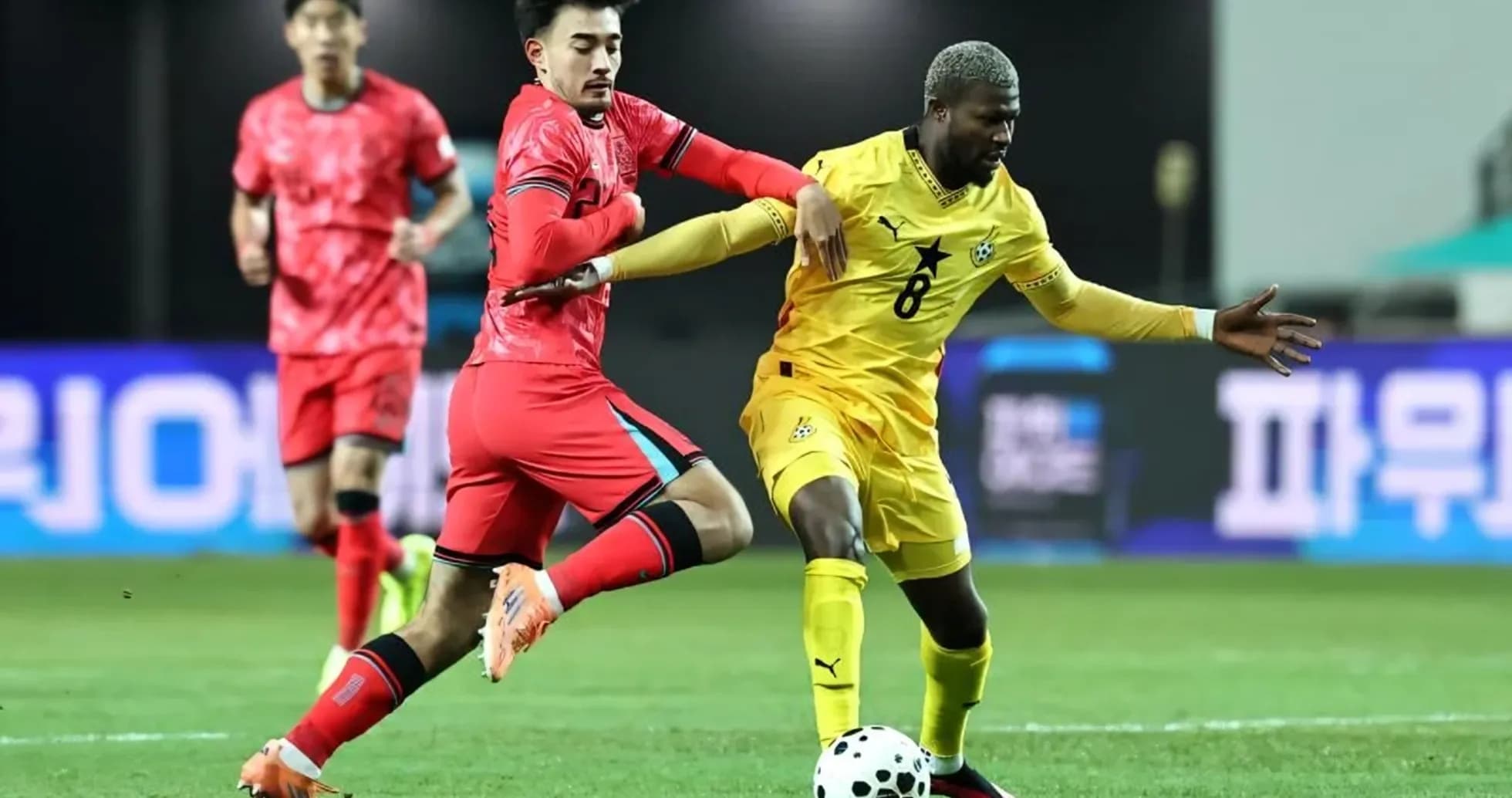
Jens Castrop: Balancing Aggression and Discipline Ahead of World Cup
Jens Castrop knows exactly what the headlines say about him right now.
Two red cards in a Bundesliga season. Eleven yellows in Germany’s second tier last year. A three‑match suspension that has cut short his campaign with Borussia Mönchengladbach. For a midfielder on the brink of a World Cup call-up, the narrative writes itself: talent wrapped in trouble.
He is having none of it.
Speaking to Korean reporters via video from Germany on Wednesday evening, the Korean German midfielder cut a defiant, clear-eyed figure. He didn’t apologise for who he is on the pitch. He defended it.
“I don't really think that it's an issue,” he said. “Of course, it's my play style. I'm an aggressive player; I like to win the ball. I like to give 100 percent in the drills.”
That edge has carried him to the brink of the biggest stage in football. Born to a Korean mother and a German father, Castrop has collected five caps under head coach Hong Myung-bo since last fall and is widely expected to be named in Korea’s FIFA World Cup squad on May 16. A lifelong dream is suddenly within touching distance.
Yet the timing of his latest dismissal could hardly be worse. At the weekend, he flew into a late challenge on Sael Kumbedi of VfL Wolfsburg and saw red — his second direct sending-off of the season. The disciplinary committee followed with a three-match ban. With Gladbach having only three league fixtures left, his season is over.
For many players, that would trigger a mea culpa. Castrop drew a line instead.
He freely admitted that his first red card of the season, shown against Bayern Munich on Oct. 25, was on him. “Too late,” he had said of that tackle, calling it “my mistake.” This one, though? Different story.
“I think we can all agree that the second red card that I got in the last match was not a red card, just a regular yellow one. Nobody got injured. It wasn't a bad foul,” he insisted. “I think I had my emotions under control. We needed that one point, and in the 92nd minute, I would not let my opponent cross free without pressure or without me trying to hold him back. So that's why I tackled him, and I think it was the right decision, even though I got the red card.”
Those words lay bare the tension at the heart of his game. The same aggression that drives him to close down a cross in the 92nd minute is the trait that puts him under the referee’s microscope. Last season in the 2. Bundesliga, he racked up 11 yellow cards in 25 matches, tied for the third-highest total in the division. He plays on the edge. Sometimes he goes over it.
World Cup stage, different stakes
Castrop knows that line cannot be crossed in June and July.
“I know that it can be very stupid to get a red card in an important game at the World Cup,” he said. “So this is something that will not happen.”
There was no bravado in that promise, just a recognition of what is at stake. A red card in a domestic league game costs points. A red card at a World Cup can wreck a nation’s campaign.
If, as expected, Hong includes him in the squad, Castrop will arrive in camp with something unusual for a modern footballer: enforced rest. The suspension has ended his club season early, but the midfielder is already looking for the upside.
He has been carrying knocks to his feet, back and knees. The ban, he suggested, could become a blessing in disguise, giving him extra time to heal before he throws himself into national-team duty.
The physical scars will fade. The disciplinary numbers will stay on the record. Castrop seems comfortable with that. He is not trying to reinvent himself as a cautious, risk-averse midfielder. He is trying to sharpen his judgment without dulling his edge.
Representing his mother’s country
Beneath the talk of cards and tackles lies something more personal. For Castrop, a World Cup with Korea is not just about a tournament; it is about identity.
“I think the World Cup is the biggest tournament in world football, so it always is the dream for every player to participate in the World Cup. So if I get called up, I will be very honored and proud to play my first World Cup,” he said.
His ambitions stretch far beyond simply making up the numbers.
“Of course, I have big expectations. I want Korea to be as successful as possible. I want to help the team, and I want to play a good World Cup on this big stage. I have big dreams and big hopes for this World Cup.”
The words are bold, but he quickly anchored them in something more practical. For all his personal hunger, he knows the foundations of any World Cup run are more basic than tactical systems or individual form.
“But first of all, the most important part is that our players stay in good condition,” Castrop continued. “We have to face some difficulties, and we need to stay strong and stick together as a team if we want to be successful. So this is the No. 1 priority.”
That is where his own story loops back into the collective. A player whose reputation has been built on individual aggression is now talking about unity, resilience, and shared responsibility.
On May 16, when Hong Myung-bo reads out his World Cup squad, we will discover whether the coach believes that Castrop’s fire can be controlled and channelled on the game’s grandest stage.
If the midfielder’s vow holds — if the cards stay in the referee’s pocket and the tackles stay just the right side of the line — Korea might find that the man once branded a disciplinary risk becomes one of their most important weapons.