Juventus vs Bologna: Champions League Aspirations Shine
Allianz Stadium under the lights, a cool Turin evening, and a Juventus side quietly sharpening its Champions League credentials. Following this result, a 2–0 win over Bologna in Serie A’s Round 33, the table tells a clear story: Juventus sit 4th on 63 points with a goal difference of 28 (57 scored, 29 conceded), while Bologna remain 8th on 48 points and a far slimmer cushion of 3 (42 for, 39 against). The scoreline matches the seasonal DNA: Juventus efficient and controlled, Bologna ambitious but ultimately outgunned.
I. The Big Picture – Shapes, Context, Control
Luciano Spalletti doubled down on his season’s blueprint, rolling again with a 3-4-2-1 that has now been used 21 times. It is the system that underpins their overall average of 1.7 goals for and just 0.9 against per match, and at home those numbers swell to 2.0 scored and 0.8 conceded. The structure was clear: M. Di Gregorio behind a back three of P. Kalulu, Bremer, and L. Kelly; width and verticality from E. Holm and A. Cambiaso; central ballast in M. Locatelli and W. McKennie; and a fluid front line of F. Conceicao, J. Boga, and J. David.
Vincenzo Italiano answered with a 4-3-3, one of Bologna’s alternative shapes to their usual 4-2-3-1. F. Ravaglia started in goal, protected by a back four of N. Zortea, E. Fauske Helland, J. Lucumi, and J. Miranda. In midfield, S. Sohm, R. Freuler, and T. Pobega were tasked with resisting Juventus’ central superiority, while the front three of R. Orsolini, S. Castro, and N. Cambiaghi carried the attacking burden for a side that, on their travels, averages 1.5 goals for but concedes 1.2.
Heading into this game, the contrast in home and away records framed the narrative. Juventus at home: 17 played, 10 wins, 6 draws, 1 defeat, 34 goals for and 13 against. Bologna away: 17 played, 8 wins, 4 draws, 5 defeats, 26 scored and 21 conceded. One fortress, one dangerous raiding party.
II. Tactical Voids – Absences and Discipline
Both coaches had to redraw their plans around important absences. Juventus were without J. Cabal, A. Milik, M. Perin, and, crucially, D. Vlahovic – the latter’s calf injury stripping Spalletti of his most natural penalty-box reference. The response was telling: the 3-4-2-1 leaned more into mobility and interchange, with J. David asked to stretch the line and drop into pockets rather than purely occupy centre-backs.
Bologna’s list was even longer: K. Bonifazi (inactive), N. Casale, T. Dallinga, B. Dominguez, and first-choice goalkeeper L. Skorupski all missing. That pushed F. Ravaglia into the XI and forced Italiano to trust a back line that, in aggregate, belongs to a team with 39 goals conceded overall and only 10 clean sheets in 33 league matches.
The disciplinary undercurrent of this match was always likely to matter. Juventus’ yellow-card profile shows a late-game surge between 61–75 minutes (22.73% of their yellows) and 76–90 (18.18%), while Bologna are even more combustible, with 26.67% of their yellows arriving from 61–75 and 28.33% from 76–90. Add Bologna’s red-card distribution – four reds spread from 16–90 minutes – and the risk of a chaotic finale was baked in. Spalletti’s side, by contrast, are more controlled: just two reds all season, split between 31–45 and 76–90.
III. Key Matchups – Hunter vs Shield, Engine Room, and Wide Wars
The “Hunter vs Shield” duel was etched across Bologna’s right flank. R. Orsolini, with 8 league goals and 3 penalties scored (but 2 missed), was the visiting spearhead, drifting inside from the right to attack the channels between L. Kelly and Bremer. His season numbers – 59 shots, 28 on target – illustrate a high-volume shooter, but against a Juventus defence that has conceded only 13 at home and kept 8 home clean sheets, he found the margins far tighter.
For Juventus, the primary hunter was not on the pitch from the start but sat on the bench: K. Yildiz, the club’s top scorer with 10 goals and 6 assists, a 7.47 rating, and a staggering 71 key passes. His presence as a substitute option shaped Bologna’s risk calculus: push too high, and a fresh, direct attacker with 131 dribble attempts and 71 successes would be unleashed into the spaces behind.
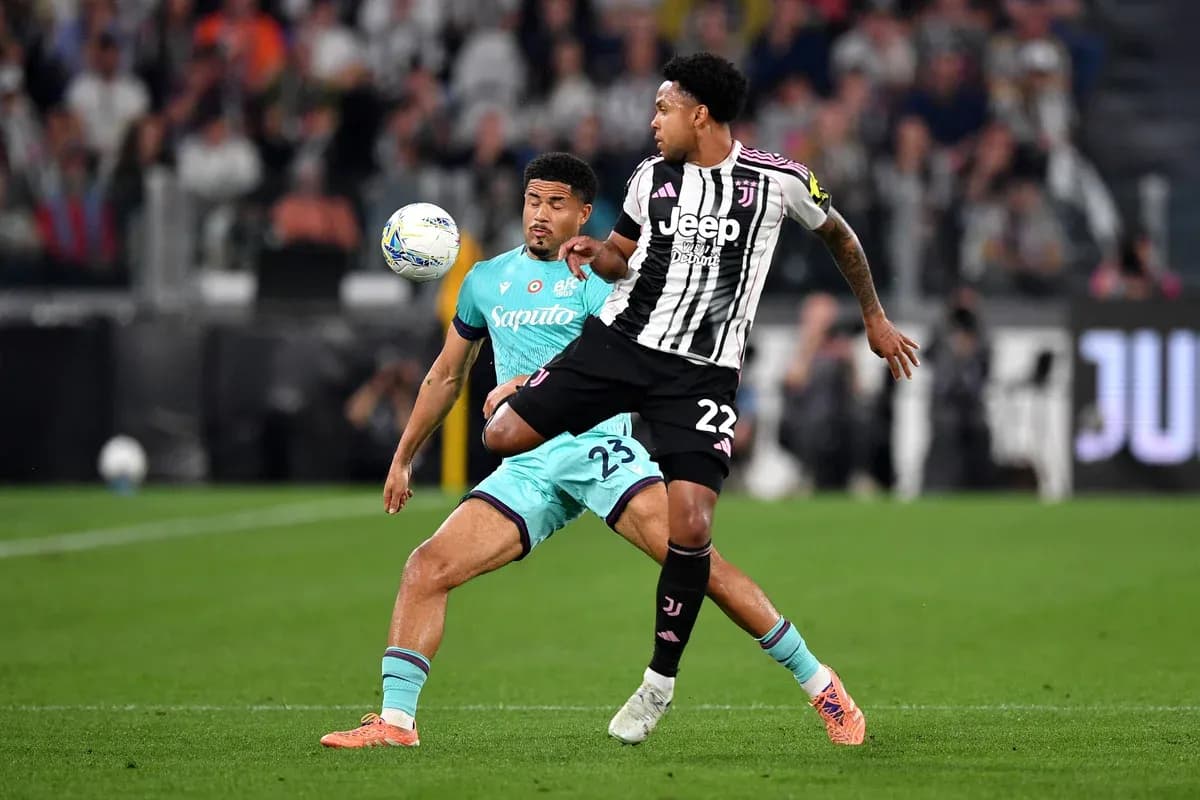
In the “Engine Room”, M. Locatelli and W. McKennie faced R. Freuler and S. Sohm. Locatelli’s season is the portrait of a deep-lying controller with bite: 2,354 passes at 88% accuracy, 89 tackles, and 23 successful blocks. He is also a disciplinary tightrope, with 7 yellows and 44 fouls committed. McKennie complements him with vertical running and aggression: 5 goals, 5 assists, 39 key passes, and 33 tackles, plus 7 blocked shots. Against them, Freuler’s job was to slow Juventus’ tempo and protect central spaces, while Sohm’s energy tried to disrupt the build-up. Over 90 minutes, Juventus’ double pivot simply exerted more control, turning Bologna’s 4-3-3 into a reactive unit.
Out wide, the duel between A. Cambiaso and N. Cambiaghi encapsulated the game’s tension. Cambiaso, a creative wing-back with 3 goals, 3 assists, and 47 key passes, is also one of Juventus’ red-card holders this season. His high positioning, supported by Holm on the opposite flank, stretched Bologna’s full-backs and pinned back Cambiaghi, who usually thrives in transition and has 3 goals, 4 assists, and a red card of his own. Instead of being the tormentor, Cambiaghi spent long spells tracking runners and absorbing pressure.
Up front, S. Castro – 7 goals and 2 assists, with 2 penalties won – fought a lonely battle against Bremer and company. His 260 duels and 110 won this season speak to his willingness to scrap, but Juventus’ back three, protected by Locatelli, kept Bologna largely on the periphery. Di Gregorio’s clean sheet folds neatly into a Juventus campaign that already boasted 14 overall shutouts heading into this match.
IV. Statistical Prognosis – xG Logic and Defensive Gravity
Even without explicit xG numbers, the statistical contours make the 2–0 scoreline feel almost inevitable. Juventus, at home, average 2.0 goals for and 0.8 against; Bologna away, 1.5 for and 1.2 against. Overlay those baselines and the “expected” outcome gravitates toward a Juventus win by one or two goals, with a strong probability of a home clean sheet given their 8 home shutouts and Bologna’s 3 away matches without scoring.
Add the squad dynamics: Juventus could rotate elite attacking pieces like Yildiz and L. Openda from the bench, while Bologna were missing key depth, especially in central defence and goal. Orsolini’s penalty record, with 2 misses despite 3 scored, underlines that even Bologna’s highest-leverage moments carry risk.
Following this result, Juventus look every inch a Champions League-bound side built on structure and defensive solidity, capable of winning without their marquee striker. Bologna, brave and tactically coherent under Italiano, remain a dangerous away outfit, but nights like this in Turin show the ceiling: against a side with Juventus’ defensive gravity and midfield control, their margin for error is razor-thin, and the numbers – as much as the narrative – tilt inexorably toward black and white.