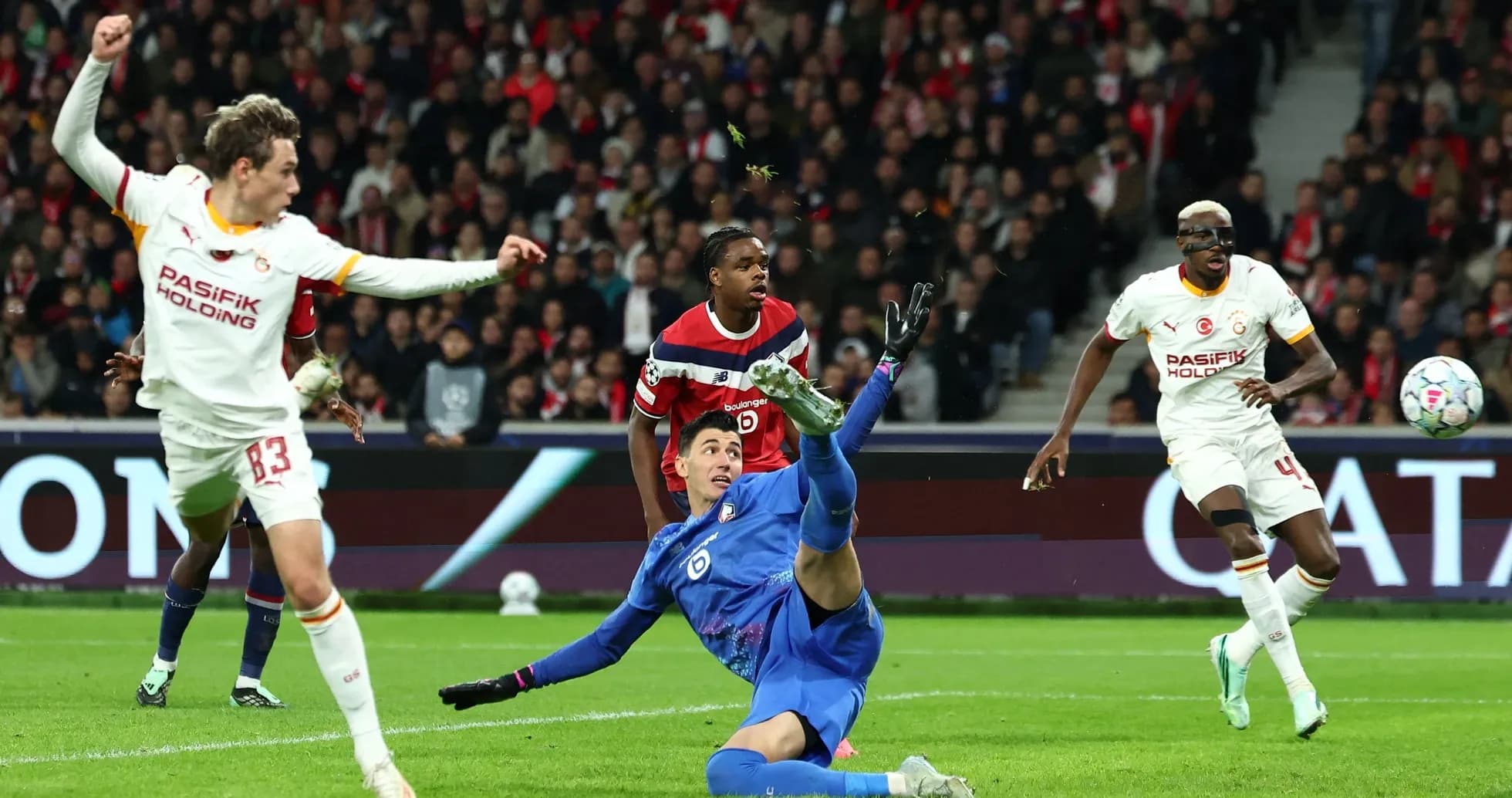
Lille's UEFA Champions League Struggles: Tactical Flaws Exposed
Under the closed roof of Stade Pierre-Mauroy, Lille’s League Stage story in the UEFA Champions League took another dark twist. A 4-2 home defeat to Galatasaray did more than settle a wild ninety minutes; it crystallised the tactical identities and structural flaws of both sides three games into this new-format campaign.
I. The Big Picture – contrasting trajectories
Following this result, Lille sit 35th in the overall league table with 0 points from 3 matches. Overall they have scored 4 and conceded 10, giving them a goal difference of -6. At home, the numbers are stark: 2 matches, 0 points, 4 goals scored and 7 conceded. Their attacking output at home – 2.0 goals on average – is being completely undermined by a defensive record of 3.5 goals conceded per home game.
Galatasaray, by contrast, climb to 23rd with 3 points from 3 fixtures. Overall they have 6 goals for and 9 against, a goal difference of -3. On their travels, they have now played 2, winning 1 and losing 1, with 5 goals scored and 5 conceded away. An average of 2.5 goals scored and 2.5 conceded away underlines what this match confirmed: Okan Buruk’s side are chaotic but potent, built to trade punches rather than control the tempo.
The scoreline in Lille – 2-2 at half-time, 2-4 at full-time – mirrored both teams’ seasonal DNA: Lille can hurt opponents but cannot sustain defensive concentration; Galatasaray can be opened up, but their individual quality in advanced zones eventually tilts the balance.
II. Tactical voids and absences
Davide Ancelotti’s selection was shaped by a brutal absentee list. H. Igamane and T. Santos were both ruled out with knee injuries, A. Ueda with a foot injury, while O. Sahraoui missed out by coach’s decision. Most disruptive, though, was the suspension of E. Mbappé after his red card earlier in the campaign. Mbappé’s previous outing in this competition – 56 minutes, an assist, 20 passes and energetic work between the lines – had hinted at a young midfielder capable of linking Lille’s phases. His absence forced Ancelotti into a more orthodox, workmanlike midfield trio.
The 4-3-3 he deployed placed B. Özer behind a back four of M. Goffi, N. Ngoy, Alexsandro Ribeiro and C. Verdonk. In midfield, N. Mukau, N. Bentaleb and B. André formed a narrow triangle, while the front three of D. Bakwa, H. Haraldsson and S. Diaoune were tasked with stretching Galatasaray’s back line.
Galatasaray had their own notable omissions. R. Leao’s injury removed a high-end dribbling threat from the left, while a cluster of “off the roster” absentees – E. Aydin, K. Ayhan, A. Guner, K. Karatas, A. Unyay and A. Yilmaz – trimmed Buruk’s rotation options but not his core. With U. Çakır in goal, a back four of R. Sallai, D. Sánchez, A. Bardakcı and I. Jakobs sat behind a double pivot of L. Torreira and Gabriel Sara. Ahead of them, Y. Akgün, A. Batrakov and B. Yılmaz supported lone striker V. Osimhen in a 4-2-3-1 that was clearly designed to attack the spaces around Lille’s full-backs.
Disciplinary patterns from the season added another layer of tension. Lille’s yellow-card profile shows a late-game spike: 40.00% of their cautions arriving between 76-90 minutes, with another 20.00% from 91-105. They also have a red card in the 46-60 window – the Mbappé dismissal that cost him this match. Galatasaray’s bookings are similarly back-loaded, with 50.00% of their yellows coming between 76-90 minutes and 16.67% each in the 46-60, 61-75 and 91-105 ranges. This shared tendency to lose discipline late on foreshadowed a frantic, open second half.
III. Key matchups – Hunter vs Shield, Engine Room battles
The defining duel of the night was the “Hunter vs Shield” confrontation between V. Osimhen and Lille’s central defensive axis of N. Ngoy and Alexsandro Ribeiro. Osimhen, leading the line in a system that averages 2.5 goals away, thrived on the structural weaknesses already evident in Lille’s season: overall they concede 3.3 goals per game, with 3.5 at home. The Nigerian’s constant runs into the channels between full-back and centre-back forced Lille’s line to retreat, opening pockets for Y. Akgün and B. Yılmaz to attack.
On Lille’s side, the front three posed their own questions. D. Bakwa’s starting berth on the right of the 4-3-3 targeted I. Jakobs and A. Bardakcı, aiming to drag the left-back out and isolate the centre-back. H. Haraldsson, operating centrally, tried to drop into the same pockets that A. Batrakov and B. Yılmaz occupy for Galatasaray, but the lack of a true creative 10 in Lille’s structure meant their attacks often relied on direct runs and wide combinations rather than subtle central overloads.
In the “Engine Room”, the contest between B. André and N. Bentaleb against L. Torreira and Gabriel Sara defined the rhythm. André’s role as Lille’s organiser was complicated by the need to shield a back line that has already conceded 10 overall. Torreira, by contrast, could play on the front foot, snapping into duels and launching transitions once Galatasaray’s press forced turnovers. Gabriel Sara’s capacity to step higher and link with A. Batrakov gave Galatasaray a numerical edge between Lille’s lines that became more pronounced as the game stretched.
IV. Statistical prognosis – what this result tells us
Following this result, Lille’s campaign reads as a team whose attacking numbers are respectable but whose defensive structure is unsustainable. Overall they score 1.3 goals per game but concede 3.3; at home the split is 2.0 for and 3.5 against. Without penalties to bail them out – they have taken none so far, with 0 scored and 0 missed – they must create everything from open play, and that burden is heavy on a side missing several forwards and a key young midfielder through suspension.
Galatasaray, meanwhile, embrace volatility. Overall they average 2.0 goals scored and 3.0 conceded, with no clean sheets home or away. Their away profile – 2.5 goals both for and against – suggests that any match involving Buruk’s side is likely to be decided in the boxes rather than in midfield control. Their late yellow-card surge (50.00% between 76-90 minutes) hints at a team that pushes the physical and tactical limits as they protect or chase results.
In xG terms, even without explicit figures, the patterns are clear: Lille’s defensive concession rate and structural fragility against runs in behind will continue to inflate opponents’ chance quality. Galatasaray’s aggressive 4-2-3-1, with Osimhen’s vertical threat and a trio of creators behind him, is built to exploit exactly that profile.
For Lille, the tactical preview of the remaining league-stage fixtures is grim unless Ancelotti can tighten the central corridor and reduce exposure in transition. For Galatasaray, this 4-2 away win is both a template and a warning: their attacking ceiling is high enough to trouble anyone, but until the goals against column drops from its current 3.0 overall, they will live on a knife-edge in this Champions League campaign.