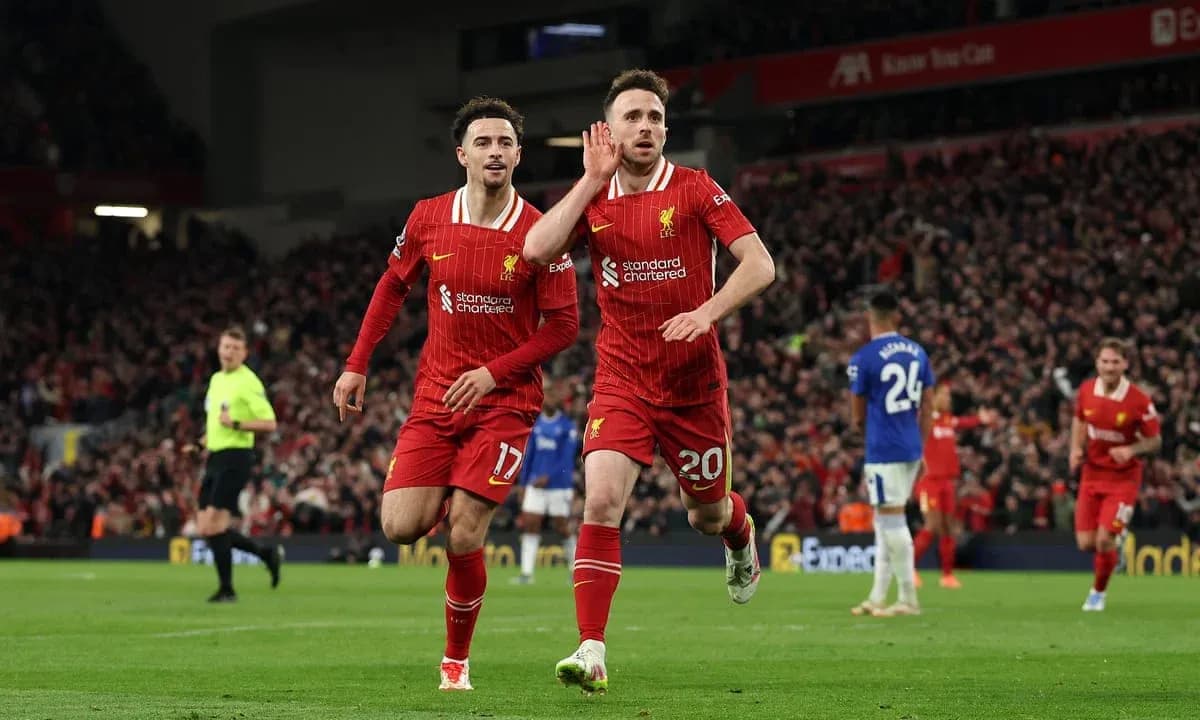
Liverpool's Clinical Victory Over Everton: A Tactical Analysis
On a raw Merseyside afternoon at Hill Dickinson Stadium, a 2–1 Liverpool win felt less like a smash-and-grab and more like a clinical assertion of hierarchy. Following this result, the table tells a clear story: Everton sit 10th on 47 points with a goal difference of 1 (40 scored, 39 conceded), while Liverpool, 5th with 55 points and a goal difference of 11 (54 scored, 43 conceded), continue to look like a side calibrated for Champions League football.
The league-season DNA of these teams framed the narrative long before kick-off. Everton’s campaign has been defined by grind and late drama. Overall they average 1.2 goals for and 1.2 against per match, a statistical knife-edge that mirrors their mid-table reality. At home, they score 1.3 and concede 1.2, a marginal positive that has not translated into dominance: just 6 wins from 17 at Hill Dickinson Stadium. Their goal timings are revealing – only 5.13% of their goals arrive in the first 15 minutes, but a striking 30.77% come between 76-90', a late-game surge that has rescued points all season.
Liverpool’s profile is more expansive, but not without vulnerability. Overall they score 1.6 goals per game and concede 1.3; on their travels, that becomes 1.5 for and 1.5 against, an away record that mixes threat with fragility. Their attacking curve peaks late: 30.77% of their goals also land between 76-90', and another 25.00% arrive in the 31-45' window. Defensively, the red zone is stark: 37.78% of their goals conceded come in that same 76-90' stretch, a structural weakness that has repeatedly invited late jeopardy.
Into this statistical tension stepped two very different squads.
Arne Slot’s Liverpool lined up in a familiar 4-2-3-1, reshaped by absences but rich in technical quality. With Alisson out through a muscle injury, the responsibility in goal fell to G. Mamardashvili, whose calm distribution allowed Liverpool to build from deep despite the ferocity of the derby. Ahead of him, the back four of C. Jones, I. Konate, V. van Dijk and A. Robertson blended youth, power and experience. Van Dijk’s authority underpinned a high line that dared Everton to play through or beyond it; Konate’s recovery pace made the risk viable.
The double pivot of D. Szoboszlai and R. Gravenberch became the structural heart of Liverpool’s control. Szoboszlai, who has already amassed 1938 passes at an 87% accuracy with 61 key passes this league season, orchestrated from deep, switching play and stepping into half-spaces. His disciplinary record – 7 yellows and 1 red, plus a missed penalty this campaign – underscored the edge in his game, but here that aggression was channeled into front-foot pressing and sharp counter-pressing.
Ahead of them, the trio of M. Salah, F. Wirtz and C. Gakpo offered an elastic line of creators. Salah, with 7 goals and 6 assists in the league, drifted inside from the right, constantly probing the channel between Everton’s right centre-back and full-back. Gakpo, whose 6 goals and 5 assists come with 48 shots and 48 key passes, floated between lines, sometimes acting as a second striker off A. Isak, sometimes dropping to overload midfield. Wirtz stitched the pockets together, linking with Szoboszlai and Gravenberch to ensure Liverpool always had a spare man between Everton’s lines. At the tip, Isak’s movement dragged markers away, clearing corridors for late runners.
Sean Dyche’s Everton, by contrast, were stripped of a key creative outlet. J. Grealish, one of the league’s leading providers with 6 assists and a dribbling profile built on 57 attempts and 58 fouls drawn, missed out with a foot injury. His absence removed a ball-carrying pressure valve and left Everton more direct, more vertical, and more reliant on set-pieces and second balls.
The back four of J. O'Brien, J. Tarkowski, J. Branthwaite and V. Mykolenko carried the familiar Dyche imprint: aerially strong, aggressive, and compact. O'Brien, who has blocked 16 shots this season, again acted as a key last-ditch defender, while Tarkowski and Branthwaite anchored the line against Liverpool’s rotations. In front of them, the “engine room” was defined by J. Garner and I. Gueye. Garner’s campaign numbers – 1531 passes at 87% accuracy, 103 tackles, 9 blocked shots and 51 interceptions – mark him as Everton’s metronome and enforcer rolled into one. Gueye, with 43 tackles and 28 interceptions, snapped into duels, trying to break Liverpool’s rhythm at source.
This was the game’s central clash: Liverpool’s creative axis of Szoboszlai and Wirtz versus Everton’s double shield of Garner and Gueye. For long spells, Garner held his own, stepping out to press Wirtz and tracking Gakpo’s inward drifts. Yet the cumulative effect of Liverpool’s circulation eventually pulled Everton’s block too wide and too deep, particularly as the match moved into the period where Liverpool historically thrive – the 31-45' and 76-90' windows.
Discipline and card profiles shaped the undercurrent. Everton’s season-long yellow-card curve spikes late, with 23.73% of their bookings between 76-90' and another 16.95% in added time. Liverpool mirror that pattern, with 28.57% of their yellows in the final quarter-hour and 16.33% in stoppage. In a derby decided by fine margins, those late fouls and free-kicks became both lifeline and liability. Garner, already the league’s leading yellow-card collector with 9, walked that tightrope in the second half, forced to moderate his aggression just as Liverpool pushed hardest.
From a macro perspective, the “Hunter vs Shield” dynamic tilted red. Liverpool’s overall 54 goals, with 16 in the final quarter of matches, met an Everton defence that concedes 1.2 per game overall and 25.00% of its goals between 76-90'. That intersection – Liverpool’s late attacking surge against Everton’s late defensive leak – always threatened to be decisive, and the pattern of the 2–1 scoreline reflected that pressure, even if the goals themselves were spread across the 90 minutes.
In xG terms, Liverpool’s season profile – higher volume of goals, more sustained territorial control, and only 4 matches all season where they have failed to score – suggests they would have shaded the underlying chances here as well. Everton, with just 4 home matches over 0.5 home goals conceded fewer than once and 9 total clean sheets at home and away, were always likely to bend under repeated waves.
Following this result, the tactical prognosis is clear. Liverpool’s 4-2-3-1, even without Alisson and several injured squad players, remains a high-ceiling structure when Szoboszlai, Salah and Gakpo are synchronised. Their late-game defensive frailty on their travels persists as a concern, but their attacking power continues to outweigh it. Everton, meanwhile, remain an honest, combative mid-table side whose margins are too fine: solid enough to frustrate, not yet incisive enough to consistently overturn superior talent, especially when deprived of Grealish’s creativity.
The derby, in the end, became a mirror of the season: Liverpool, flawed but forceful, finding a way; Everton, valiant but narrow, living on the edge of their own statistics.