Mexico Dominates South Africa 2-0 in World Cup Match
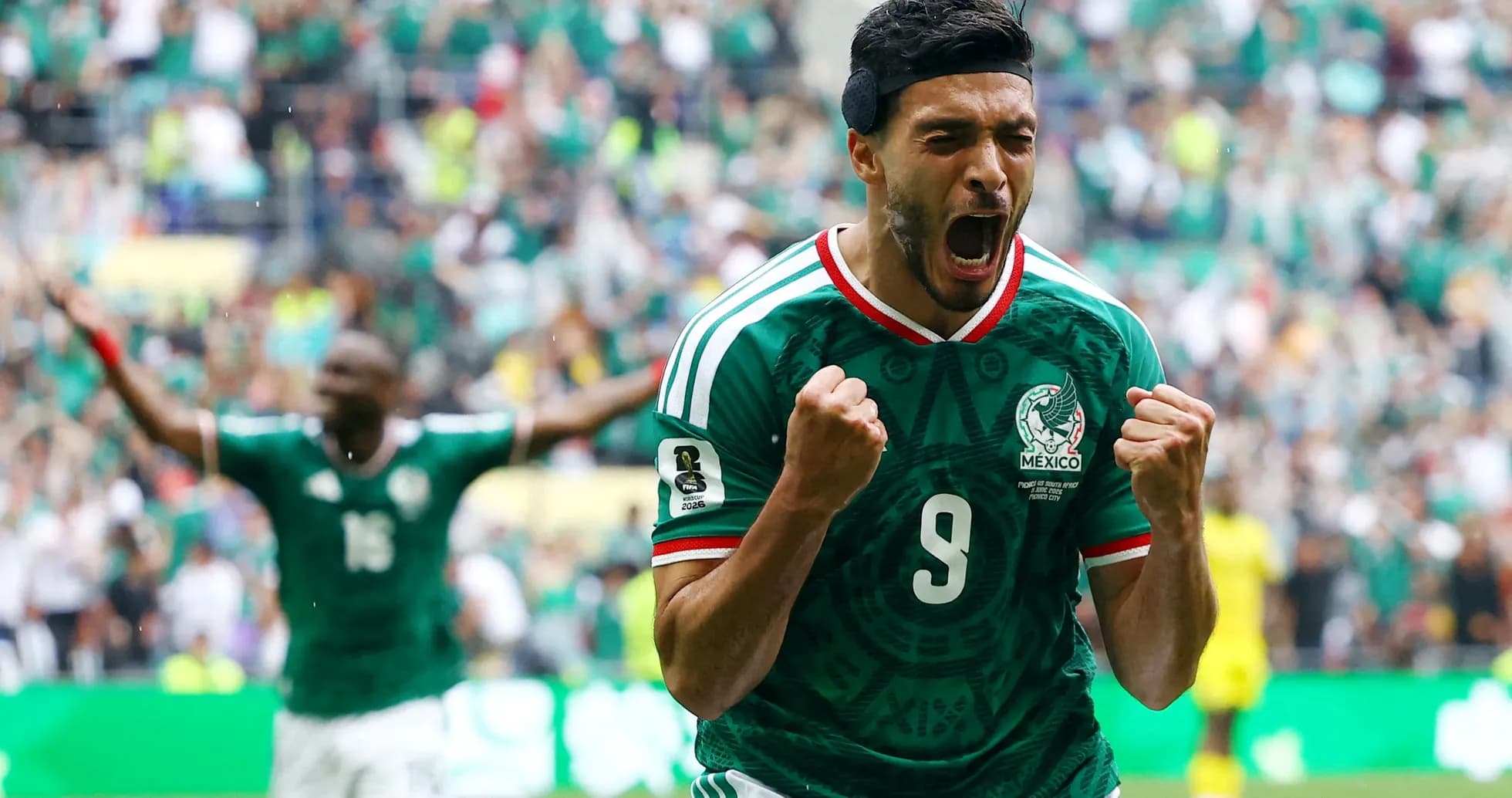
Mexico’s 2-0 win over South Africa at Estadio Azteca was a textbook example of how structure, ball circulation and game-state control can dismantle a deep 5-3-2 block, especially once numerical superiority arrived. Across 90 minutes, Mexico’s 4-1-4-1 imposed itself through possession (61% to 39%), volume of shots (16 to 3) and territory, while South Africa gradually sank into survival mode, then into damage limitation after two red cards.
Javier Aguirre’s 4-1-4-1 was very clear in its roles. Erik Lira operated as the single pivot in front of a back four of Israel Reyes, César Montes, Johan Vásquez and Jesús Gallardo. Ahead of him, a fluid band of four — Roberto Alvarado, Brian Gutiérrez, Álvaro Fidalgo and Julián Quiñones — supported Raúl Jiménez as the lone striker. In possession, this often morphed into a 2-3-5: Lira dropped close to the centre-backs, full-backs pushed high, and the “4” in midfield occupied half-spaces and wide channels to stretch South Africa’s back five.
Mexico’s dominance with the ball was underpinned by clean distribution: 520 passes, 467 accurate (90%). The structure ensured constant short options around the ball, allowing them to recycle quickly from one flank to the other and probe the compact South African block. Nine of their 16 shots came from inside the box, reflecting their ability to progress into dangerous central zones rather than settling for speculative efforts; seven attempts from outside the box were largely a by-product of territorial control rather than desperation.
Hugo Broos set South Africa up in a conservative 5-3-2, with Khuliso Mudau and Aubrey Modiba as wing-backs flanking a back three of Nkosinathi Sibisi, Ime Okon and Mbekezeli Mbokazi. In midfield, Teboho Mokoena, Siphephelo Sithole and Jayden Adams were tasked with screening central lanes, while Iqraam Rayners and Lyle Foster led a front two primarily focused on pressing triggers rather than sustained possession play. With only 335 passes (272 accurate, 81%), South Africa accepted a reactive role, trying to compress central spaces and deny Mexico access between the lines.
First Half
The opening goal at 9’ — Julián Quiñones finishing a move assisted by Erik Lira — was tactically significant. It rewarded Mexico’s insistence on playing through the first line and immediately changed the game-state: South Africa’s 5-3-2 now had to consider more aggressive transitions, but their attacking plan never really materialised. They managed just three shots all game, with only one from inside the box, and an xG of 0.07 underlined how sterile their attacks were.
Defensive Structure
Mexico’s defensive structure was largely untroubled. With the ball, Lira’s positioning allowed quick counter-pressing whenever possession was lost, and the back four rarely had to defend large open spaces. The foul count — 12 for Mexico, 11 for South Africa — reflects a match where both sides used tactical fouls, but the key defensive moments came in last-man situations. The red card for Siphephelo Sithole at 49’ for “Professional foul last man” tilted the tactical balance decisively. South Africa’s midfield lost one of its central screeners, forcing them into a 5-2-2 or 5-2-1-1 shape, with even less capacity to contest central areas.
From that point, Mexico’s 61% possession became even more dominant in terms of field position. They were able to lock South Africa in, sustaining attacks with three corner kicks and repeated waves of pressure. The second goal at 67’, scored by Raúl Jiménez and assisted by Roberto Alvarado, came at the perfect moment: just after Mexico had freshened the midfield with Gilberto Mora (IN) for Álvaro Fidalgo (OUT) and Luis Chávez (IN) for Brian Gutiérrez (OUT) at 66’. Those substitutions kept the intensity of Mexico’s press and circulation high, ensuring the extra man was fully exploited.
Game Management
Aguirre’s subsequent changes were all about game management and energy. Armando González (IN) came on for Raúl Jiménez (OUT) at 76’, and Edson Álvarez (IN) replaced Erik Lira (OUT) at the same minute, shoring up the pivot role with a more defensively minded profile to protect the 2-0 lead. At 79’, Alexis Vega (IN) came on for Julián Quiñones (OUT), adding fresh legs and ball-carrying to exploit spaces against a tiring, numerically depleted opponent.
On the South African side, Broos tried to adjust within the constraints of the red card. Thalente Mbatha (IN) came on for Lyle Foster (OUT) at 56’, suggesting a shift toward reinforcing midfield and sacrificing a striker. Themba Zwane (IN) replaced Jayden Adams (OUT) at 61’, offering more technical quality between the lines, but the team’s low volume of attacks meant his influence was limited. Later, Oswin Appollis (IN) came on for Aubrey Modiba (OUT) and Evidence Makgopa (IN) for Iqraam Rayners (OUT) at 77’, but by then South Africa were down to nine men after Zwane’s own dismissal for “Violent conduct” at 84’, following a VAR “Card upgrade” review at 82’.
Disciplinary Actions
The disciplinary pattern had clear tactical consequences. South Africa finished with two red cards — Sithole for “Professional foul last man” at 49’ and Zwane for “Violent conduct” at 84’ — on top of yellow cards for Teboho Mokoena (“Foul”, 17’) and Nkosinathi Sibisi (“Foul”, 74’). Mexico, for their part, saw Brian Gutiérrez booked for “Foul” at 23’ and then lost César Montes to a late red card for “Professional foul last man” at 90+2’. That final dismissal did not alter the outcome but underlined how high Mexico’s defensive line and aggression remained even with a two-goal cushion.
Goalkeeping Performance
In goal, Raúl Rangel (Mexico) was largely a spectator, officially called upon for 2 saves, matching South Africa’s meagre attacking threat. Ronwen Williams (South Africa) also recorded 2 saves, but his defensive unit faced a much heavier workload: Mexico generated 4 shots on goal, 16 total shots and 5 blocked efforts, consistently testing the block in front of him rather than the goalkeeper directly. Mexico’s goals prevented figure of -0.47, combined with an xG of 1.41, indicates that their finishing slightly outpaced expectation, but not in a way that contradicted the pattern of control.
Statistically, the 2-0 scoreline aligned closely with the underlying numbers. Mexico’s xG of 1.41 to South Africa’s 0.07 reflected a match where one side repeatedly entered high-value zones and the other barely did. The possession split, passing volume and accuracy, and shot distribution all pointed to a Mexico side using a well-drilled 4-1-4-1 to dominate territory, manipulate a back five and convert that control into a comfortable, tactically mature World Cup group-stage win.