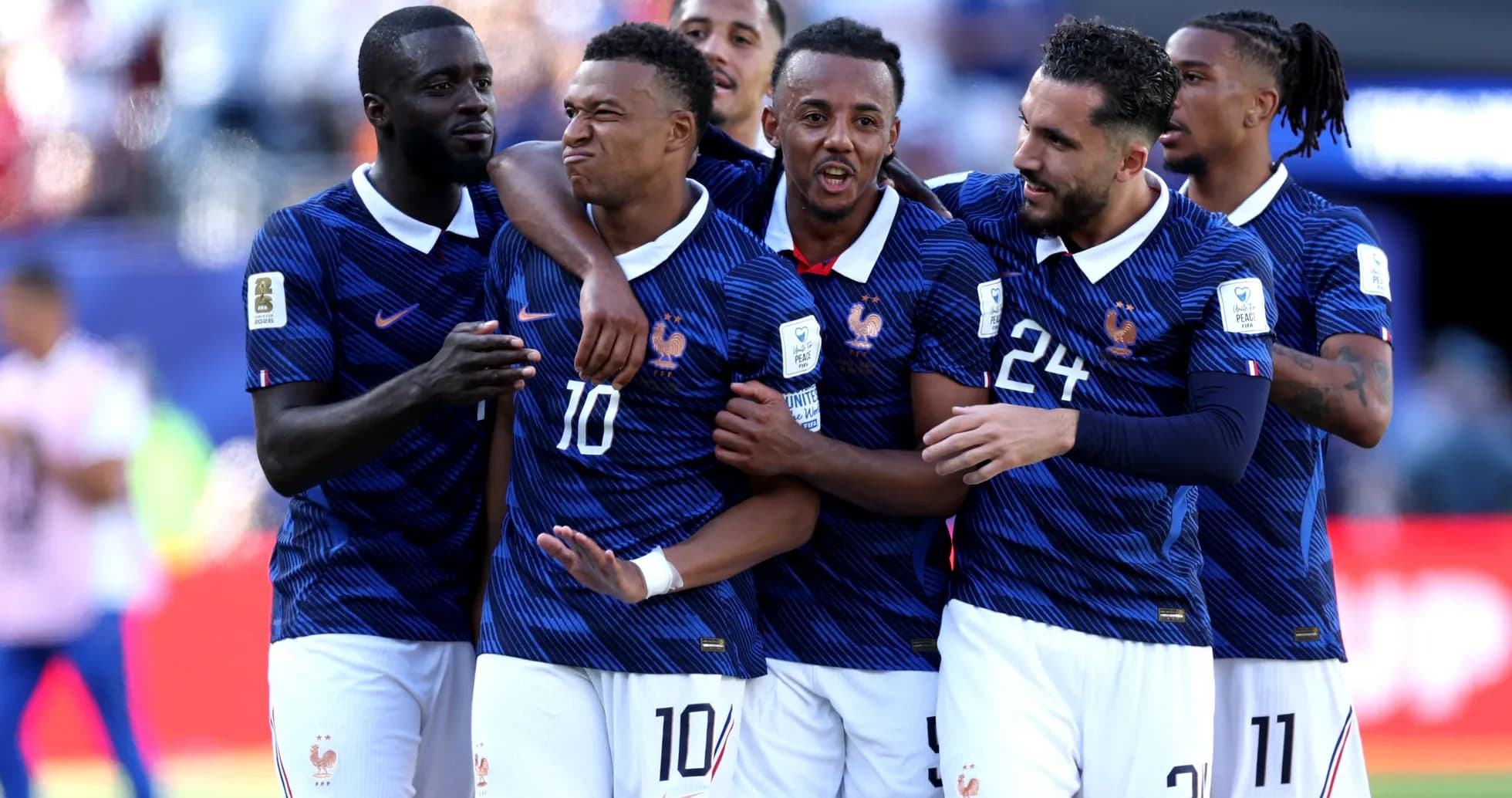
France Dominates Senegal 3-1 in World Cup Group I Clash
MetLife Stadium watched a heavyweight statement in Group I as France dismantled Senegal 3-1, a result that immediately sketches the tactical identities of both sides in this World Cup. In total this campaign, France have played 1 match, winning it 3-1; Senegal, on their travels, have lost their only outing by the same scoreline. The early table reflects that contrast: France sit 2nd in Group I on 3 points with a goal difference of +2 (3 goals for, 1 against), while Senegal are 3rd with 0 points and a goal difference of -2 (1 for, 3 against).
I. The Big Picture – Deschamps’ control vs Senegal’s stretched bravery
Both teams lined up in a mirrored 4-2-3-1, but the shapes behaved very differently over 90 minutes. Didier Deschamps’ France used the system as a platform for territorial control and vertical bursts, while Bouna Thiaw Pape’s Senegal leaned into transition, trying to spring from a compact double pivot into the open grass behind France’s back line.
France’s structure was classic Deschamps: Mike Maignan behind a disciplined back four of Jules Kounde, Dayot Upamecano, William Saliba and Theo Hernandez. Ahead of them, Aurelien Tchouameni and Adrien Rabiot formed a double pivot, with a fluid line of three – Michael Olise, Ousmane Dembele and Desire Doue – feeding Kylian Mbappe as the lone striker.
Senegal mirrored the 4-2-3-1: Edouard Mendy in goal, protected by Krepin Diatta, Kalidou Koulibaly, Moussa Niakhate and Moussa Diouf. Idrissa Gueye and Pape Gueye anchored midfield, with Ismaila Sarr, Lamine Camara and Sadio Mane supporting Nicolas Jackson up front. On paper it was symmetrical; on the pitch, France’s superior structure and individual quality pulled the game out of shape in their favour.
Heading into this game, France’s season numbers were clean but limited: in total this campaign they had scored 3 goals and conceded 1, all at home in this single fixture. Their average of 3.0 goals for and 1.0 against at home underlines a side that can overwhelm but still leaves small pockets of vulnerability. Senegal’s early profile is the mirror image: on their travels they have scored 1.0 goal on average and conceded 3.0, underlining an attack that can threaten but a defence that is too easily exposed when the block is stretched.
II. Tactical Voids – What was missing, and where the discipline cracked
There is no formal injury or suspension list in the data, so the “voids” here are structural rather than personnel-based. For France, the main risk in this 4-2-3-1 is the space behind Theo Hernandez when he advances. With Olise tucking inside and Mbappe drifting left, France often morph into a 3-2-4-1 in possession, leaving Tchouameni and Rabiot to patrol large zones. That worked because Senegal’s central counter-pressure was inconsistent; when Pape Gueye and Idrissa Gueye stepped up together, they could trouble France, but the distances to Sarr and Mane were too big to sustain a high press.
Disciplinary data for both teams in this World Cup is blank so far: no recorded yellow or red card timings across any interval. That absence tells its own story – this was not a game of cynical fouling or stop-start rhythm, but one where France’s technical security allowed them to avoid desperation tackles, and Senegal’s problems were more positional than disciplinary.
For Senegal, the biggest void was between Koulibaly and his full-backs. Diatta, an attacking profile at right-back, and Diouf on the left were repeatedly caught in two minds: step to France’s wingers or tuck in to protect the half-spaces. With Mbappe constantly threatening the channel between full-back and centre-back, that indecision became fatal.
III. Key Matchups – Hunter vs Shield, Engine Room battles
Hunter vs Shield was defined by Mbappe against Senegal’s defensive core. Mbappe arrives as one of the early stars of the tournament: in total this campaign he has 2 goals from 1 appearance, converting all 4 of his shots on target. His 8.2 rating, 6 dribble attempts and 93% passing accuracy show a forward not just finishing chances but knitting play. Against a Senegal side that, on their travels, concedes an average of 3.0 goals, this was always likely to be decisive.
Koulibaly and Niakhate tried to compress space behind Jackson, but France’s use of the three attacking midfielders was clever. Olise and Dembele stretched the width, while Doue attacked the pockets between Senegal’s lines. Every time Senegal’s back four stepped up to compress Mbappe, one of the three underneath him appeared between the lines, forcing the defence to retreat and reopening the very space they had tried to close.
In the Engine Room, Tchouameni and Rabiot faced Idrissa Gueye and Pape Gueye. The French pair controlled tempo, recycling possession and denying Senegal the vertical passes they needed to spring Jackson and Sarr early. Without sustained ball-winning high up the pitch, Senegal were forced into deeper, longer phases of defending – exactly the scenario where France’s patient circulation and individual quality grind opponents down.
Senegal’s attacking spark came from the bench. Ibrahim Mbaye, one of the tournament’s early surprise names, has 1 goal in total this campaign from just 15 minutes, with 1 shot on target and an 87% passing accuracy. Combined with Iliman Ndiaye, who already sits among the top assist providers with 1 assist from 17 minutes and a 90% pass accuracy, Senegal’s late-game substitutions added guile and penetration that had been missing from the starting shape. Their cameo chemistry hints at a different attacking blueprint for the next group matches.
IV. Statistical Prognosis – What this result tells us about their paths
Following this result, France’s overall profile in the World Cup is that of a contender already playing at knockout intensity. In total this campaign they have a 100% win rate from 1 match, 3.0 goals scored per game and 1.0 conceded, with no penalties taken or missed. The lack of clean sheets (0 in total) is a minor concern, but the attacking ceiling, driven by Mbappe’s 2 goals and Bradley Barcola’s sharp contribution off the bench (1 goal, 7 passes at 85% accuracy), gives Deschamps enormous tactical flexibility. France can afford to rotate around a settled 4-2-3-1 without losing their core identity.
Senegal’s numbers paint a more precarious picture. In total this campaign they have 0 points from 1 match, with 1.0 goal scored and 3.0 conceded on their travels, and no clean sheets. Yet the late contributions from Mbaye and Ndiaye suggest that the current 4-2-3-1 can be rebalanced into a more aggressive, creative version – perhaps by introducing one or both earlier to connect with Mane and Jackson.
From an xG-style perspective, even without explicit figures, the shot and goal patterns are clear: France generated higher-quality chances through structured possession and repeated entries into the box, while Senegal relied on fewer, more direct moments. If those underlying trends persist, France are on course not just to qualify from Group I, but to do so as one of the tournament’s most efficient attacking units. Senegal, meanwhile, must tighten their defensive spacing and lean into the technical qualities of their bench creators if they are to turn their raw attacking flashes into points.