Nice's Collapse: From Champions League Dreams to Relegation Battle
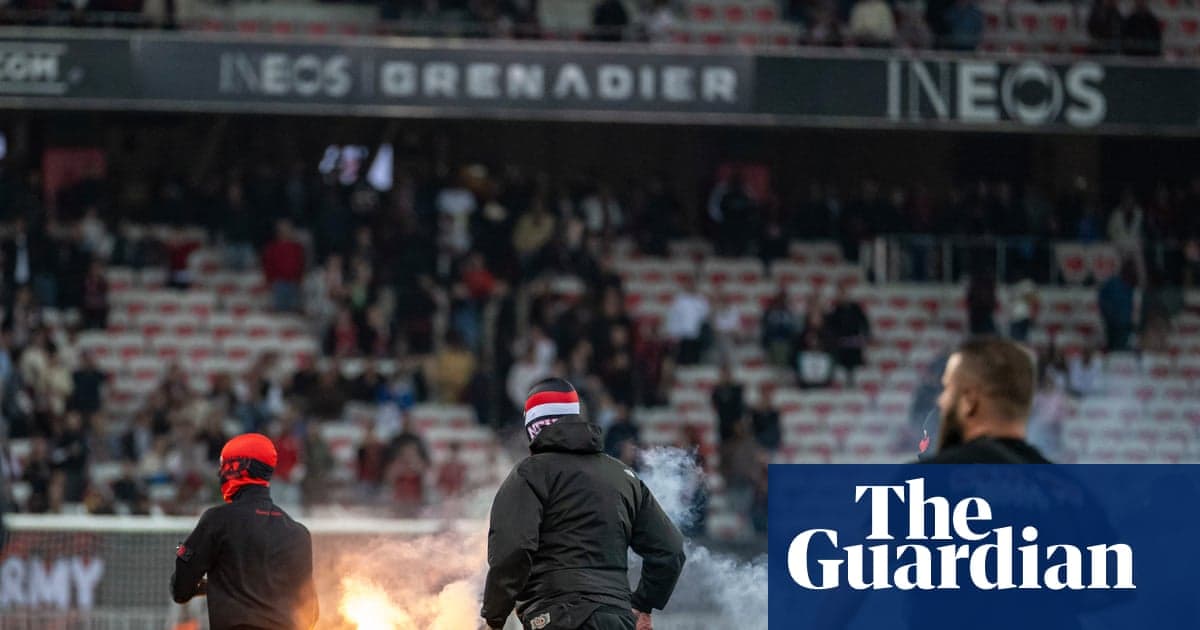
The final whistle had barely cut through the night air when chaos spilled over at the Allianz Riviera. Nice’s players sprinted for the tunnel, stewards scrambled, and the club’s ultras poured on to the pitch, their fury no longer confined to banners and chants. A few months after attacking their own players and staff, they were back again, this time after a goalless draw with already-relegated Metz that summed up the scale of Ineos’s collapse on the Côte d’Azur.
This was supposed to be a project to challenge PSG. It now stands one tie away from Ligue 2.
From Champions League dreams to relegation roulette
Nice’s season began with Champions League qualifiers and grand talk of a return to Europe. It will now be decided in a two-legged relegation playoff against Saint-Étienne. Their failure to beat Metz on the final day sealed that fate, and the timing could hardly be worse for Ineos, who are already looking for the exit door after failing to turn their €100m investment in 2019 into a genuine contender.
All they needed on Sunday was a home win. Just one. Something they had not managed in the league since 29 October.
They could scarcely have handpicked more obliging visitors. Metz were already down, with only three league victories to their name all season and none since Benoît Tavenot took charge in January. Tavenot arrived in search of a fresh start and ends the campaign with a brutal ledger: no wins, nine draws, 18 defeats and two relegations, counting his winless stint at Bastia before October. Yet even that sorry record did not make Nice look like favourites.
The task was simple. Nice turned it into an ordeal.
“Get your arses into gear,” the home fans roared before kick-off. The mood was fractured even then – part rage, part farewell party, part cup-final anticipation. A banner ordered “Everyone to Paris”, a nod to Friday’s Coupe de France final against Lens at the Stade de France. A huge tifo honoured captain Dante, 42 years old and hoping this would be his last match at the Allianz Riviera before retirement.
Any sense of celebration evaporated quickly. Anger swallowed everything.
Just as the Coupe de France should have been the highlight of the season, it has now been shoved into the shadows by the looming playoff with Saint-Étienne. “It is no longer a priority at all,” co-president Jean-Pierre Rivère admitted. Nice will go to Paris with their minds somewhere else, much like Reims did last season when they lost the cup final to PSG and then fell to Metz in the relegation playoff.
One player knows that story all too well. Yehvann Diouf was in goal for Reims in all three of those matches last year before moving to Nice in the summer. He will be desperate not to relive that nightmare in a different shirt.
A project starved, a squad stripped
The warning signs were there, scattered across the season like discarded plans. The club’s objectives were deliberately vague: a return to Europe, but no clear target, no clear roadmap. With Ineos shifting their focus and resources towards Manchester United, the tap in Nice effectively ran dry.
Key players left. Evann Guessand and Marcin Bulka were sold, their replacements nowhere near the required level. Kevin Carlos, brought in to fill Guessand’s boots, has yet to score a league goal. Other potential signings looked elsewhere. Mahdi Camara chose Rennes over Nice, a telling snub for a club that once sold itself as an ambitious destination.
On the touchline, Franck Haise saw the storm forming. In the autumn he publicly lamented that he did not have the players to compete for Europe. Then he went further, saying he simply could not “create a group” from this squad. The words landed heavily among a fanbase already simmering with frustration.
That frustration quickly found multiple targets. The players bore the brunt, but sporting director Florian Maurice was in the firing line too. So was Fabrice Bocquet, who briefly replaced Rivère as president before also heading for the door.
The season’s most chilling moment came in November. After a defeat at Lorient, Terem Moffi and Jérémie Boga were attacked by supporters as they stepped off the team bus at the training ground. Both would later leave the club. Bocquet soon followed. By the end of the year, Haise was gone as well.
Puel’s return and the unraveling
Rivère’s solution was to turn back the clock. He brought Claude Puel back to the dugout, a decision that has since looked more like an act of desperation than strategy. Convinced that Haise had lost his fight, the club agreed a mutual parting in December and handed Puel the reins.
The results have been grim. Two league wins in 18 games. Tactics that baffled. Selections that infuriated. Performances that drained belief from stands and dressing room alike.
On Sunday, the boos rained down almost non-stop during a sterile, lifeless draw with a team already condemned to the drop. It became impossible to tell exactly who the supporters were targeting. The answer felt obvious: everyone.
At half-time, the ultras moved from the second tier down to the first. Nobody believed they were chasing a better view. The tension in the stadium thickened with every misplaced pass, every wasted attack, every reminder that Metz had nothing to play for and still looked comfortable.
When the final whistle sounded, the dam burst. The ultras surged on to the pitch, their rampage continuing around the stadium late into the night. Staff, guests and journalists were locked inside until after midnight as trouble flared outside.
Puel tried to acknowledge the fury. Their “disappointment is legitimate,” he said. Rivère called for “unity”. The words felt small against the scale of the fracture.
Nice look broken in every direction. No one inside the club appears capable of fixing it, and with talks ongoing with potential buyers, Ineos may not be around long enough to try. If they walk away this summer, they will leave behind a scorched landscape – a club that started the season talking about Europe and now stares down the barrel of Ligue 2.
A league on edge: Nantes implode, PSG celebrate in the shadows
Nice’s ultras at least waited until the end. In Nantes, the final-day meltdown came early.
Hosting Toulouse with relegation already confirmed, Nantes saw their match abandoned after just 22 minutes. The club’s owners had stayed away, citing safety fears. They were not wrong. Ultras hurled black flares, then stormed the pitch in large numbers, many masked, turning the Beaujoire into a scene of confrontation rather than farewell.
As players, officials and staff bolted for the dressing rooms, one man stayed behind. Vahid Halilhodžić, the Nantes manager, stood his ground. He faced the fans, arms out, voice raised, pleading with them before finally heading down the tunnel, anguish and exhaustion etched across his face.
“In the 40 years of my career as a player and then a manager, I have never experienced that. It will be deeply engraved in my memory,” he said afterwards. He then confirmed it would be his last memory in football. An extraordinary, painful note on which to bow out. Happy retirement, “Coach Vahid”.
On a night of grim images across France, Paris served up something different: a title party that looked oddly makeshift.
PSG had secured the Ligue 1 crown in midweek by beating Lens, but there had been no trophy presentation. They wanted to stage it after Sunday’s Paris derby against Paris FC. The hosts had other ideas. Paris FC, having just guaranteed their own survival in Ligue 1, had planned their own post-match ceremony and were in no mood to hand over their stage.
PSG improvised. They erected a small stand in front of the away end before kick-off, a temporary platform for champions who measure themselves by nights in the Champions League, not domestic podiums.
The celebration felt subdued, almost awkward. A league title, another one, marked in front of a sliver of travelling fans after a 2-1 defeat to their city neighbours. Luis Enrique had already said his eyes were fixed firmly on the Champions League final against Arsenal. His team played like it.
Across France, the images told the story of a league in flux: ultras on the pitch, a legendary coach walking away in disbelief, champions shrugging off a derby defeat as they chase bigger prizes abroad.
For Nice, though, the picture is far more stark. A club that once talked about knocking PSG from their perch must now find a way past Saint-Étienne just to stay in the division. The Allianz Riviera has already seen what happens when that fear turns to fury. What will it look like if the worst comes true?