Osasuna vs Atletico Madrid: Tactical Analysis of the 2-1 Defeat
Osasuna’s 2-1 defeat to Atletico Madrid at Estadio El Sadar was defined by contrasting models of control. Alessio Lisci’s side imposed territorial and possession dominance (58% possession, 23 total shots), but Diego Simeone’s Atletico executed a brutally efficient counter-punching plan, scoring twice from just 5 attempts and then surviving long spells under siege, even after going down to ten men.
I. Executive Summary
Osasuna set up in a 4-2-3-1, using a high volume, wing-focused attack to pin Atletico back and create repeated entries into the box (18 shots inside the area, xG 2.16). Atletico’s 4-4-2, fronted by Antoine Griezmann and A. Lookman, accepted long defensive phases, banking on transitions and set-piece leverage; they generated 1.64 xG from just 5 shots and converted two high-value chances. The game’s tactical hinge was Marcos Llorente’s 79' dismissal, which forced Atletico into a deep 4-4-1 and invited an Osasuna onslaught that yielded only a late Kike Barja goal, too little to overturn the deficit.
II. Scoring Sequence & Disciplinary Log
Goals (verified against final score: Osasuna 1-2 Atletico Madrid)
- 15' A. Lookman (Atletico Madrid) — Penalty (no assist). Awarded after a penalty confirmed by VAR at 13', giving Atletico an early lead against the run of possession.
- 71' A. Sorloth (Atletico Madrid) — assisted by M. Llorente. A classic transition: Llorente broke down the right and supplied Sorloth to make it 0-2, maximizing Atletico’s minimal shot volume.
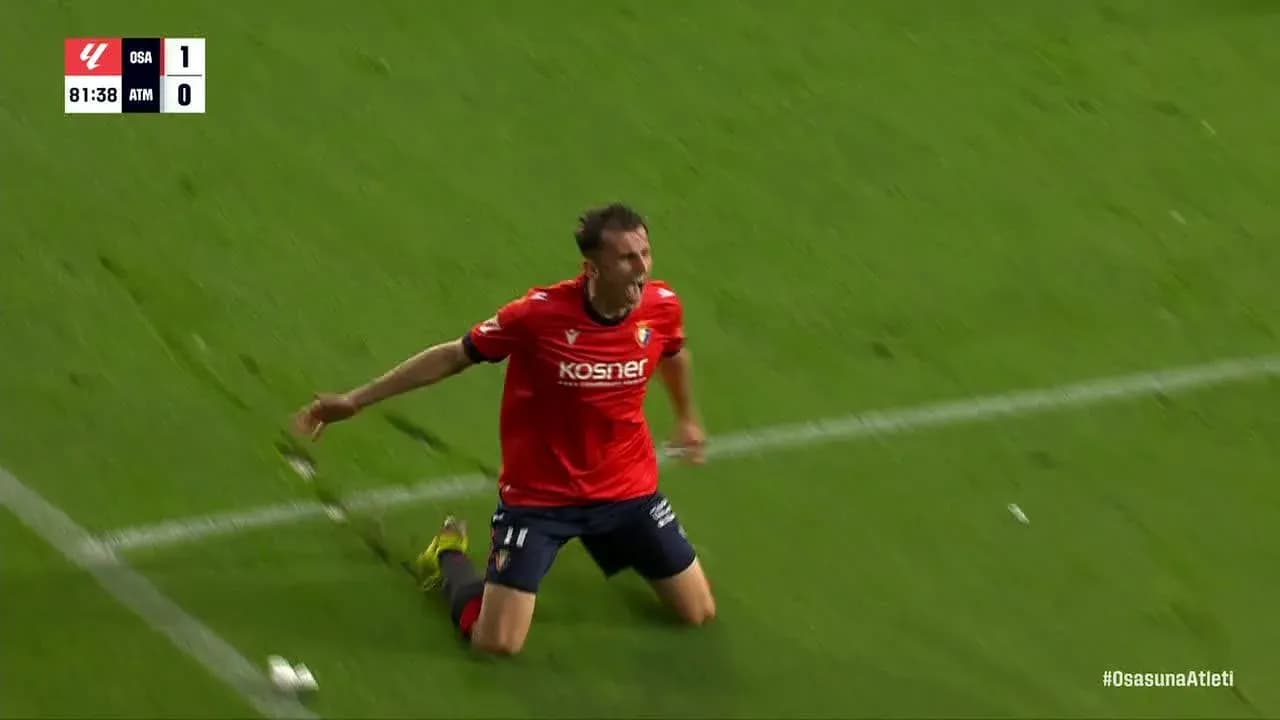
- 90' K. Barja (Osasuna) — assisted by R. Garcia. Barja’s late strike, arriving from Osasuna’s left-sided pressure, rewarded sustained attacking but came too late to change the result.
Cards (all events, chronological, with exact reasons)
- 14' Javi Galán (Osasuna) — Handball
- 30' Rubén García (Osasuna) — Foul
- 45+9' Ante Budimir (Osasuna) — Argument
- 52' Marcos Llorente (Atletico Madrid) — Argument
- 57' Kike Barja (Osasuna) — Argument
- 57' Koke (Atletico Madrid) — Foul
- 59' Marc Pubill (Atletico Madrid) — Foul
- 79' Marcos Llorente (Atletico Madrid) — Foul (Yellow Card)
- 79' Marcos Llorente (Atletico Madrid) — Foul (Red Card)
- 85' Alejandro Catena (Osasuna) — Argument
- 85' Robin Le Normand (Atletico Madrid) — Argument
- 90+2' Enzo Boyomo (Osasuna) — Foul
Totals locked: Osasuna 6 yellow cards, Atletico Madrid 5 yellow cards and 1 red card, total 11 cards.
VAR interventions
- 13' VAR (Atletico Madrid) — Penalty confirmed for a foul on Antoine Griezmann, directly preceding Lookman’s opener.
- 45+3' VAR (Osasuna) — Penalty cancelled; a potential penalty involving Ante Budimir was disallowed, removing Osasuna’s best chance to equalize before half-time.
III. Tactical Breakdown & Personnel
Osasuna’s 4-2-3-1 was structurally aggressive. Lucas Torró and J. Moncayola anchored midfield, allowing R. Moro and M. Gomez to push high from the half-spaces and Javi Galán to advance from left-back. With 477 passes, 415 accurate (87%), Osasuna circulated confidently, especially through their left, where Galán’s overlaps and Moro’s inside movements targeted the channel outside Marc Pubill and M. Llorente.
The early handball yellow for Galán at 14' was a by-product of this high defensive line; Osasuna squeezed up, and any direct ball in behind carried risk. Offensively, their 18 shots inside the box reflected consistent occupation of Atletico’s area, but the final action was often rushed. A. Budimir’s role as a central reference was crucial for territory but also emotional; his 45+9' yellow for Argument underlined a growing frustration, compounded by VAR cancelling a potential penalty at 45+3'.
Atletico’s 4-4-2 had clear asymmetry. O. Vargas and T. Almada (later replaced by A. Sorloth at 46') provided vertical outlets, while Koke and R. Mendoza (swapped for Robin Le Normand at 18', shifting the structure) ensured central compactness. M. Ruggeri and Pubill stayed relatively narrow, trusting Llorente’s athleticism on the right to handle wide overloads and then spring forward. This was decisive on the second goal: at 71', Llorente surged from deep to assist Sorloth, exploiting the space left by Osasuna’s full-backs.
The substitution vector mattered. Atletico’s early change — R. Mendoza (OUT), Robin Le Normand (IN) at 18' — effectively turned their midfield into a more conservative, back-five capable block in phases, with Le Normand reinforcing central defence against Budimir. Later, A. Lookman (OUT), C. Lenglet (IN) at 82' further underlined Simeone’s shift to a survival mode 4-4-1 after Llorente’s dismissal.
Osasuna’s bench usage was more about adding attacking layers than changing structure. Kike Barja (IN) came on for R. Moro (OUT) at 37', injecting directness from the right and later scoring at 90'. R. Garcia (IN) for Rubén García (OUT) at 60' and A. Bretones (IN) for J. Galan (OUT) at 60' slightly refreshed the left flank without altering the 4-2-3-1 shape. A. Oroz (IN) for L. Torro (OUT) and A. Osambela (IN) for M. Gomez (OUT), both at 72', tilted the midfield further towards creativity, sacrificing some protection in front of the defence in pursuit of a comeback.
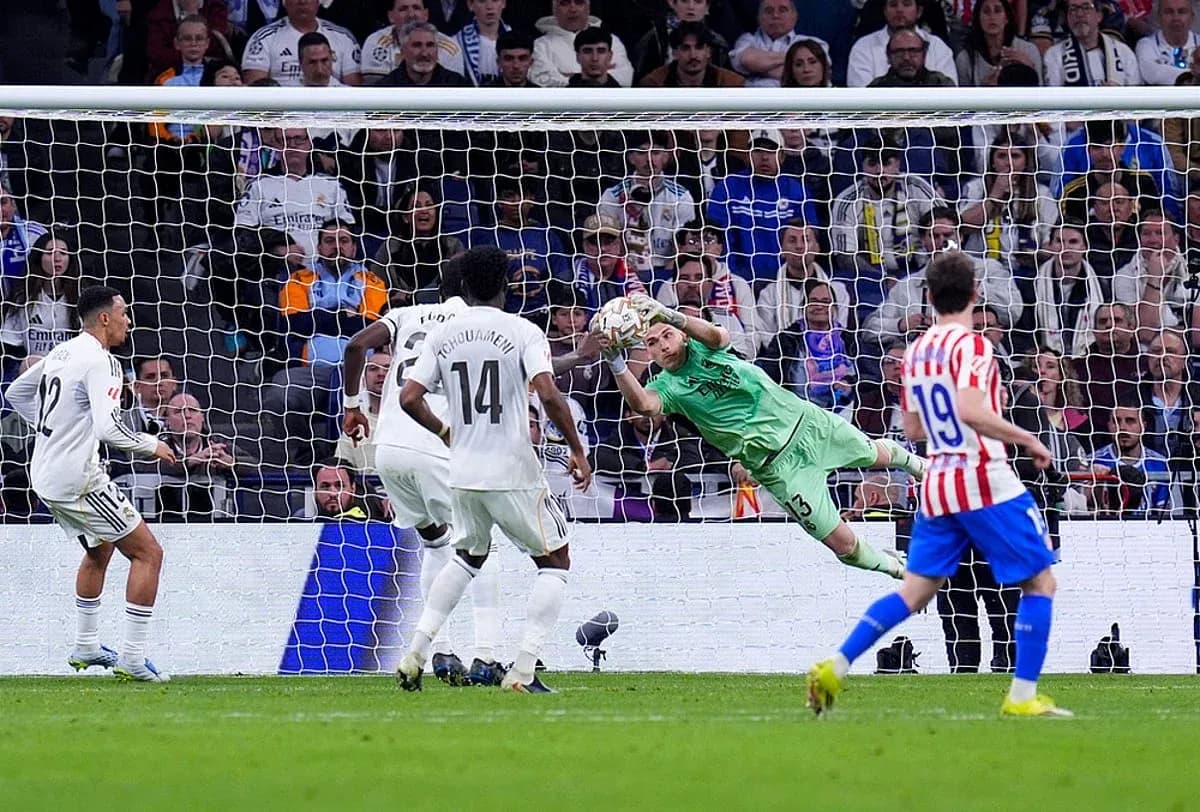
Goalkeeper dynamics were telling. A. Fernandez for Osasuna faced only 4 shots on goal, saving 2, with 0.32 goals prevented; Atletico’s finishing, particularly from the spot and Sorloth’s chance, largely overcame his interventions. At the other end, J. Musso made 4 saves with 0.32 goals prevented, underpinning Atletico’s low-block resilience. His handling of numerous box entries and set pieces was central to preserving the 1-2 scoreline under intense late pressure.
Marcos Llorente’s disciplinary arc — Argument yellow at 52', then Foul yellow and red both at 79' — was the tactical inflection point. Until his dismissal, Atletico’s right side had balanced defence and transition threat; once reduced to ten, Simeone compressed his lines, withdrew attacking ambition, and accepted deeper pressure. Osasuna responded by flooding the final third, but Atletico’s compact 4-4-1, reinforced by Lenglet and Le Normand, forced them into lower-quality shooting positions despite the volume.
IV. The Statistical Verdict
The numbers sharpen the tactical story. Osasuna’s 23 total shots to Atletico’s 5, and 18 inside the box to Atletico’s 4, reflect sustained territorial dominance and a clear attacking plan built on crosses, second balls, and zone-two recycling. Their xG of 2.16 versus just one goal underscores inefficiency in finishing and the importance of Musso’s interventions.
Atletico’s 1.64 xG from 5 shots highlights a strategy built on chance quality, not quantity. A penalty plus a well-worked transition chance accounted for most of their threat; both were converted, aligning with Simeone’s long-standing emphasis on clinical execution in limited attacking moments. With only 358 passes (287 accurate, 80%) and 42% possession, Atletico rarely controlled the ball but controlled the scoreboard.
Discipline was asymmetric and tactically revealing: Osasuna’s 6 yellow cards, many for Argument and Foul, spoke to frustration with VAR decisions and Atletico’s disruptive defending. Atletico’s 5 yellows and 1 red, including Llorente’s dismissal, showed the cost of their aggressive, duel-heavy approach. Yet even at a numerical disadvantage, their Defensive Index — reflected in low shots conceded on target (5 on goal from 23 total) and Musso’s 0.32 goals prevented — remained high enough to carry a 2-1 away win that was strategically coherent, if statistically against the flow.