Rayo Vallecano vs Girona: A Draw Reflecting Contrasting La Liga Lives
The Vallecas night ended level, a 1–1 draw that felt like a snapshot of two very different La Liga lives converging under floodlights. Following this result, Rayo Vallecano’s season-long solidity at Campo de Futbol de Vallecas met Girona’s relegation anxiety head‑on, and neither blinked quite enough to claim all three points.
I. The Big Picture – contrasting trajectories in the same frame
This was Round 35 of La Liga, a late‑season fixture where context weighed almost as heavily as tactics. Rayo arrived as a top‑half side, 10th with 43 points, built on a stubborn defensive base: overall they had scored 36 and conceded 42, a goal difference of -6, but at home they were a different animal. At home they had played 18, losing only 2, with 6 wins and 10 draws, scoring 22 and conceding just 15. Vallecas has been a place where games get dragged into Rayo’s rhythm rather than the visitors’.
Girona came in from the opposite direction: 18th place, 39 points, trapped in the relegation zone with a goal difference of -15 (37 for, 52 against overall). On their travels they had been awkward rather than convincing – 3 away wins, 8 draws, 7 defeats, 18 goals scored and 27 conceded – a side that often clings to games but rarely controls them.
The 1–1 scoreline felt almost pre‑written by those numbers: Rayo’s habit of tight home games, Girona’s tendency to share points away, and two teams whose seasons have been defined less by brilliance than by margins.
II. Tactical Voids – absences that shaped the script
The teamsheets told their own story of what was missing as much as what was present. Rayo were without four notable names. I. Akhomach (muscle injury) and D. Mendez (knee injury) stripped some depth from the flanks and rotation options, but the real structural blows were Luiz Felipe (injury) in defence and, above all, I. Palazon, suspended after a red card.
Palazon’s numbers this season underline how big that hole was. Across La Liga he had 3 goals and 3 assists, but the deeper story is in his profile: 39 key passes, 48 dribble attempts with 23 successes, and 51 fouls drawn. He is Rayo’s chaos generator between the lines, the man who bends games toward the box. His 10 yellow cards and 1 red capture the edge he plays with, but also why his absence forces a more conservative, pattern‑based attack. Without him, Inigo Perez leaned into a 4‑3‑3 that felt more balanced than explosive, with U. Lopez and O. Valentin asked to share creative responsibility.
For Girona, the list of absentees was longer and more chaotic. B. Gil (suspension for yellow cards) removed a wide option; Juan Carlos and Portu (both knee injuries), V. Vanat (injury), and D. van de Beek (Achilles tendon injury) stripped depth through the spine and half‑spaces. The inclusion of M. ter Stegen on Girona’s missing list is an oddity, but as per the data he, too, was unavailable. Michel responded with a 4‑2‑3‑1 built around control rather than verticality, trusting A. Witsel and F. Beltran as a double pivot to slow the game and protect a back line that has been repeatedly exposed this season.
Disciplinary trends also hung over the contest. Rayo’s season card profile shows a steady spread of yellow cards, with a late‑game rise: 19.39% between 61–75 minutes and 15.31% between 76–90, plus a striking 16.33% in added time (91–105). Their red cards often arrive in the second half too, with 22.22% between 61–75 and 22.22% between 76–90. Girona, by contrast, are a late‑game flashpoint: a huge 39.19% of their yellows arrive between 76–90 minutes, and 17.57% in 91–105. Both sides are at their most combustible when legs are heavy and decisions get ragged – and the second half duly became more stretched and emotional than the first.
III. Key Matchups – Hunter vs Shield, and the battle for control
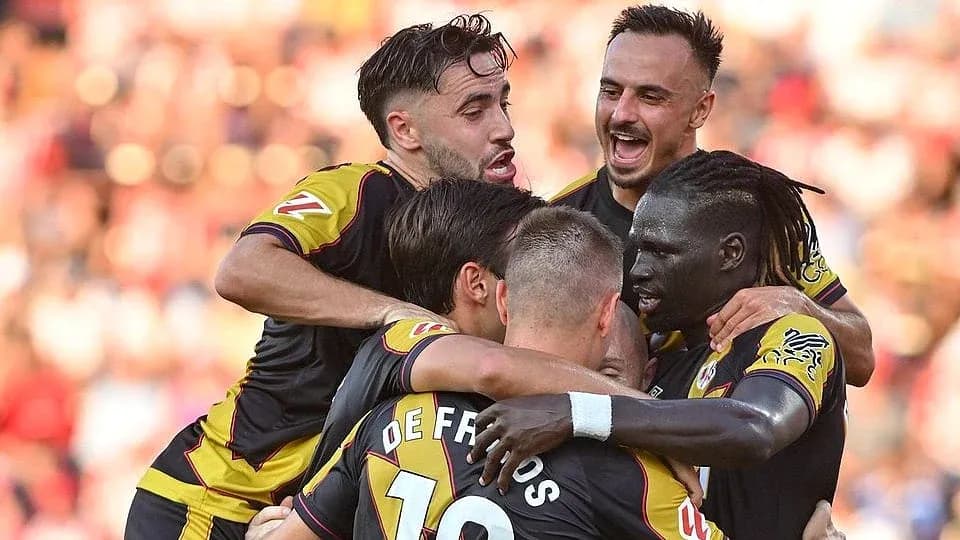
The headline duel was always going to be “Hunter vs Shield”: Jorge de Frutos, Rayo’s leading scorer this season, against a Girona defence that has bled goals all year.
De Frutos came into the fixture with 10 league goals and 1 assist, a quietly lethal return from a wide‑forward role. His 47 shots with 26 on target speak to a player who consistently works his way into shooting positions, while 27 key passes and 53 dribble attempts (26 successful) show that he is more than just a finisher. At Vallecas, where Rayo average 1.2 goals scored per game at home, he is the primary cutting edge.
His task was to probe a Girona back line anchored by Vitor Reis, one of the few defensive bright spots in their season. Vitor’s statistical profile is that of a pure shield: 38 blocked shots, 46 tackles, 30 interceptions, and 91% passing accuracy across 1,766 passes. He is both the stopper and the first passer, the man tasked with stepping into De Frutos’ lane and then starting Girona’s build‑up. The duel down Rayo’s right channel – De Frutos attacking from the flank, Vitor stepping out from the left‑sided defensive slot – framed much of the tactical tension.
Behind that, the “Engine Room” battle pitted U. Lopez and O. Valentin against Witsel and Beltran. Rayo’s season profile suggests a side comfortable in 4‑2‑3‑1 and 4‑3‑3 shapes, able to tilt the midfield line depending on game state. Their overall goals against average of 1.2 per game, and only 15 conceded at home (0.8 per home match), is built on that midfield screen. Witsel and Beltran, meanwhile, were charged with slowing transitions and keeping Girona’s shape intact long enough for the advanced line of V. Tsygankov, T. Lemar, J. Roca and A. Ounahi to combine.
IV. Statistical Prognosis – why a draw made sense
Following this result, the numbers still sketch a clear picture of why the game bent toward parity. Heading into this game, Rayo’s home scoring rate of 1.2 goals per match and home concession rate of 0.8 set an expectation of a tight, low‑scoring contest. Girona’s away profile – 1.0 goals for and 1.5 against on their travels – hinted at vulnerability but also at their knack for staying in games.
Rayo’s season‑long Expected Goals trends (inferred from their modest scoring but strong defensive record) suggest a team that often edges xG but rarely blows opponents away. Girona, with 37 goals for and 52 against overall, look like a side whose defensive xG against is consistently high, but who occasionally over‑perform in attack enough to nick something.
Overlay that with the disciplinary patterns – both teams prone to late yellows, Girona particularly so with 39.19% of their cautions in the 76–90 window – and the script of a tense, increasingly fractured second half becomes almost inevitable. Even without explicit minute‑by‑minute goal data, the statistical DNA points toward a match where Rayo’s structure and home comfort are balanced out by Girona’s desperation and willingness to drag the game into a scrap.
In the end, the 1–1 draw at Vallecas felt like a meeting point between those arcs. Rayo extended their identity as a hard‑to‑beat home side, Girona clung to a precious away point that keeps their survival hopes flickering, and the night closed with the sense that the numbers had quietly been steering the narrative all along.