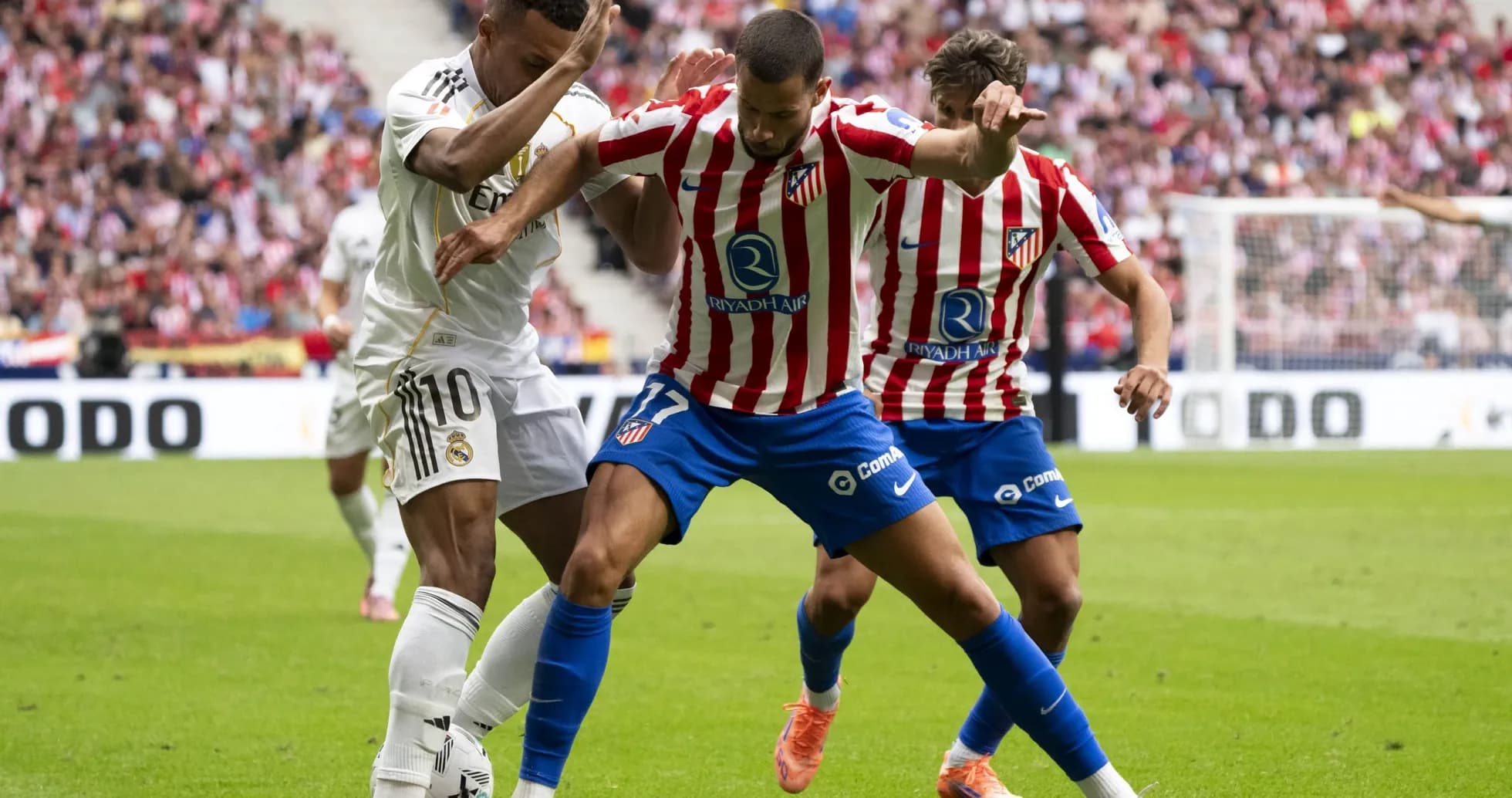
Real Madrid vs Atlético Madrid: A Dramatic Derby Analysis
Under the lights of the Estadio Santiago Bernabéu, this Madrid derby arrived with La Liga’s title race and Champions League seeding braided into its narrative. Real Madrid, second in the table on 69 points with a +37 goal difference, edged a 3-2 win over an Atlético Madrid side sitting fourth on 57 points and +21. It was a meeting of two heavyweights whose statistical DNA already promised volatility.
Across 29 league matches to date, Real Madrid have profiled as a 2.2-goals-per-game juggernaut (63 scored), with a defence conceding just 0.9 per game (26 against). At home, the numbers sharpen: 36 goals in 15 matches at 2.4 per game, with only 12 conceded. Atlético arrived with a slightly more modest attacking output – 49 goals (1.7 per game) – but with a similarly disciplined back line (28 conceded, 1.0 per game), especially ruthless at the Metropolitano. Away from home, though, their edge dulls: 15 scored and 16 conceded in 14 matches, a near-even profile that has been the one blemish on Diego Simeone’s otherwise Champions League-level campaign.
Both coaches leaned into a mirrored 4-4-2, but with very different intentions. Alvaro Arbeloa’s Real Madrid used the shape as a launchpad for vertical, high-tempo football built around movement and overloads. Simeone’s Atlético treated the same structure as an exoskeleton for compactness, counters and control of central space. The final 3-2 scoreline – after Atlético’s 1-0 half-time lead – felt like a pure expression of those identities colliding over 90 minutes.
The Butterfly Effect (Absences & Tactical Shifts)
This derby was shaped long before kick-off by the absentees. Real Madrid were without Thibaut Courtois (thigh), Éder Militão and Ferland Mendy (both hamstring), Dani Ceballos (muscle) and Rodrygo (knee). That injury cluster forced a structural rethink at the back and in the final third.
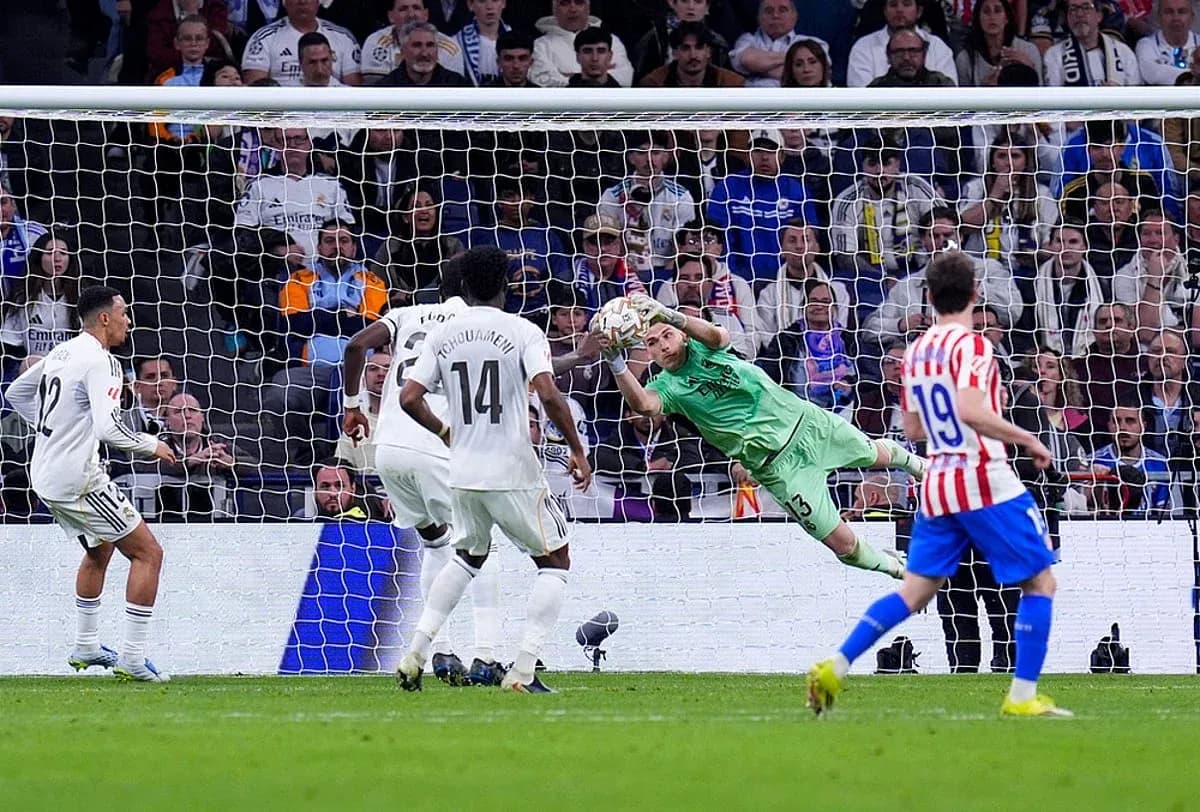
In goal, Andriy Lunin continued as the de facto No. 1, while the centre-back pairing of Antonio Rüdiger and Dean Huijsen underlined how much responsibility has shifted to the younger core. Huijsen, already among the league’s more aggressive defenders with 11 blocked opponent attempts and a red card on his record, had to balance front-foot defending with discipline against Atlético’s counter threats. On the left, Fran García’s inclusion over the suspended-prone Álvaro Carreras (who carries both a red card and five yellows this season) hinted at a desire for controlled aggression rather than sheer physicality.
Up front, the absence of Rodrygo altered the usual rotation in the attacking line. Brahim Díaz partnered Vinicius Junior, while the league’s top scorer Kylian Mbappé – 23 goals and 4 assists in 24 appearances – started on the bench, a luxury and a looming threat. Arbeloa’s midfield four, with Federico Valverde, Aurélien Tchouameni, Arda Güler and youngster T. Pitarch, was built to both circulate and surge.
Atlético had their own voids. Jan Oblak’s muscle injury handed the gloves to Juan Musso, a significant psychological shift for a defence accustomed to one of Europe’s most reliable shot-stoppers. Without P. Barrios and M. Pubill (both muscle injuries) and R. Mendoza, Simeone leaned into his core: a back four of Marcos Llorente, Robin Le Normand, Dávid Hancko and Matteo Ruggeri; a midfield anchored by Koke and Johnny Cardoso, with Giuliano Simeone and Ademola Lookman wide; and a front two of Antoine Griezmann and Julián Álvarez.
Disciplinary profiles added another layer to the tactical tightrope. Real Madrid’s season-long yellow-card curve spikes between 61-75 minutes (24.53%), but also remains high in the 31-45 and 76-90 windows (both 16.98%), with a notable 20.75% chunk in added time (91-105). Their reds are heavily concentrated late as well, with 28.57% in 91-105 and another 28.57% in undefined stoppage patterns. Atlético’s yellows crest in the 31-45 band (20.00%), but the 16-30 and 76-90 windows (both 18.18%) are nearly as heated. Both sides, in other words, tend to flirt with chaos just as games become stretched – a factor that loomed large as Real chased the match after the interval.
Narrative Matchups (The Chess Match)
The Hunter vs. The Shield was defined by Mbappé’s shadow as much as his presence. With 23 league goals, 83 shots (51 on target) and 116 dribble attempts (63 successful), he is the league’s No. 1-rated player and its most relentless finisher. His penalty record – 8 scored from 9 attempts, with 1 miss – underscores both volume and responsibility from the spot. Facing an Atlético defence that has conceded only 28 times all season, and just 12 in 15 home matches but 16 in 14 away, his introduction from the bench threatened to dismantle a unit that is far less secure on the road.
Yet from the opening whistle, it was Vinicius who set the tone. Ranked 10th in the league by rating, he arrived with 11 goals, 5 assists and a league-leading 61 fouls drawn. His 159 dribble attempts (70 successful) and 318 duels (157 won) make him the competition’s most persistent one-on-one problem, but also one of its most combustible: 7 yellow cards, placing him among the highest-ranked carded players. Up against Llorente and Simeone on that flank, every carry was a test of Atlético’s ability to stay on the right side of J. Munuera’s line.
In the Engine Room Duel, Arda Güler and Valverde squared off indirectly with Koke and Cardoso. Güler, ranked fourth in La Liga for assists with 8, has produced 63 key passes and 91% pass accuracy – numbers that speak to his ability to dictate tempo and find seams. Valverde, ranked fifth in the assist charts with 7, adds a different dimension: 1,577 passes at 89% accuracy, 39 key passes, and a defensive portfolio of 37 tackles, 6 blocked opponent attempts and 20 interceptions. Together, they sought to pull Atlético’s midfield block apart horizontally, forcing Koke and Cardoso to choose between stepping out or protecting Griezmann’s supply line.
On the other side, Giuliano Simeone’s 6 assists and 30 key passes, combined with 34 tackles and 17 interceptions, made him Atlético’s two-way reference point. His 251 duels (124 won) and 39 fouls drawn illustrated why he is so central to Simeone’s transition game: win the ball, ride the contact, and spring Griezmann and Álvarez into space.
Depth and game-changers tilted the bench battle toward Real. Beyond Mbappé, Arbeloa could call on Eduardo Camavinga, Jude Bellingham, Álvaro Carreras, F. Mastantuono and G. Garcia – a bench capable of completely reconfiguring the match’s geometry. Bellingham’s omission from the starting XI turned him into a potential second-half conductor, while Camavinga offered fresh legs and pressing resistance in a midfield that already had control of the ball.
Atlético’s bench had its own threats – Alexander Sørloth, with 10 goals and a bruising duel profile (235 contests, 111 won), plus creative options like A. Baena and Thiago Almada – but the drop-off from the starting XI was steeper. Sørloth’s disciplinary record (4 yellows and 1 red, with 2 blocked opponent attempts) also meant Simeone had to weigh impact against risk in a match trending toward late-card territory.
The Statistical Prognosis (Verdict)
Viewed through the season-long lens, Real Madrid’s comeback win felt like a statistical inevitability accelerated by tactical choices. A side averaging 2.4 goals per home game, with 11 clean sheets and just 3 blanks in 29 matches, was always likely to generate sustained pressure, especially against an Atlético team whose away record – 4 wins, 5 draws, 5 defeats, 15 scored and 16 conceded – is far more ordinary than their overall standing suggests.
The decisive factor lay in the intersection of Real’s attacking peaks and Atlético’s away vulnerability. With Güler and Valverde dictating from midfield, Vinicius relentlessly drawing contact, and Mbappé available to exploit tiring legs, Real had multiple ways to dismantle a compact block. Atlético’s plan – to neutralize, counter and manage the game’s emotional temperature – held through a 1-0 first half, but the second period fell into the very window where both teams’ card profiles spike and Real’s attacking volume typically surges.
In the end, depth, home attacking volume and the league’s most decisive individual – Mbappé – tilted the derby. Atlético’s structure and resilience kept them in the contest, but over 90 minutes at the Bernabéu, the numbers said Real Madrid would eventually exploit the cracks. The 3-2 scoreline simply gave that prognosis a dramatic, derby-appropriate script.