Switzerland's Tactical Mastery in 2-0 Victory Over Algeria
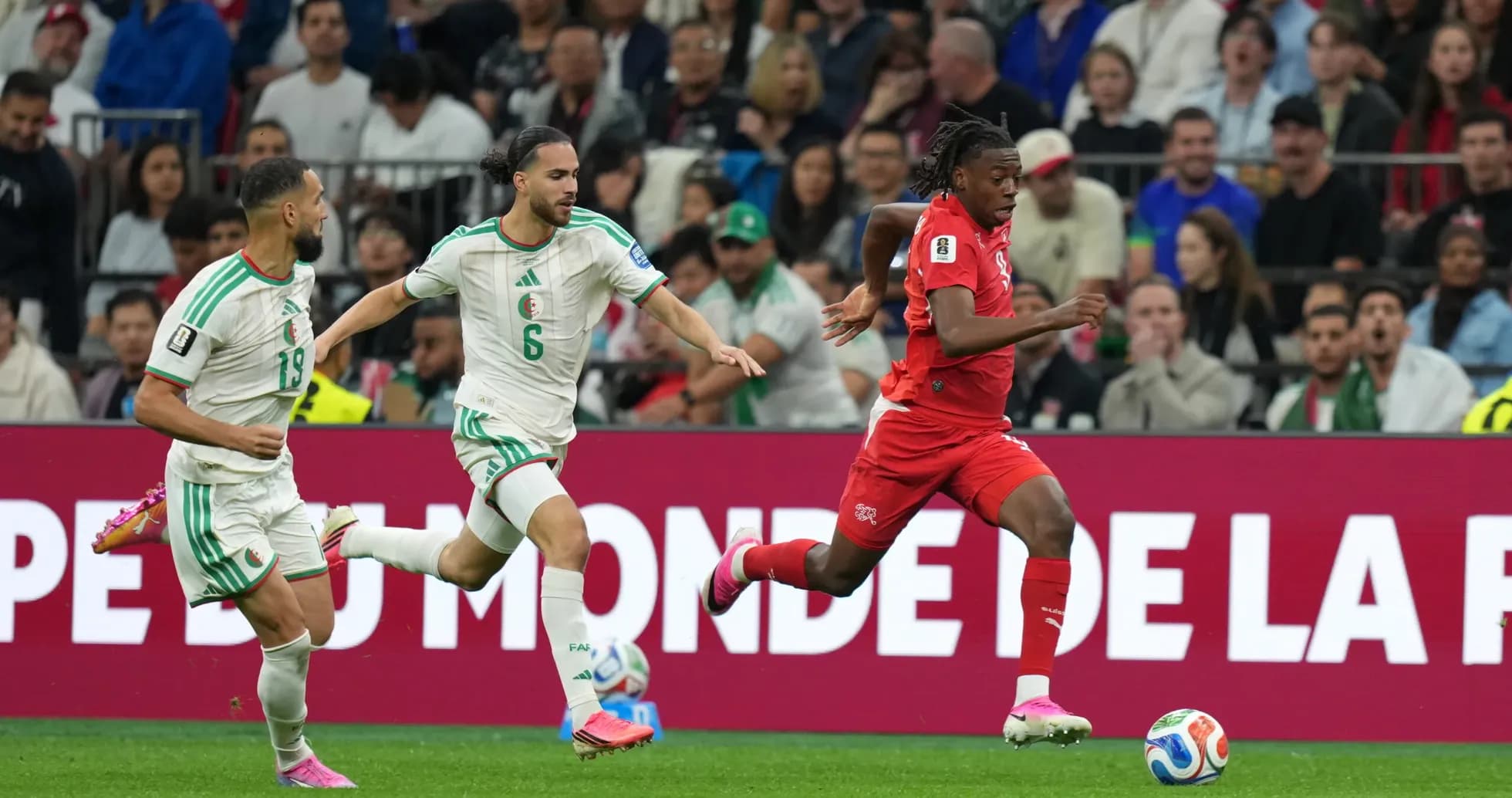
Switzerland’s 2-0 win over Algeria at BC Place in this World Cup Round of 32 tie was a controlled, structurally coherent performance built on a clear contrast of ideas: Swiss vertical efficiency in a 4-2-3-1 against Algeria’s more ball-dominant but blunter 4-3-3. Despite having only 45% possession and fewer passes, Switzerland generated the better chances, translated into a higher xG (2.56 to 0.73) and a clean two-goal margin that accurately reflected their attacking clarity and defensive stability.
Swiss Formation
Murat Yakin’s 4-2-3-1 was defined by the double pivot of Remo Freuler and Granit Xhaka, with Johan Manzambi operating centrally behind Breel Embolo, and Dan Ndoye and Rubén Vargas starting wide. The back four of Ricardo Rodríguez, Manuel Akanji, Nico Elvedi and Denis Zakaria stayed relatively compact, allowing Switzerland to defend in a mid-block and spring quickly once possession was won. The early 10th-minute goal by B. Embolo, assisted by J. Manzambi, was emblematic: quick progression through the middle, Manzambi finding the forward with a decisive final ball, and Embolo attacking space before Algeria’s back line could reset.
Algerian Strategy
Algeria, under Vladimir Petkovic in a 4-3-3, sought control through their midfield trio of Ramiz Zerrouki, Nabil Bentaleb and Farès Chaïbi, supported by full-backs Rayan Aït-Nouri and Ramy Bensebaini stepping high. They completed 561 passes to Switzerland’s 436, with a superior 85% accuracy versus 81%, and held 55% of the ball. However, their possession was often sterile, circulating in front of a well-organised Swiss block rather than breaking lines consistently. The front three of Riyad Mahrez, Ibrahim Maza and Houssem Aouar struggled to find pockets between the Swiss midfield and defence, frequently being forced wide or into predictable crossing zones.
Key Tactical Moments
The key tactical hinge came immediately after half-time. At 1-0 and with Algeria presumably instructed to push higher, Switzerland struck on 46 minutes through D. Ndoye. That second goal, arriving right at the start of the second period, punished Algeria’s more aggressive positioning and effectively flipped the game state: from a one-goal deficit where patient probing was viable, to a two-goal hole requiring greater risk and exposing more space in transition. From then on, Switzerland could lean into their strength: compact defending, selective pressing triggers and efficient use of transitions.
Out of possession, Switzerland’s 4-2-3-1 often resembled a 4-4-1-1, with Ndoye and Vargas tucking into the line of four and Manzambi screening Algeria’s deepest midfielder. Xhaka and Freuler controlled central access, forcing Algeria to build wide. The Swiss defensive line, anchored by Akanji and Elvedi, dealt well with crosses and direct balls, limiting Algeria to just 8 total shots, only 2 of which were on target. Gregor Kobel (Switzerland) made 2 saves; his involvement was limited but assured, a reflection of how effectively the structure in front of him suppressed high-quality attempts.
Goalkeeper Performances
Algeria’s goalkeeper Luca Zidane (Algeria) also registered 2 saves, but the underlying numbers tell a different story. Switzerland produced 11 total shots, with 5 on goal and 9 inside the box, underlining how their attacks were more incisive and better positioned. Algeria, by contrast, managed only 5 shots inside the box and 3 outside, and their xG of 0.73 indicates that most of these efforts came from less threatening positions. Both goalkeepers are credited with the same goals prevented value (-0.29), suggesting that, if anything, the finishing on display slightly overperformed the shot quality rather than being a product of extraordinary shot-stopping.
Substitution Patterns
The substitution patterns further highlight the tactical narrative. Petkovic’s double change on 58 minutes — J. Hadjam (IN) came on for H. Aouar (OUT) and A. Gouiri (IN) came on for R. Zerrouki (OUT) — signalled a shift towards more attacking profiles, but it also altered the balance of the midfield. With Zerrouki off, Algeria lost some control in front of the defence, and Switzerland increasingly found space to play through or around the first line of pressure. Later, at 71 minutes, A. Hadj Moussa (IN) came on for R. Mahrez (OUT) and H. Boudaoui (IN) came on for N. Bentaleb (OUT), another attempt to refresh the front line and inject energy between the lines. Yet Boudaoui’s immediate yellow card for “Roughing” at 72 minutes reflected a side chasing the game and occasionally losing tactical discipline.
On the Swiss side, the changes were more about energy management and maintaining structure. At 71 minutes, F. Rieder (IN) came on for R. Vargas (OUT) and N. Okafor (IN) came on for J. Manzambi (OUT), preserving the 4-2-3-1 shape while adding fresh legs in the attacking midfield and wide areas. Later, Z. Amdouni (IN) came on for B. Embolo (OUT) at 83 minutes, S. Widmer (IN) came on for D. Zakaria (OUT) at 87 minutes, and M. Aebischer (IN) came on for D. Ndoye (OUT) also at 87 minutes. Each of these substitutions was conservative in intent: protect the lead, maintain defensive intensity on the flanks, and ensure the double pivot remained well shielded by disciplined wide players.
Discipline and Control
In terms of territorial and set-piece play, Switzerland’s 4 corner kicks to Algeria’s 2 underline their ability to reach advanced zones despite having less of the ball. The Swiss committed 10 fouls to Algeria’s 12, and while Switzerland avoided any bookings, Algeria collected two yellow cards — F. Chaibi for “Tripping” on 36 minutes and H. Boudaoui for “Roughing” on 72 minutes. This asymmetry in discipline mirrors the game’s flow: Switzerland largely in control of game state and tempo, Algeria increasingly forced into riskier defensive actions as they tried to recover.
Statistically, the verdict is clear. Switzerland combined lower possession with higher shot volume, more shots on goal, and a significantly higher xG. Their passing volume (436 passes) and accuracy (81%) were sufficient to support their game model: secure enough to retain the ball when needed, but always geared towards verticality and penetration rather than sterile circulation. Algeria’s 561 passes at 85% accuracy and 55% possession show technical competence and territorial ambition, but without the mechanisms to consistently turn that control into high-quality chances.
Overall, this was a tactically mature Swiss performance: a disciplined mid-block, efficient transitions, and intelligent game management once ahead. Algeria’s 4-3-3 had structure and ball control, but lacked the incisive patterns and penalty-box presence required to trouble a well-organised opponent at this level.