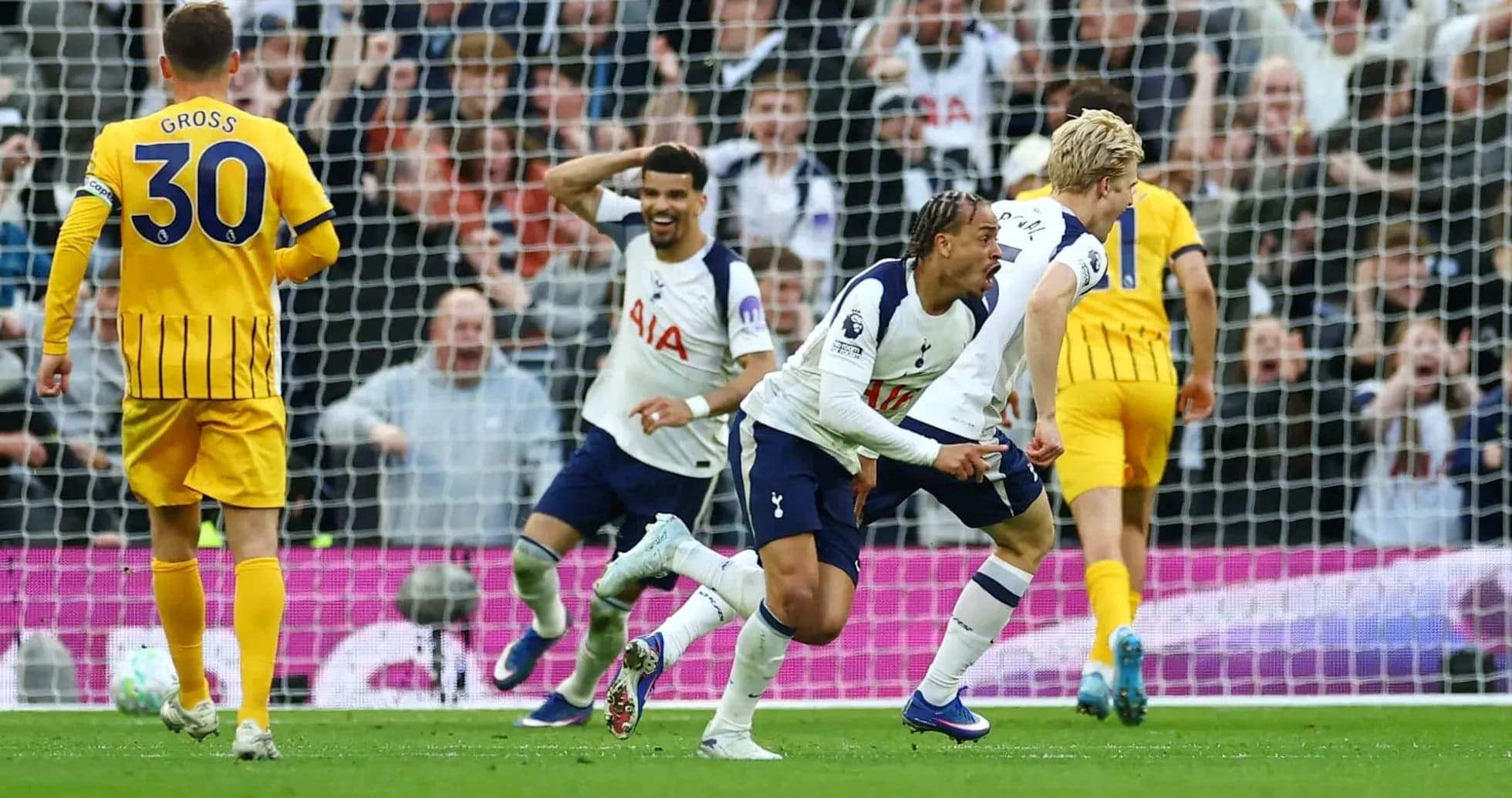
Tottenham vs Brighton: Tactical Analysis of Premier League Draw
Tottenham and Brighton shared a 2–2 draw at Tottenham Hotspur Stadium in this Premier League Round 33 fixture, a match that tactically balanced Brighton’s structured possession against Tottenham’s vertical, transition-heavy 4-3-3. The scoreline mirrored the underlying data: Tottenham were more incisive in the box, Brighton more in control of territory and tempo. Both sides produced similar expected goals (Tottenham 1.08, Brighton 0.89), and the late 90+5' equaliser from Georginio Rutter confirmed a contest where neither team ever fully imposed defensive control for long stretches. The halftime score stood 1–1, and the second half evolved into a chess match of substitutions and structural tweaks.
First Half
Pedro Porro opened the scoring at 39', finishing a move assisted by Xavi Simons to give Tottenham a 1–0 lead against the run of possession. Just before the interval, Brighton’s pressure was rewarded when Kaoru Mitoma, on since 20', levelled at 45+3' from a Pascal Groß assist, ensuring a 1–1 halftime score that reflected Brighton’s territorial advantage but Tottenham’s sharper edge in the box.
Second Half
The second half swung again when Tottenham’s bench impact proved decisive. At 77', Xavi Simons, now operating with fresher legs around him, struck to make it 2–1, assisted by substitute Lucas Bergvall. That lead lasted into stoppage time, but Brighton’s persistence from set and wide areas culminated in Rutter’s 90+5' goal, created by centre-back Jan Paul van Hecke, for a 2–2 final.
Disciplinary Control
Disciplinary control was generally steady but tactically important. Yves Bissouma collected a yellow card for a foul at 34', constraining his ability to press aggressively as the single pivot. Brighton’s only booking came at 37', when right-back Mats Wieffer was cautioned for a foul, shaping his later duels against Tottenham’s wide forwards. In the second half, Tottenham’s defensive line was further compromised when centre-back Kevin Danso received a yellow card for a foul at 65', forcing a more conservative approach to Brighton’s late pressure. Xavi Simons was then booked at 78'; while no specific reason is listed, the timing immediately after his goal suggested emotional or tactical tension just as Tottenham sought to close the game down. In total: Tottenham three yellow cards (Bissouma 34', Danso 65', Simons 78'); Brighton one yellow card (Wieffer 37'). No reds were issued.
Tactical Analysis
Tottenham’s 4-3-3 under Roberto De Zerbi was built on verticality rather than control. With only 42% possession and 319 passes (80% accuracy), they accepted long phases without the ball, trusting their front three and full-backs to generate high-quality moments. The shot profile underlines this: 13 total shots, 10 from inside the box, and 6 on target. The first goal encapsulated their plan: progression through midfield into advanced full-back zones, with Porro arriving high to finish from Simons’ supply. Simons, nominally a forward in the front three, frequently dropped into the right half-space, effectively acting as a hybrid 10/winger, which Brighton struggled to track between their double pivot and back four.
In midfield, Bissouma anchored with Gallagher and Bentancur as shuttlers. Bissouma’s early yellow at 34' reduced his ability to step out aggressively, which partly explains Brighton’s comfort in circulating centrally. Nevertheless, Tottenham’s midfield trio focused on collapsing space in front of the box rather than pressing high. Their 14 fouls mirror Brighton’s 14, but Tottenham’s were more often about stopping transitions and protecting the central corridor.
Substitution Patterns
The substitution pattern significantly reshaped Tottenham’s structure. At 57', Mathys Tel (IN) came on for Randal Kolo Muani (OUT), and Archie Gray (IN) came on for Yves Bissouma (OUT). Gray’s introduction shifted the midfield profile: less of a pure destroyer, more of a runner, which increased energy but slightly weakened screening. At 67', Joao Palhinha (IN) came on for Rodrigo Bentancur (OUT), restoring a more natural holding presence and allowing Gallagher and Gray to push wider and higher.
On the flanks, De Zerbi altered both full-back and midfield dynamics at 76'. Djed Spence (IN) came on for Destiny Udogie (OUT), adding more defensive security on the left, while Lucas Bergvall (IN) came on for Conor Gallagher (OUT), injecting creativity between the lines. Bergvall’s immediate impact was decisive: he found Simons in a pocket at 77' for Tottenham’s second goal. That move illustrated Tottenham’s late-game pattern: win second balls, feed creative players between Brighton’s lines, and attack quickly before their block reset.
Goalkeeping Performance
Antonín Kinský in goal faced only 3 shots on target, making 1 save. With Brighton’s xG at 0.89 and goals prevented at 0, the data suggests he conceded roughly what would be expected. Tottenham’s Defensive Index in this match is mixed: they limited Brighton’s shot volume (10 total, 8 inside the box) but allowed two high-leverage moments late in each half, both converted. The bookings to Bissouma and Danso narrowed their defensive options in managing those phases.
Brighton's Tactical Approach
Brighton, in a 4-2-3-1 under Fabian Hurzeler, controlled the game’s rhythm with 58% possession and 424 passes at 83% accuracy. The double pivot of Pascal Groß and Yasin Ayari (before Ayari’s late substitution) provided stable circulation, with Groß particularly influential in connecting to the advanced trio. Their attacking pattern emphasised width and underlaps: full-backs Ferdi Kadıoğlu and Mats Wieffer pushed high, while the band of three – Diego Gómez, Jack Hinshelwood, and Yankuba Minteh – rotated to find overloads.
The early substitution at 20' was key: Kaoru Mitoma (IN) came on for Diego Gómez (OUT). This gave Brighton a more direct 1v1 threat on the flank, and Mitoma’s goal at 45+3', from a Groß assist, validated the change. His ability to receive wide, drive inside and attack the half-space forced Tottenham’s back line deeper, contributing to Brighton’s territorial dominance even if their final-third execution remained slightly below their control.
Late Substitutions
Hurzeler’s triple substitution at 75' represented an aggressive late push: Maxim De Cuyper (IN) came on for Kaoru Mitoma (OUT), Matt O'Riley (IN) came on for Jack Hinshelwood (OUT), and Georginio Rutter (IN) came on for Danny Welbeck (OUT). De Cuyper offered fresh running and crossing from wide, O'Riley added a creative central presence, and Rutter brought mobility and link play up front. Later, at 82', Charalampos Kostoulas (IN) came on for Yasin Ayari (OUT), further tilting the balance towards attacking profiles.
The 90+5' equaliser came from this reconfigured structure: van Hecke stepped up from centre-back to provide the assist, and Rutter’s finish underscored Brighton’s commitment to pushing central defenders into advanced zones when chasing the game. Bart Verbruggen, meanwhile, was busier than Kinský, making 4 saves from Tottenham’s 6 shots on target. With Brighton’s goals prevented at 0, the numbers suggest he performed to expectation rather than producing extraordinary stops, but his interventions were crucial in keeping the deficit at a single goal long enough for Rutter to rescue a point.
Statistical Overview
Statistically, the verdict aligns with the narrative. Tottenham generated 1.08 xG from 13 shots, heavily concentrated inside the box (10), reflecting a strategy of fewer, higher-quality chances. Brighton’s 0.89 xG from 10 shots (8 inside the box) indicates that while they reached good zones, their shot volume and quality per possession were slightly lower than their territorial dominance might imply. Both teams committed 14 fouls, mirroring an evenly contested physical battle, but Tottenham’s three yellow cards to Brighton’s one show that De Zerbi’s side paid a higher disciplinary price for their aggressive defensive interventions.
Overall Assessment
In overall form terms, Tottenham showed they can threaten elite defences with vertical, high-quality attacks but still struggle to close games out when forced deep. Brighton’s overall form as a possession side remains strong: they controlled the ball, managed tempo, and used their bench to alter the attacking picture late. From a Defensive Index perspective, both teams will be concerned: Tottenham allowed key chances at the end of each half, and Brighton conceded two goals from relatively modest xG, exposing vulnerabilities when their full-backs are advanced and their rest defence is tested in transition.