Understanding the Complexity of Individual Awards in Team Sports
Whose fault was that score? Anyone’s?
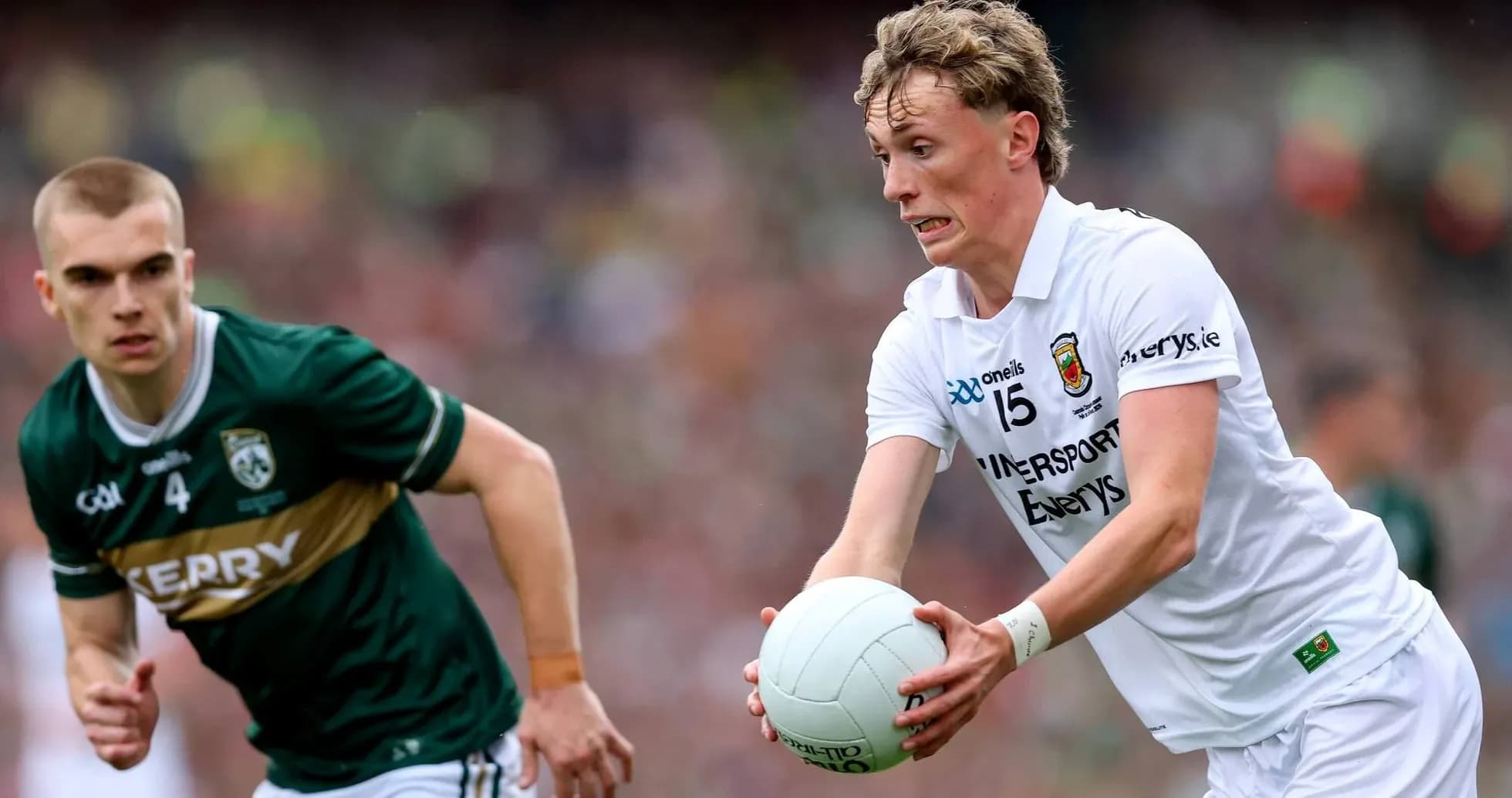
Kobe McDonald had done everything right, or close to it. He tracked Donal Casey from deep, matching the Kerry man’s surge stride for stride. Then he hit the brakes on halfway, like Wile E Coyote at the canyon’s edge, because the system said: do not breach. Hold the line.
Just behind him, Eoin McGreal hovered, body angled away from the ball, eyes locked instead on Paudie Clifford. The obsession was understandable. The danger was elsewhere.
Jordan Flynn took over Casey’s run. Then Casey laid off the ball and Flynn’s instincts kicked in. He went hunting leather. Casey kept moving. Clifford saw what everyone else missed and threaded the pass for the opening point.
So who wears that one? Should a Mayo teammate have rotated out to free McDonald to stay with his man? Should another man-marker have shuffled towards the ball-carrier? Should Flynn have stayed glued to Casey rather than chasing the play?
And what does any of that chaos mean when the All-Stars come around?
Judgement, not an equation
This is where individual awards in a team sport fray at the edges. Every decision is a compromise. Every final selection leaves someone unconvinced. It is judgement, not mathematics, and the margins are razor-thin.
Every season the same demands roll in. Let current players and managers have more say. Lean harder on data. Give the league and the early championship rounds extra weight.
It’s the same search, dressed in different clothes: find the one thing.
Players crave the one thing that will nudge them into a starting 15 or bump them into elite company. Managers chase the one thing that will make this year the year. Journalists hunt the one thing that explains why one team climbed the steps and another trudged down the tunnel.
But the game refuses to bow to neat answers. Games, seasons, careers – none of them pivot on a single element. A simple storyline is tidy and seductive. Reality is messier: a mind-bending mesh of moments and roles and responsibilities, all of which matter when the awards board meets.
There is no perfect system. There never has been.
The tyranny of the ball
Part of the problem is baked into how the sport is measured. GAA data is overwhelmingly tilted towards what happens in possession: kickout wins, scores, shots, assists. Everything glows under the spotlight of the ball.
Those numbers matter. They should shape the conversation. But context breathes life into them.
Take Mayo’s 2026 championship. Their leading assisters? A three-way tie: Ryan O’Donoghue, Kobe McDonald and Jack Carney. Just behind them, somewhat surprisingly, came Sam Callinan. He created 13 points and scored with the only two shots he took.
From corner-back.
How much weight does that carry when his job description starts with stopping, not creating? How do you file that under “impact” when you’re comparing him with forwards whose entire season is judged on end product?
There are out-of-possession numbers too: tackles, turnovers won, defensive “breaches” that log when a defender is beaten by man or ball. Some inter-county setups track them religiously. They are laborious to collect, harder to explain and, bluntly, nowhere near as glamorous as scores.
But they tell a different story, one that rarely fits into a neat column of stats.
When the matchups blur
Then come the matchups, the lines that get repeated so often they start to sound like facts carved in stone.
How many times has it been said that Jack Coyne held his direct opponent scoreless from play in his last four games?
Scratch the surface and the picture changes. In the All-Ireland final, Coyne opened on Dylan Geaney, with McGreal shadowing Paudie Clifford. By midway through the second half, both McGreal and Geaney were gone. Coyne found himself facing Clifford instead.
For Kerry’s final point of the day, Clifford picked up the ball outside the arc. He paused, weighed up Coyne, dipped once, twice, then slid past him on the left and clipped it over.
Does that one moment strip Coyne of his season-long credentials? Of course not. He still put together a campaign worthy of serious recognition. But it does challenge the comforting stat about scoreless markers and clean sheets. It reminds you how fluid roles become once the ball is thrown in.
The sport has shifted dramatically. The rules, the conditioning, the systems – everything tilts towards the attacker. For defenders, “bend, don’t break” is often the best possible outcome. They call switches, drift into space, cover runners they never met in the team meeting. The choices they make are rarely straightforward and almost never visible in a box score.
Reconciling contradictions
Consider David McBrien. He toiled at midfield against Roscommon. Bobby McCaul gave him real trouble for Monaghan. Louth’s Ciaran Downey kicked 0-4 directly off him. Those are hard facts.
Yet so much of McBrien’s value lies in what he does for the collective: doubling up, dropping as an extra shield, organising the defensive shape. In the decider, he had a legitimate claim to Player of the Match. How do you reconcile those competing truths when you’re filling out an All-Star ballot?
Or Matthew Whittaker. How heavily should it count that he spent so much of the year playing through injury? The numbers don’t always show the strapping, the injections, the training sessions done at three-quarters pace just to make it to Sunday.
Jordan Flynn’s workload in a centrefield that was, at times, under siege is another example. He grafted, plugged gaps, chased shadows. The stat sheet will never quite capture what it looks like to survive in a storm.
Then there is Paudie Clifford. Eight championship games. Across the final three outings in Croke Park, he hit 0-13, with 0-9 from play. In the earlier rounds, against Cork, Donegal and Armagh, his influence was blunted by various impediments. So which version of Clifford carries more weight? The man who lit up headquarters in the closing stretch, or the one who had to wrestle with constraints earlier on?
These are not footnotes. They are the argument.
Can the process catch up?
None of this means the system should stand still.
For the Tailteann Cup Team of the Year, players and management already submit their own selections, feeding an extra layer of insight into the process. A mid-championship stocktake could stop early-season form from slipping through the cracks once the business end takes over.
There is scope for more structured analysis too. The All-Star sponsors could bring in an external provider like GAA Insights to produce an independent data dossier: a deep dive that lands on the selectors’ desks, fuels the online debate and arms every barstool pundit with something more substantial than hunches.
But even then, the numbers won’t close the case.
Individual tallies, team roles, injuries, big moments, dips and surges in form, fitness levels and the things you can’t quite quantify – leadership, bravery, calm – all of them sit on the table when the arguments start.
There is no clean answer. Insisting otherwise doesn’t just oversimplify the game. It shortchanges the players whose seasons live in those grey areas, in the half-step decisions like McDonald’s on halfway, in the runs Casey keeps making, in the passes Clifford keeps seeing.
The awards will always be a judgement call. The real question is how honest we’re prepared to be about the chaos that lies behind it.