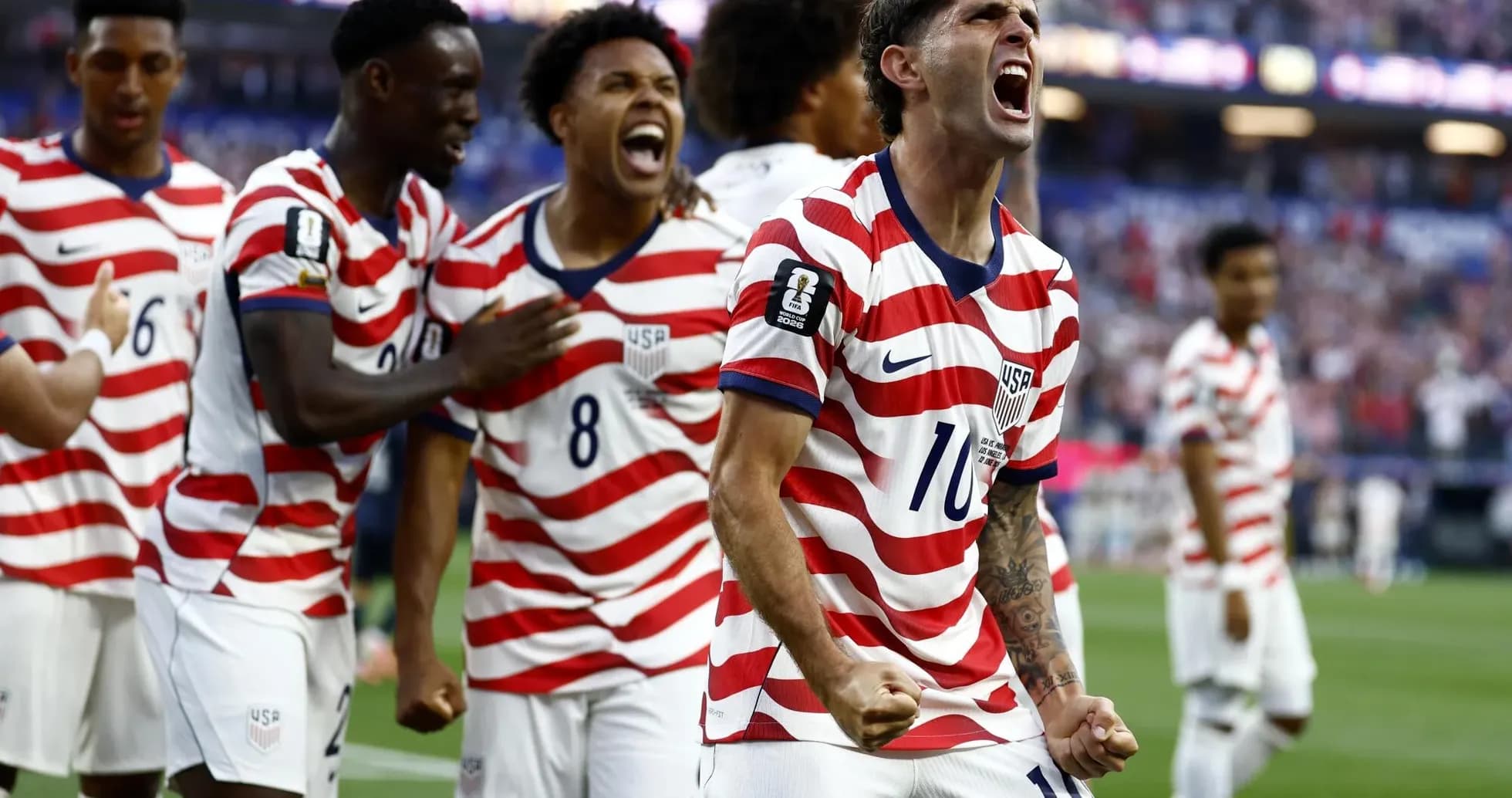
USA Dominates Paraguay with Tactical Superiority in 4-1 Victory
USA’s 4-1 win over Paraguay at SoFi Stadium was built on structural superiority and tempo control rather than pure finishing volume. Mauricio Pochettino’s side translated a 65% share of possession, a 596–320 passing advantage and a 1.27–0.51 xG edge into a three-goal margin, using an aggressive 4-2-3-1 to stretch Paraguay’s 4-4-2 block both vertically and horizontally.
USA’s shape was textbook: Matthew Freese behind a back four of Alexander Freeman, Chris Richards, Tim Ream and Antonee Robinson; Tyler Adams and Malik Tillman as the double pivot; a narrow, creative line of three in front (Sergiño Dest right, Weston McKennie central, Christian Pulišić left) supporting Folarin Balogun as the lone striker. Paraguay’s 4-4-2, with Orlando Gill in goal, a back four anchored by Gustavo Gómez and Omar Alderete, a midfield line of Diego Gómez, Andrés Cubas, Damián Bobadilla and Miguel Almirón behind Antonio Sanabria and Julio Enciso, was set up to be compact and counter rather than press high.
From the opening minutes, USA’s build-up used Ream and Richards to draw Paraguay’s front two into narrow pressing lanes, freeing the full-backs. Robinson advanced very high on the left, pinning Juan Alonso back and allowing Pulišić to drift inside as an extra playmaker. On the right, Freeman was more conservative early, with Dest stepping into the right half-space as an auxiliary No. 8. This asymmetry created a 3-2-5 in possession: Richards–Ream–Freeman as the first line, Adams–Tillman as the double pivot, and a front five of Dest–McKennie–Balogun–Pulišić–Robinson across the width.
The early own goal at 7' from Damián Bobadilla underlined the pressure Paraguay were under in their own box. USA’s 13 shots inside the box (out of 16 total) show how consistently they managed to access the penalty area, often via third-man combinations between Adams, McKennie and the inside wingers. Paraguay’s back four were repeatedly forced to defend facing their own goal, a dangerous dynamic that contributed directly to that opening mistake.
Balogun’s disallowed goal at 28'—overruled by VAR for offside—was a warning of the timing and depth of his runs. Three minutes later, he adjusted his starting position and was rewarded, finishing from a Pulišić assist at 31'. The pattern was clear: USA used patient circulation to pull Paraguay’s midfield line sideways, then punched vertical passes into Balogun’s feet or into space behind. The second Balogun goal at 45+5', assisted by Tillman, came from that same mechanism, with Tillman stepping higher from the double pivot to attack the right half-space as Paraguay’s midfield tired.
Out of possession, USA pressed selectively rather than continuously. The front four would jump when the ball went to Paraguay’s full-backs, with Adams screening passes into Cubas and Diego Gómez. The foul count (USA 13, Paraguay 17) reflects a controlled aggression: USA were willing to stop counters early but avoided chaotic duels. Tyler Adams’ yellow card for “Roughing” at 59' came in one such moment of counterpressing, but overall his screening work limited Paraguay to just four shots inside the box and a single shot on goal.
Paraguay’s 4-4-2 struggled to progress centrally. With Cubas often outnumbered 2v1 against Adams and Tillman, they resorted to longer passes into the channels for Enciso and Sanabria. When they did find joy, it was usually when Almirón drifted infield off the left to overload zones between USA’s lines. His yellow card for “Diving” at 53' reflected frustration as he tried to draw fouls in advanced areas rather than receiving cleanly between lines.
Gustavo Alfaro’s substitutions were an attempt to inject energy and directness. Mauricio (IN) came on for Damián Bobadilla (OUT) at 46', immediately offering more vertical running from midfield. Later, Alex Arce (IN) replaced Antonio Sanabria (OUT) at 62', giving Paraguay a more physical reference up front. The reward came quickly: at 73', Mauricio scored from a Julio Enciso assist, a rare moment where Paraguay broke USA’s counterpress and attacked a disorganized back line.
However, USA’s bench also shifted the tactical picture. Sebastian Berhalter (IN) for Pulišić (OUT) at 46' moved the team towards a more stable midfield triangle, with McKennie able to surge forward while Berhalter and Adams controlled rest defense. At 72', Tim Weah (IN) for Dest (OUT) and Ricardo Pepi (IN) for Balogun (OUT) refreshed the front line with more direct running in behind. Finally, Giovanni Reyna (IN) for Tillman (OUT) at 82' added late-game control and creativity; Reyna’s 90+8' goal from a Freeman assist was emblematic of USA’s ability to keep pushing, combining from deep right-back zones into the half-space even in added time.
Defensively, USA’s back four were rarely stretched in open play. Freese (USA) faced only one shot on goal and made 1 save, a testament more to the team’s collective structure than to a busy night for the goalkeeper. At the other end, Gill (Paraguay) made 3 saves but was repeatedly exposed by the volume of high-quality USA entries into the box. Both goalkeepers carried the same negative goals prevented figure (-1.16), indicating that the finishing on display outstripped the underlying xG for both sides—USA clinically so, Paraguay in their lone goal.
The statistical verdict underlines USA’s tactical control. Their 596 passes to Paraguay’s 320, with 508 accurate (85%) against Paraguay’s 230 (72%), show a side comfortable circulating under minimal pressure and able to break lines with precision. The 16–9 shot count, and especially the 6–1 shots on goal differential, align with the territorial dominance implied by 65% possession. Paraguay’s 5 blocked shots suggest last-ditch defending rather than proactive control.
Discipline tilted heavily towards Paraguay: five yellow cards (Juan Cáceres “Tripping”, Miguel Almirón “Diving”, Diego Gómez “Holding”, Alex Arce “Roughing”, Junior Alonso “Holding”) against just Adams’ single booking. That imbalance mirrors the game’s flow: Paraguay’s midfield and back line were constantly reacting to late USA runs and rotations, forced into contact situations they could not control. Within the context of the group stage, this was a statement of USA’s tactical maturity: a coherent structure, effective in-possession patterns, and a bench that reinforced rather than disrupted the game model.