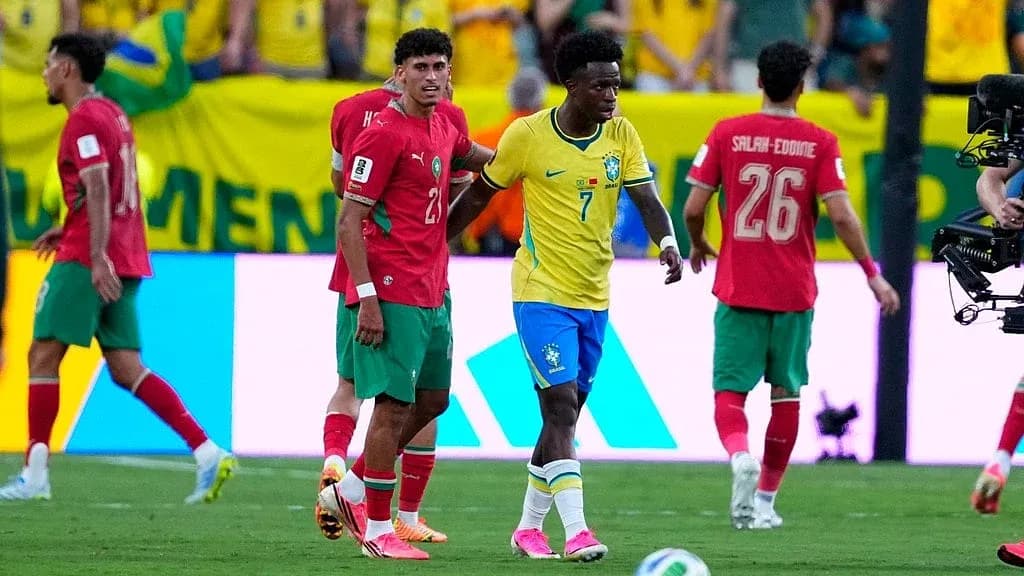
Brazil and Morocco Share Points in Balanced Match
Brazil 1-1 Morocco at MetLife Stadium opens Group C with both sides moving to 2 points from two draws, leaving Brazil second and Morocco top on goal difference as their campaigns remain finely balanced rather than decisively launched.
Match Report
The game’s first major incision came on 21', when Morocco struck the opener. A flowing move down the right ended with a sharp cut-back and a composed finish: 21' Morocco goal — I. Saibari (assisted by B. Diaz) for 0-1, punishing Brazil’s loose defensive spacing between the lines.
Brazil responded with greater tempo and found parity just after the half-hour. On 32', a vertical pass broke Morocco’s midfield screen and released the hosts into space on the left: 32' Brazil goal — Vinicius Junior (assisted by Bruno Guimaraes) for 1-1, the winger bending a precise finish beyond Bono after a well-timed through ball.
The equaliser did not immediately settle Brazil’s defensive discipline. On 37', Casemiro (Brazil) — yellow card (Tripping) was booked for a late challenge in midfield as he tried to halt a Moroccan transition. Six minutes later, 43' Ibanez (Brazil) — yellow card (Tripping) collected a caution for another mistimed intervention, underlining Brazil’s difficulties in containing Morocco’s mobile attacking midfielders.
Carlo Ancelotti reacted at the interval with a defensive reshuffle. On 46', Danilo replaced Ibanez (Brazil), a like-for-like change designed to stabilise the right side of the back four. Simultaneously, 46' Fabinho replaced Casemiro (Brazil), refreshing the holding role and reducing the risk of a second yellow in a game increasingly played at high tempo through midfield.
As Brazil sought more penetration, Ancelotti turned to his bench again. On 61', M. Cunha replaced Lucas Paqueta (Brazil), adding a second central presence higher up the pitch to combine with Igor Thiago and occupy Morocco’s centre-backs. A minute later, 62' Luiz Henrique replaced I. Thiago (Brazil), injecting fresh pace and 1v1 threat on the flank to attack tired full-backs.
Morocco responded with a double change on 65' to restore control in advanced zones. First, 65' C. Talbi replaced B. Diaz (Morocco), removing the creative number 10 who had assisted the opener and adding fresher legs in the attacking line. At the same time, 65' S. El Mourabet replaced A. Ounahi (Morocco), rotating the midfield and providing renewed energy to press Brazil’s build-up.
With the game finely poised entering the final quarter-hour, Mohamed Ouahbi adjusted his left side. On 80', A. Salah-Eddine replaced N. Mazraoui (Morocco), introducing a new left-back to cope with Brazil’s right-sided surges. In the same minute, 80' A. Amaimouni replaced B. El Khannouss (Morocco), altering the attacking midfield profile to offer more direct running against Brazil’s centre-backs.
Brazil also made a late midfield adjustment on 80', 80' Danilo Santos replaced Bruno Guimaraes (Brazil), aiming to maintain pressing intensity and ball circulation as Guimaraes tired after a high-volume passing display.
Morocco’s final substitution came on 89', 89' S. Rahimi replaced I. Saibari (Morocco), withdrawing the goalscorer and introducing fresh pace to threaten on the counter in the closing minutes. Despite both coaches’ aggressive use of the bench, neither side could fashion a decisive chance, and the contest closed at 1-1.
Fixture Statistics & Tactical Audit
- xG: Brazil 1.24 vs 1.28 Morocco
- Possession: Brazil 54% vs 46% Morocco
- Shots on Target: Brazil 4 vs 2 Morocco
- Goalkeeper Saves: Brazil 1 vs 3 Morocco
- Blocked Shots: Brazil 4 vs 6 Morocco
The underlying numbers point to an essentially balanced contest, with Morocco’s marginal xG edge (1.28 vs 1.24) offset by Brazil’s higher shot volume on target (4 vs 2). Brazil were more dominant in territorial terms (54% possession, 501 passes at 88% accuracy), but Morocco’s compact block and six blocked shots underlined how effectively they protected the central lane. Bono’s three saves against Brazil’s four efforts on goal show that Morocco’s keeper had the busier evening, yet the quality of Moroccan chances — reflected in near-parity of xG despite fewer shots on target — justifies the draw as a fair reflection of chance creation rather than pure territory.
Standings Update & Seasonal Impact
The draw leaves Brazil on 2 points, with 2 goals scored and 2 conceded for a neutral goal difference of 0, consolidating second place in Group C and keeping them firmly on course for the Round of 32 but without the cushion an early win would have provided. Morocco also move to 2 points, with 2 goals for and 2 against and a goal difference of 0, staying top of the group on ranking criteria and maintaining their position in the advancing zone, though like Brazil they have yet to turn control phases into a decisive victory.
Lineups & Personnel
Brazil Starting XI
- GK: Alisson
- DF: Douglas Santos, Gabriel Magalhães, Marquinhos, Roger Ibañez
- MF: Bruno Guimarães, Casemiro, Vinícius Júnior, Raphinha, Lucas Paquetá
- FW: Igor Thiago
Morocco Starting XI
- GK: Bono
- DF: Noussair Mazraoui, Chadi Riad, Issa Diop, Achraf Hakimi
- MF: Ayyoub Bouaddi, Neil El Aynaoui, Bilal El Khannouss, Azzedine Ounahi, Brahim Díaz
- FW: Ismael Saibari
Post-Match Verdict
This was a measured, evenly-matched opener in which Brazil’s territorial control (54% possession, 501 passes) was offset by Morocco’s compact defensive organisation and efficient chance creation (xG 1.28 from just 2 shots on target). Brazil were intermittently incisive rather than consistently clinical (4 shots on target from 12 attempts), with their best moments arriving when Bruno Guimarães and Vinicius Junior combined between Morocco’s lines. Defensively, early yellow cards for Casemiro and Ibañez highlighted vulnerability in transition, though the half-time changes helped stabilise the back line.
Morocco executed a disciplined, structurally dominant defensive performance (6 blocked shots, 3 saves from Bono) that restricted Brazil to relatively few clear looks despite long spells of possession. Their attacking threat was concentrated in sharp, well-timed surges, epitomised by the Saibari goal from a Díaz assist, and the xG edge underscores how dangerous those moments were. Ultimately, a draw reflects a tactical stalemate: Brazil controlled the ball without fully breaking Morocco’s block, while Morocco’s selective aggression produced chances of comparable quality but not the volume to tilt the scoreline.