South Korea Edges Czechia 2-1 in World Cup 2026 Opener
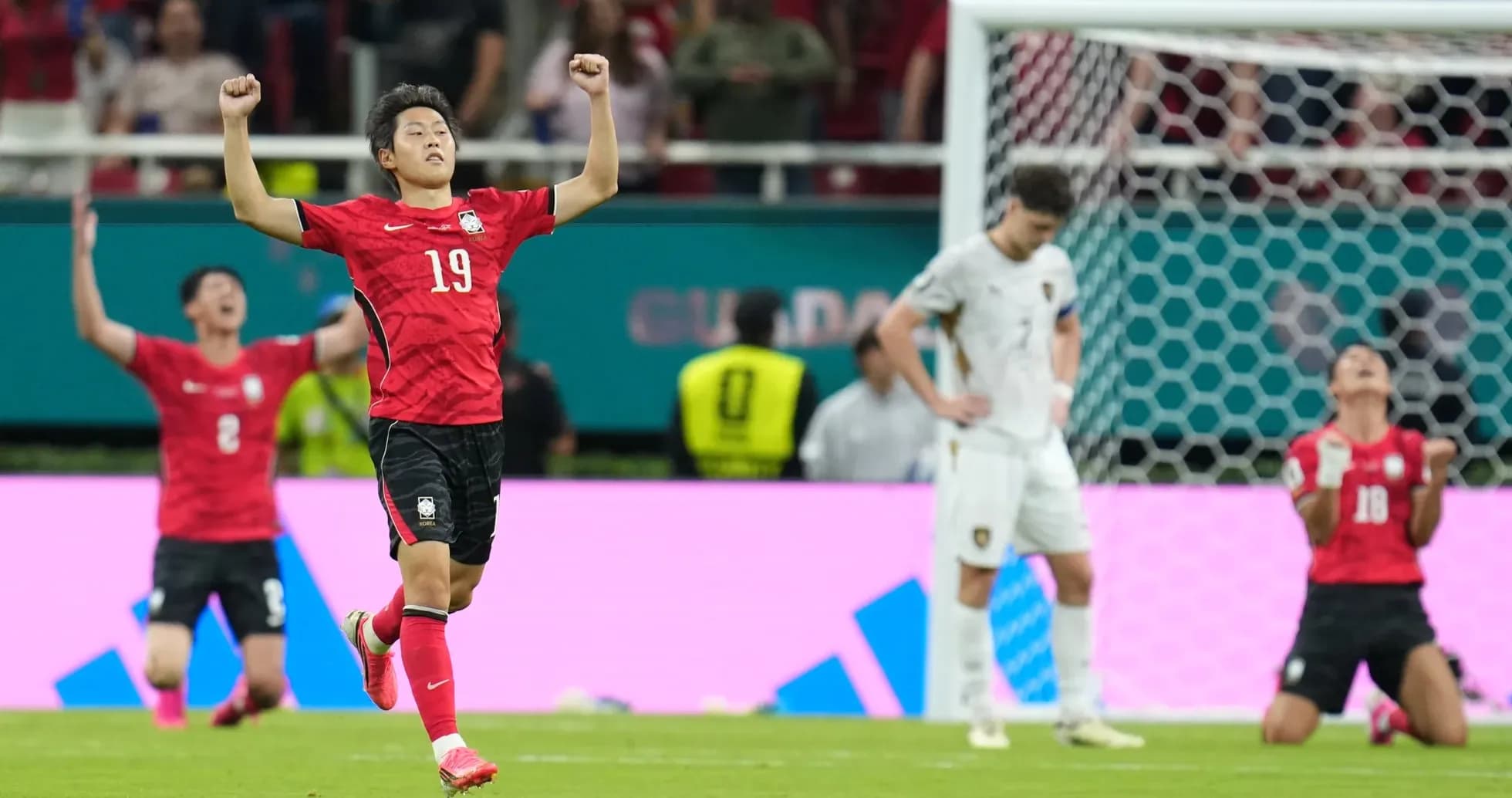
Under the lights of Estadio Akron in Guadalajara, South Korea and Czechia opened their World Cup 2026 accounts with mirrored blueprints and very different outcomes. Both coaches, Myung-Bo Hong and Miroslav Koubek, trusted a 3-4-2-1, but the same shape produced contrasting identities as South Korea edged a 2-1 win in regular time.
I. The Big Picture – Structure, Scoreline, Stakes
Following this result, South Korea sit 2nd in Group A with 3 points, a goal difference of +1 (2 goals scored, 1 conceded) and a perfect early record of 1 win from 1. Czechia, beaten 2-1, are 3rd in the group with 0 points and a goal difference of -1 (1 goal scored, 2 conceded) from their single outing.
The numbers underline how sharply their paths diverged in the same 90 minutes. At home in this World Cup, South Korea have played 1, won 1, scoring 2.0 goals on average and conceding 1.0. On their travels, Czechia have played 1, lost 1, averaging 1.0 away goal for and 2.0 against. The symmetry of the 2-1 scoreline is already baked into their seasonal DNA.
II. Tactical Voids and Disciplinary Undercurrents
With no formal list of absentees, both coaches could lean into their preferred structures. The real “voids” were not personnel but spaces: how each side protected or exposed the half-spaces behind their wing-backs.
Hong’s back three of Gi-Hyuk Lee, Kim Min-jae and Han-Beom Lee formed a narrow, almost old-school stopper line, with Young-woo Seol and Lee Tae-seok tasked with the exhausting dual role of wing-back and auxiliary midfielder. The price of that aggression was always going to be defensive isolation, and the disciplinary data hints at the strain: South Korea’s season card map shows a lone yellow in the 91-105' window, a 100.00% concentration of bookings in added time. That late caution belongs to Gi-Hyuk Lee, whose World Cup so far is defined by a defender walking the disciplinary tightrope – 1 yellow and also listed among the top red card profiles, a statistical quirk that underlines how close his interventions have been to the edge.
Czechia’s card profile remains blank across all minute ranges. It suggests a side that tried to defend with structure rather than disruption, trusting Tomáš Souček and Alexandr Sojka to screen rather than foul, and relying on Vladimír Coufal and Jaroslav Zelený to channel Korean attacks wide instead of chopping them down. In a group opener, that restraint is admirable; in a game of fine margins, it might have been too respectful.
III. Key Matchups – Hunter vs Shield, Engine Room vs Enforcer
Hunter vs Shield
For South Korea, the “hunter” is less a pure No.9 and more a network of creators and late runners. Hwang In-beom, nominally a central midfielder, has emerged as the most decisive finisher so far: in total this campaign he has 1 goal and 1 assist, with 3 shots (2 on target) and an 8.9 rating. He is not just scoring; he is orchestrating, with 81 passes at 90% accuracy and 1 key pass. When he breaks the line, the Korean attack suddenly has teeth.
Ahead and around him, Lee Kang-in knits the final third together. In total this campaign he has 1 assist, 37 completed passes at a perfect 100% accuracy and 3 key passes. His 6 dribble attempts with 5 successes mark him as the primary ball-progressor between the lines, constantly asking questions of Hranáč and Chaloupek in the right half-space.
Czechia’s “shield” against this fluidity starts with Ladislav Krejčí on the left of the back three. He has already scored 1 goal himself, but his defensive profile is just as telling: 3 tackles, 13 duels with 7 won, and 43 passes at 72% accuracy. He is both breaker and launcher, the man who must step into Hwang’s corridor without leaving Son Heung-min free to dart behind.
Engine Room – Playmaker vs Enforcer
The true strategic duel of this tie unfolded in midfield. Hwang In-beom is the metronome: high volume, high precision, able to shift the rhythm from cautious circulation to vertical incision. His 2 interceptions show he is not only a passer but also a counter-pressing trigger.
Opposite him, Tomáš Souček is Czechia’s enforcer, the fulcrum who must both protect and progress. While his individual stat line is not detailed in the top lists, his positional role in the 3-4-2-1 is clear: screen the central lane, dominate aerials, and provide a late box threat. Yet in this match, the balance tilted. South Korea’s double pivot of Hwang and Seung Ho Paik, supported by the tireless Lee Tae-seok and Seol, consistently outnumbered Czechia’s central duo, forcing Souček deeper and leaving Sojka with too much ground to cover.
On the flanks, Coufal versus Lee Tae-seok was a running battle. Coufal, with 1 assist and 1 key pass from 26 passes at 65% accuracy, remains a dangerous crosser, but he was often dragged back by the need to contain Lee Kang-in drifting wide. Every time Coufal stepped out, space opened for Son to dart into the channel, or for a late arrival like Oh Hyeon-gyu – who has 1 goal from the bench, 4 duels with 3 won and 1 key pass – to attack the box.
IV. Statistical Prognosis – Patterns Behind the Score
Overall, South Korea’s early World Cup profile is of a side that accepts risk to manufacture control. In total this campaign they have scored 2 goals and conceded 1, with no clean sheets and no failures to score. They are yet to win or miss a penalty, so their threat comes almost exclusively from open play and structured possession.
Czechia’s numbers are the mirror image: in total this campaign they have scored 1 and conceded 2, also with no clean sheets and no failures to score. Their biggest away loss is already this 2-1, and their attacking spark has come from deeper lines – Krejčí’s goal and Coufal’s assist – rather than a dominant centre-forward performance.
Without explicit xG values, the expected goals story must be inferred from usage and profiles. South Korea’s high pass volumes in midfield (Hwang’s 81, Lee’s 37), combined with the dribbling and duel success of Lee Kang-in and Oh Hyeon-gyu, point to a side consistently entering dangerous zones and creating repeated shooting opportunities. Czechia, by contrast, appear more reliant on moments: set-piece quality from Krejčí, crossing from Coufal, and opportunistic finishing.
Following this result, the prognosis is clear. South Korea project as a team whose underlying process – high possession, high technical security in midfield, and multiple creative hubs – should sustain their scoring rate around the current 2.0 home goals per game. Czechia, conceding an average of 2.0 away goals while scoring 1.0, must tighten the spaces in front of their back three and free Souček to step higher, or they risk every match turning into a knife-edge chase.
In a group where margins will be thin, this 2-1 was more than an opening win. It was a tactical declaration: South Korea will live by the ball, Czechia by the duel. On this night in Guadalajara, the ball won.