Argentina's Tactical Dominance in 2-1 Win Over Cape Verde Islands
Argentina’s 2-1 extra‑time win over Cape Verde Islands at Hard Rock Stadium was a contest defined by territorial dominance versus compact resistance. Across 120 minutes in this World Cup Round of 32 tie, Argentina’s 64% possession, 22 shots and 849 passes gradually ground down a disciplined 4-1-4-1 block, with the decisive moment ultimately coming from an own goal under sustained pressure.
I. Executive Summary
Argentina, set up by Lionel Scaloni in a 4-4-2, imposed their structure on the game from the outset. The back four and double pivot allowed continuous circulation, while Lionel Messi and Lautaro Martínez operated as a flexible front two. Cape Verde Islands, in Pedro Leitao Brito’s 4-1-4-1, accepted a low-possession game (36%) and tried to compress central spaces, leaning on transitions and set-pieces. The match finished 1-1 after 90 minutes and 2-1 after extra time, reflecting Argentina’s territorial control but also Cape Verde Islands’ capacity to strike from limited attacking volume (16 shots, 0.45 xG).
II. Scoring Sequence & Disciplinary Log
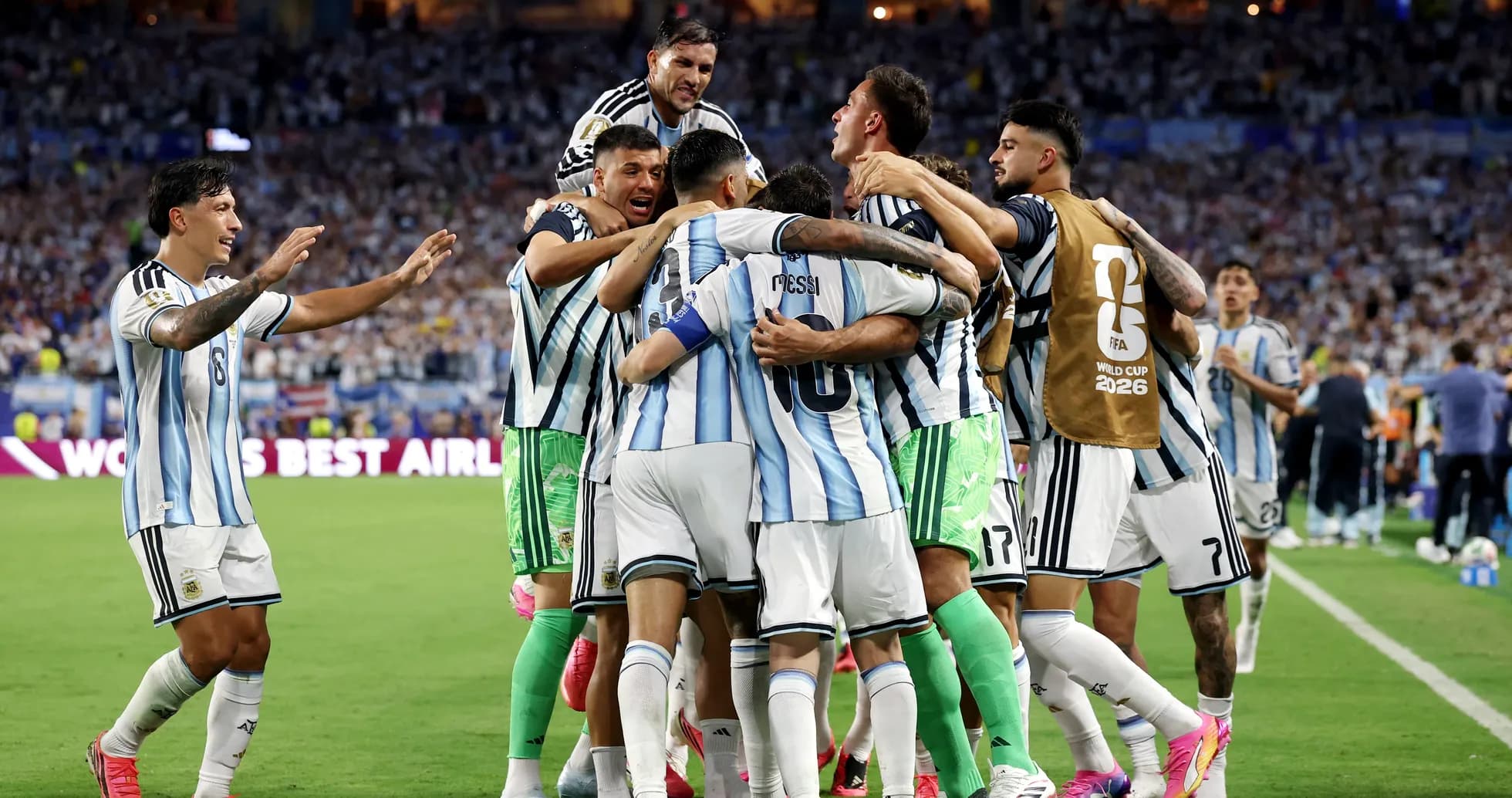
The first breakthrough came on 29', when Lionel Messi finished for Argentina, assisted by Lisandro Martínez. The centre-back’s involvement underlined Argentina’s aggressive positioning of defenders in possession, with Martínez stepping high to connect lines and find Messi between Cape Verde Islands’ midfield and defence.
Cape Verde Islands equalised on 59'. Deroy Duarte, assisted by Ryan Mendes, converted after a rare spell of attacking territory. This goal highlighted Cape Verde Islands’ plan: use the advanced midfield line of Deroy Duarte and Laros Duarte to attack the half-spaces when Argentina’s full-backs pushed on.
From there, substitutions reshaped the contest. On 63', Nicolás González (IN) came on for Thiago Almada (OUT), and Julián Alvarez (IN) came on for Lautaro Martínez (OUT), adding more vertical running and width for Argentina. Cape Verde Islands responded on 67' with Dailon Rocha Livramento (IN) for Nuno Da Costa (OUT), and Jamiro Monteiro (IN) for Laros Duarte (OUT), freshening the forward and midfield lines for transitions.
Discipline began to surface on 68':
- 68' Kevin Lenini (Cape Verde Islands) — Foul
Cape Verde Islands continued to rotate their wide and attacking players: Hélio Varela (IN) for Jovane Cabral (OUT) and Willy Semedo (IN) for Ryan Mendes (OUT) both at 80'. Argentina adjusted control centrally on 84' with Leandro Paredes (IN) for Rodrigo De Paul (OUT), and on 86' Nicolás Tagliafico (IN) for Facundo Medina (OUT), reinforcing the left side and stabilising rest defence.
Argentina’s second goal arrived at 93'. Lisandro Martínez scored, assisted by Alexis Mac Allister, capitalising on Argentina’s sustained pressure and set-piece or second-phase presence from the centre-backs.
Into extra time, Cape Verde Islands retooled again: on 100', Gilson Tavares (IN) replaced Kevin Lenini (OUT), and Yannick Semedo (IN) replaced Deroy Duarte (OUT). Three minutes later, they levelled in extra time: on 103', Sidny Lopes Cabral scored for Cape Verde Islands with no assist, a product of their persistence in attacking sporadically when Argentina’s structure loosened.
Argentina reacted on 104' by introducing Gonzalo Montiel (IN) for Nahuel Molina (OUT), seeking fresh energy on the right flank. The decisive moment came on 111': an own goal by Diney Borges, credited to Argentina, under intense pressure in the Cape Verde Islands box.
The final booking arrived late in extra time:
- 115' Gonzalo Montiel (Argentina) — Foul
Card totals were: Argentina 1, Cape Verde Islands 1, Total 2.
III. Tactical Breakdown & Personnel
Argentina’s 4-4-2 was possession-heavy and positionally aggressive. The back four of Nahuel Molina, Cristian Romero, Lisandro Martínez and Facundo Medina pushed a high line, with Martínez in particular stepping into midfield to overload Cape Verde Islands’ first line. The double pivot of Enzo Fernández and Alexis Mac Allister provided Argentina with secure progression: between them and the rest of the side, Argentina completed 779 accurate passes from 849 (92%), reflecting a controlled, low-risk circulation.
Wide midfielders Rodrigo De Paul and Thiago Almada initially tucked inside, creating central overloads and leaving full-backs to provide width. This structure allowed Messi to drift freely between lines, supported by Lautaro Martínez’s penalty-box occupation. The first goal epitomised this: a defender stepping high (Lisandro Martínez) and finding Messi in a pocket against a retreating block.
As Cape Verde Islands’ 4-1-4-1 compressed central zones, Scaloni’s substitutions shifted Argentina towards more direct running and crossing. Nicolás González and Julián Alvarez stretched the defensive line horizontally and vertically, forcing Cape Verde Islands’ full-backs deeper and opening lanes for underlaps and late runs from midfield. Paredes’ introduction further slowed the tempo and improved Argentina’s rest defence, limiting Cape Verde Islands’ transitions despite the equaliser in extra time.
Defensively, Argentina were rarely exposed in volume but were punished clinically. They conceded 16 shots and 5 on target, with an xG against of just 0.45, indicating that the chances allowed were generally low quality. The own goal by Diney Borges underlined the cumulative pressure Argentina generated rather than a clear, high-xG chance.
Cape Verde Islands’ 4-1-4-1, with Kevin Lenini screening in front of the back four, was built on compactness. The midfield line of Ryan Mendes, Laros Duarte, Deroy Duarte and Jovane Cabral shuffled laterally to deny central progression, forcing Argentina to recycle or go wide. When they did recover the ball, the immediate aim was to find Nuno Da Costa early or release wide players into space. Their first goal, finished by Deroy Duarte from a Ryan Mendes assist, came from one of the few moments when they managed to connect midfield to attack before Argentina could reset.
In extra time, fatigue and multiple substitutions altered their structure. With Gilson Tavares and Yannick Semedo introduced, Cape Verde Islands sought fresh legs to chase long passes and attack second balls. Sidny Lopes Cabral’s goal at 103' demonstrated their ability to capitalise on isolated moments even as Argentina dominated possession.
Both goalkeepers were central to the story. Emiliano Martínez (Argentina) faced 5 shots on goal and made 3 saves, with a goals prevented figure of -0.6, suggesting he conceded slightly more than the shot quality might predict. Vozinha (Cape Verde Islands) endured heavy pressure: Argentina put 10 shots on goal, and he made 8 saves, also with goals prevented at -0.6. His shot-stopping kept Cape Verde Islands alive deep into extra time, particularly as Argentina’s shot volume and territorial dominance grew.
IV. The Statistical Verdict
The numbers underline a match where Argentina’s control was overwhelming, but the scoreline remained precarious. With 22 total shots to 16, 10 on goal to 5, and an xG of 2.16 versus 0.45, Argentina consistently generated more and better chances. Their 64% possession and 849 passes at 92% accuracy show a side comfortable circulating against a low block, while Cape Verde Islands’ 476 passes at 86% reflect a more conservative, safety-first approach in build-up.
Set-pieces and wide pressure were key equalizers for Cape Verde Islands: they matched Argentina’s 8 corner kicks, despite much less ball, and used these moments to push their defensive line up and contest aerially. Defensively, Cape Verde Islands blocked 6 shots to Argentina’s 7, illustrating how both back lines were forced into last-ditch interventions.
Discipline remained controlled on both sides, with only one yellow card each, both for Foul, despite 13 fouls by Argentina and 12 by Cape Verde Islands. Ultimately, the statistical profile aligns with the final outcome: Argentina’s superior xG, shot volume and passing control justified their progression, even if the decisive 2-1 scoreline after extra time came via the cruel deflection of an own goal rather than a clean attacking action.