Arsenal's Tactical Mastery in 1-0 Victory Over Burnley
Arsenal’s 1-0 win over Burnley at Emirates Stadium was a controlled, methodical performance built on territorial dominance and structure rather than volume of clear chances. With 61% possession and a 1.03 xG to Burnley’s 0.21, Mikel Arteta’s side managed the game almost entirely in the visitors’ half, yet had to protect a single-goal margin for over 50 minutes. Burnley, under Mike Jackson, accepted a low-possession, deep 4-2-3-1 block, but produced no shots on target and relied on defensive resilience and set-piece moments to stay in the contest.
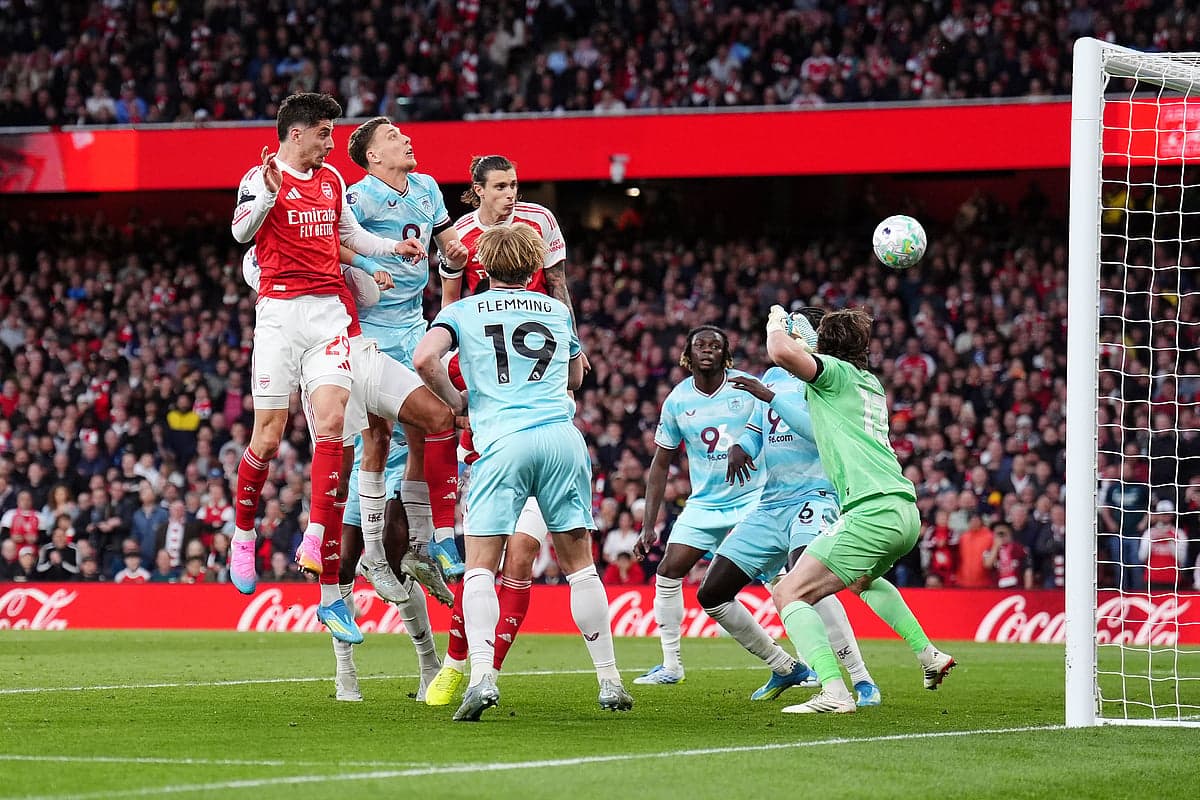
The decisive moment came on 37 minutes: K. Havertz finished for Arsenal, assisted by B. Saka. It was the one true incision that separated the sides, and it aligned with the underlying numbers: Arsenal’s xG edge reflected better shot locations (nine efforts inside the box) against a Burnley team limited to speculative efforts (three shots from outside the box, two inside). Despite the narrow scoreline, the pattern of play was one-sided, with Arsenal’s structure with and without the ball suffocating Burnley’s transitions.
Arsenal Lineup
Arsenal lined up in a 4-3-3 with D. Raya behind a back four of C. Mosquera, W. Saliba, Gabriel and R. Calafiori. In midfield, D. Rice anchored with M. Odegaard and E. Eze ahead, while B. Saka, K. Havertz and L. Trossard formed the front three. The structure produced a classic Arteta-positional map: Rice holding the central lane, full-backs providing width and underlaps, and Odegaard plus Eze occupying the half-spaces to overload Burnley’s double pivot of Florentino and L. Ugochukwu.
The possession figures and passing profile underline this control. Arsenal completed 510 passes, 440 accurate (86%), using circulation to move Burnley’s 4-2-3-1 from side to side. The 13 total shots, with nine inside the box, show that the positional play did succeed in getting the ball into advanced central zones, even if the final execution was not ruthless. The three shots on goal forced M. Weiss into two saves, with the remaining effort resulting in Havertz’s goal.
Burnley Formation
Burnley’s 4-2-3-1 was constructed to absorb and counter. The back four of K. Walker, A. Tuanzebe, M. Esteve and Lucas Pires sat deep, with Florentino and Ugochukwu screening. Ahead of them, L. Tchaouna, H. Mejbri and J. Anthony supported Z. Flemming. With only 39% possession and 325 passes (254 accurate, 78%), Burnley rarely established sustained spells on the ball. Their five total shots, none on target, and a low 0.21 xG highlight how effectively Arsenal kept them away from dangerous central spaces.
Out of possession, Arsenal’s front three and advanced eights led the press, preventing Burnley from building through the middle. The lack of Burnley offsides (0) indicates they rarely threatened with depth runs behind the line; instead, they were pinned back, often forced to clear rather than combine. Arsenal’s seven fouls versus Burnley’s 16 also reflect who was dictating tempo: Burnley had to break rhythm and halt Arsenal’s circulation more frequently.
Tactical Timeline
The discipline and event timeline reinforce the tactical story. At 28', Hannibal Mejbri (Burnley) was booked for Time wasting, a clear signal of Burnley’s early willingness to slow the game and protect territory rather than chase it. Arsenal then converted their pressure: at 37', K. Havertz (Arsenal) scored, assisted by B. Saka, capitalising on the sustained territorial dominance. In the second half, at 67', Kai Havertz (Arsenal) received a yellow card for Foul, one of Arsenal’s rare defensive lapses in timing rather than structure.
Burnley’s late push came via substitutions rather than systemic change. At 70', H. Mejbri (OUT) made way for Z. Amdouni (IN), seeking more direct attacking threat between the lines. A minute later, at 71', L. Ugochukwu (OUT) was replaced by J. Laurent (IN), freshening the double pivot. At 78', Florentino (OUT) was replaced by J. Ward-Prowse (IN), adding distribution and set-piece quality. On 82', L. Tchaouna (OUT) came off for J. Bruun Larsen (IN), and M. Esteve (OUT) was replaced by B. Humphreys (IN), an attempt to inject energy on the flank and in the back line.
Arteta’s response was to lock the game down rather than chase a second goal. At 72', R. Calafiori (OUT) made way for P. Hincapie (IN), a like-for-like defensive refresh on the left. A minute later, at 73', K. Havertz (OUT) was replaced by V. Gyökeres (IN), adding fresh pressing legs up front, and E. Eze (OUT) was replaced by M. Lewis-Skelly (IN), providing energy in midfield. In added time, at 90+3', L. Trossard (OUT) was replaced by G. Martinelli (IN), and M. Odegaard (OUT) made way for M. Zubimendi (IN), further stabilising the central structure to see out the result.
Burnley’s growing frustration and defensive strain were visible in the late bookings. At 90+1', Zian Flemming (Burnley) was shown a yellow card for Foul, and at 90+4', Lucas Pires (Burnley) was booked, also for Foul. The visitors finished with three yellow cards to Arsenal’s one, total four, matching the pattern of a side under prolonged pressure and making more last-ditch interventions.
In goal, D. Raya did not register a save, a direct consequence of Burnley failing to hit the target. Yet his contribution is captured by the goals prevented metric: 0.85, reflecting interventions beyond simple shot-stopping, such as positioning and command of the area that reduced the quality of Burnley’s few attempts. For Burnley, M. Weiss made two saves and also recorded 0.85 goals prevented, underlining that he limited Arsenal to a single strike despite the volume of box entries and the 1.03 xG against.
Statistically, Arsenal’s performance aligns closely with their output: 1.03 xG, one goal scored, 13 shots and controlled possession. They did not massively underperform or overperform the numbers; instead, they translated territorial control into a narrow but deserved win. Burnley’s 0.21 xG and zero shots on target confirm that their game plan was almost entirely defensive. They succeeded in avoiding a heavy defeat but never seriously threatened an equaliser. From a tactical lens, this was a match defined by Arsenal’s structure and control, and Burnley’s resistance without attacking punch.