Bologna vs Inter: A Tactical Showdown in Serie A Finale
Stadio Renato Dall’Ara staged a finale that felt like a season compressed into 90 minutes. Bologna, eighth in Serie A with 56 points and a goal difference of 3 (49 scored, 46 conceded overall), went toe-to-toe with champions Inter, who finished top on 87 points and a towering goal difference of 54 (89 for, 35 against overall). The 3-3 draw, sealed after Bologna led 2-1 at half-time, was a tactical chess match between Vincenzo Italiano’s reshaped 4-3-3 and Cristian Chivu’s unwavering 3-5-2.
I. The Big Picture – Structure vs Supremacy
Following this result, the table underlines just how much Bologna had to stretch to live with Inter’s season-long power. Overall, Bologna’s attack has been more efficient on their travels, with 1.6 away goals per game compared to 1.0 at home, and that tension between their cautious home output and their bolder away identity framed the way Italiano set them up: a front three built more on fluidity and work-rate than star power.
Inter arrived as the league’s most ruthless machine. Overall, they averaged 2.3 goals per game, split into 2.6 at home and 2.1 on their travels, while conceding just 0.9 overall (0.8 at home, 1.0 away). Chivu did not abandon the 3-5-2 that has underpinned all 38 league outings, but he did rotate heavily in personnel, asking his system to carry the weight of missing leaders.
The first half belonged to Bologna’s aggression between the lines. With L. Skorupski behind a back four of L. De Silvestri, E. Fauske Helland, J. Lucumi and J. Miranda, they defended in a compact 4-1-4-1 without the ball, with R. Freuler sitting as the single pivot and T. Pobega plus L. Ferguson stepping out to press Inter’s midfield. The front three of F. Bernardeschi, S. Castro and J. Rowe stretched Inter’s back three horizontally, forcing uncomfortable decisions from S. de Vrij and his partners.
Inter’s 3-5-2, with J. Martinez in goal, a back line of Y. Bisseck, de Vrij and Carlos Augusto, and a midfield five fronted by P. Sucic and P. Zielinski inside N. Barella and F. Dimarco, tried to impose the usual rhythm: wing-backs high, midfield rotations, and Lautaro Martinez dropping between the lines to connect with F. Esposito. But Bologna’s central congestion and early intensity disrupted the champions’ build-up, leading to turnovers in advanced zones and, crucially, to the 2-1 deficit by the interval.
II. Tactical Voids – Absences and Discipline
Both sides were significantly reshaped by absences, and the voids told their own tactical stories.
For Bologna, the loss of R. Orsolini – their 10-goal league scorer who also provided 1 assist and attempted 67 dribbles with 32 successes – removed their most direct right-sided threat. Without his left-footed gravity cutting inside, Italiano leaned on Bernardeschi as a creative wide forward and asked Rowe to provide vertical running from the opposite flank. At the back, the absence of K. Bonifazi and M. Vitik limited rotation options in central defence, effectively locking in Lucumi and Fauske Helland as the pairing tasked with handling Lautaro’s movement.
Inter’s absences were even more structurally symbolic. H. Calhanoglu, with 9 goals and 4 assists and a passing accuracy of 90% over 1,393 passes, is normally the metronome at the base of midfield and a major set-piece weapon. His lack of match fitness meant Chivu had to redistribute playmaking responsibility between Zielinski and Barella. Up front, resting M. Thuram – 13 goals, 6 assists, and a constant outlet in transition – forced Inter to lean more heavily on Esposito’s off-ball running and Lautaro’s all-round game.
Defensively, the missing D. Dumfries reduced Inter’s right-sided thrust and their ability to overload wide areas with raw pace, while M. Akanji’s rest further underlined how much Chivu was willing to trust his system and depth rather than his usual defensive hierarchy.
From a disciplinary standpoint, both teams carried season-long warning signs into this match. Heading into this game, Bologna’s yellow cards peaked between 61-75 minutes (26.87%) and 76-90 (25.37%), painting a picture of a side that often defends on the edge late on. Inter, similarly, showed a late spike, with 31.25% of their yellows arriving between 76-90 minutes. The second half duly became a contest increasingly defined by tired legs and tactical fouls as Bologna tried to protect their lead and Inter chased the equaliser.
III. Key Matchups – Hunter vs Shield, Engine Room
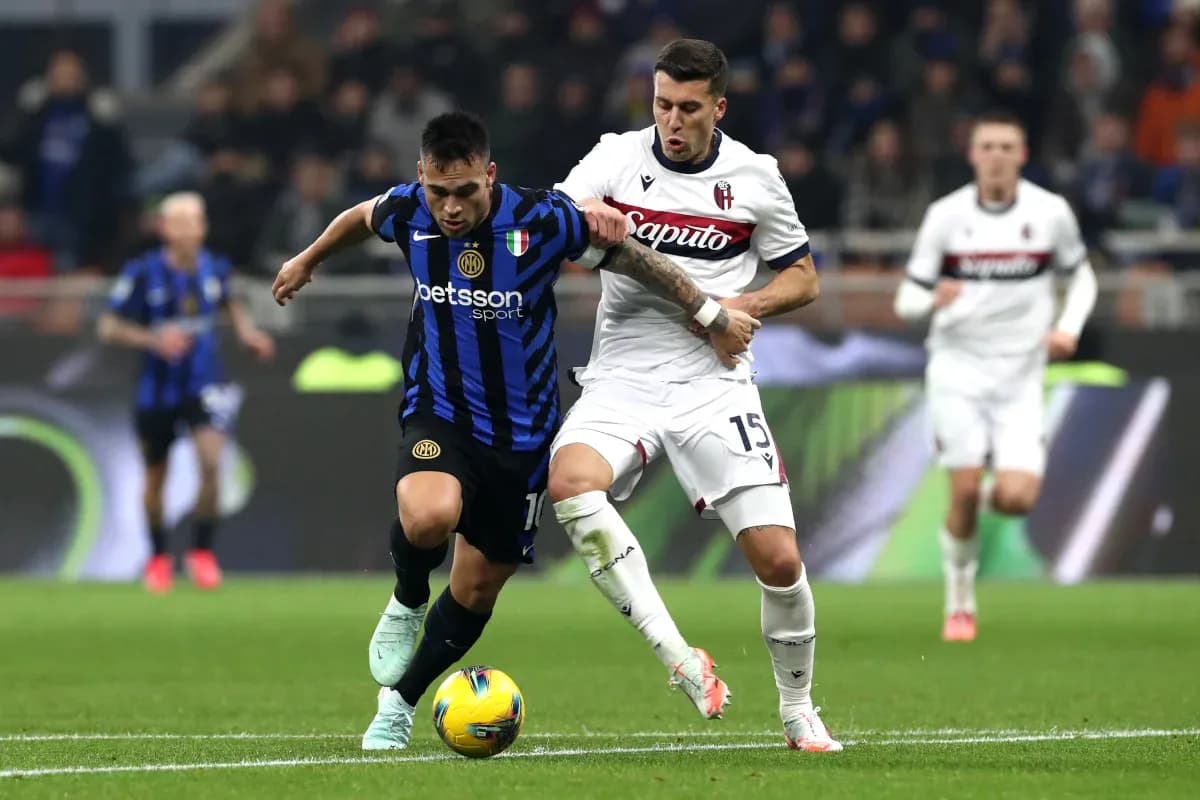
The headline duel was always going to be Lautaro Martinez against Bologna’s defensive structure. Lautaro’s 17 league goals and 6 assists this season came from a profile that blends penalty-box instincts with link play: 69 shots, 39 on target, plus 37 key passes. Bologna, who conceded 1.2 goals per game both at home and away, built a shield around him: Freuler screening, Ferguson and Pobega collapsing inwards, and Lucumi engaging aggressively when Lautaro dropped short.
Inter’s defensive shield, meanwhile, faced a more collective threat rather than a single prolific scorer. Bologna’s overall 1.3 goals per game masked the absence of Orsolini, but the front three’s rotations aimed to exploit the spaces around de Vrij. Castro’s central presence pinned the back three, allowing Bernardeschi to drift into half-spaces and Rowe to attack the channel outside Bisseck.
In the engine room, the duel between Barella and Freuler defined the tempo. Barella, with 8 assists and 53 tackles this season, is Inter’s perpetual-motion carrier, while Freuler’s brief was to break up those surges and provide the first pass into Bologna’s transitions. Around them, Sucic and Zielinski tried to find pockets, but Bologna’s narrow midfield three often forced them wide, where Dimarco’s delivery – 16 assists and 96 key passes overall – became Inter’s most reliable route into the box.
IV. Statistical Prognosis – xG Logic vs Chaos of the Day
On paper, the numbers would have forecast a different story. Inter’s away profile – 2.1 goals scored and 1.0 conceded per game on their travels – against a Bologna side averaging just 1.0 goal at home suggested a controlled away win, perhaps by a one- or two-goal margin, with Inter’s xG edge derived from sustained territorial pressure and higher shot volume.
Yet the 3-3 draw reflects how tactical context and absences can warp the expected balance. Without Calhanoglu’s control and Thuram’s stretching runs, Inter’s usual xG superiority was harder to translate into a decisive scoreline. Bologna, conversely, overperformed their typical home attacking output, turning fewer but better-quality situations into goals through sharp pressing traps and well-timed runs from their front line.
Following this result, the statistical verdict is nuanced. Inter’s season-long defensive solidity remains intact in the macro view, but this match underlines a vulnerability when key structural players are absent. Bologna, meanwhile, demonstrated that even with their main scorer missing, Italiano’s 4-3-3 can manufacture chances against the very best when the press is synchronised and the midfield compact.
In xG terms, Inter would still likely shade the underlying chances over 90 minutes, but the draw feels like a fair reflection of the tactical balance: Bologna’s opportunistic, high-impact attacks versus Inter’s more sustained, if blunted, pressure. For both coaches, this was less a dead-rubber finale and more a live laboratory, revealing how their squads bend – and occasionally break – under the strain of rotation and high-level adaptation.