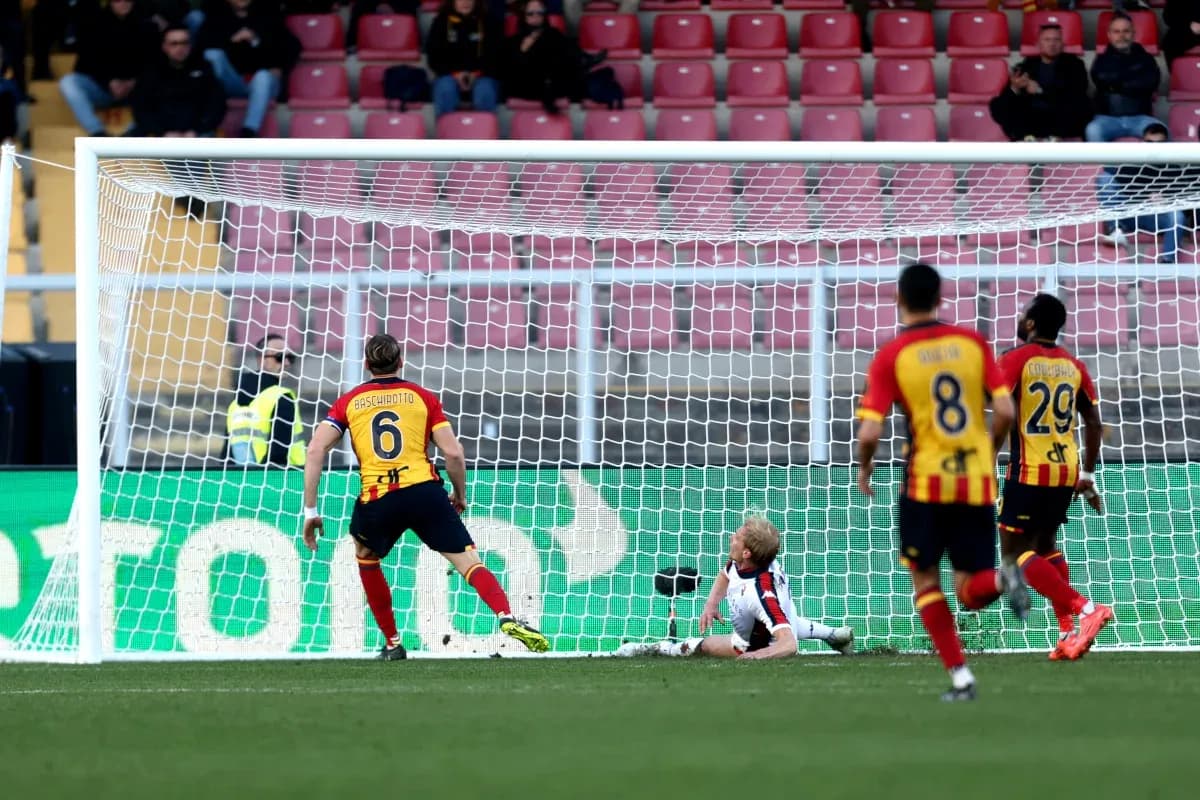
Lecce vs Genoa: A Tense Serie A Finale
The season at Via del Mare closed under floodlights and tension, a relegation-tinged Serie A finale where every duel felt like it carried the weight of an entire campaign. Lecce edged Genoa 1–0, a scoreline that mirrored the fine margins separating 17th from 16th in the final table, and underlined the contrasting identities of two flawed but stubborn sides.
I. The Big Picture – Survival football in its purest form
Following this result, Lecce finished 17th with 38 points, their overall goal difference at -22, the product of 28 goals scored and 50 conceded across 38 matches. Genoa, one rung higher in 16th, closed on 41 points with a goal difference of -10 from 41 goals for and 51 against. It was not a glamour tie, but a study in pragmatism: a team that had averaged just 0.7 goals per game in total this campaign facing one that lived on the edge, conceding 1.3 in total while trying to squeeze just enough attacking production out of a 1.1-goals-per-game offense.
Eusebio Di Francesco doubled down on Lecce’s seasonal DNA, rolling again with the 4-2-3-1 that had been his most trusted shape, used 22 times in total. Across the pitch, Daniele De Rossi’s Genoa arrived in a 3-5-1-1 – a variant of a three-at-the-back system that had defined their year, with 3-5-2 and 3-4-2-1 as their main structural references. The formations told the story: Lecce, a side built to suffer and counter in small bursts; Genoa, a team trying to control zones through numbers in midfield but often lacking cutting edge.
II. Tactical Voids – Who wasn’t there mattered almost as much as who was
Both squads came into this fixture visibly depleted. Lecce were without M. Berisha (thigh injury) and R. Sottil (back injury), robbing Di Francesco of rotation options and an extra creative spark between the lines. It placed more responsibility on the starting quartet behind the striker – L. Banda, L. Coulibaly, S. Pierotti and O. Ngom – to supply the rare chances a side averaging 0.7 goals in total and 0.7 at home could hope to carve out.
Genoa’s absentees were even more telling. T. Baldanzi (illness), M. Cornet (muscle injury), J. Ekhator (foot injury), C. Ekuban (injury), Junior Messias (muscle injury), R. Malinovskyi (inactive), J. Onana (injury), L. Ostigard (knock) and Vitinha (suspended for yellow cards) stripped De Rossi of experience, creativity and depth in almost every line. The absence of Malinovskyi, who had contributed 6 goals, 3 assists and taken 43 shots in the league, removed Genoa’s most proven long-range threat and set-piece specialist. Without Vitinha, De Rossi also lost a reference point in attack and an outlet for direct play.
Disciplinary trends shaped the tone of the contest even before kickoff. Heading into this game, Lecce’s yellow card distribution showed a pronounced late-game spike: 30.43% of their cautions arrived between 76-90 minutes, part of a broader picture of a team that lived on the edge in closing stages. Genoa, meanwhile, clustered 25.40% of their yellows between 61-75 minutes and had a red-card profile that featured dismissals early (33.33% of reds in 0-15) and around the hour mark (33.33% in 46-60). It framed a match likely to fray as fatigue and nerves set in.
III. Key Matchups – Hunter vs Shield, Engine Room vs Enforcer
With no league-wide top scorers or assist charts available, the “Hunter vs Shield” battle had to be read through structure and role rather than raw scoring tables. For Lecce, the primary attacking blade was L. Banda from the left. His season – 5 goals, 4 assists, 24 shots (15 on target) – made him the closest thing Di Francesco had to a difference-maker. Banda’s directness, reflected in 87 dribble attempts with 34 successful, and his capacity to draw 49 fouls, positioned him as the natural tormentor of Genoa’s right side.
Opposite him, Genoa’s three-man back line of N. Zatterstrom, S. Otoa and A. Marcandalli formed the shield. On their travels, Genoa had conceded 25 goals in 19 away games, an average of 1.3, slightly better than their 1.4 at home. The structure was meant to compress central zones and funnel wingers like Banda into traffic. Yet the absence of experienced defensive voices such as L. Ostigard reduced the back line’s margin for error.
In the “Engine Room” duel, the spotlight fell on Y. Ramadani. Over the season he had been Lecce’s metronome and destroyer: 37 appearances, 3214 minutes, 1445 passes with 80% accuracy, 91 tackles, 11 successful blocks and 46 interceptions. His 10 yellow cards underscored how often he operated on the disciplinary edge. Alongside him, O. Ngom provided legs and coverage, freeing Ramadani to step into challenges and screen the central channels.
Against them, Genoa deployed M. Frendrup, Amorim and P. Masini in the heart of a five-man midfield, with S. Sabelli and A. Martin providing width. Without Malinovskyi’s passing range or Onana’s physicality, Genoa’s midfield leaned more towards industry than incision. The question was whether they could pull Ramadani out of position enough to open pockets for M. E. Ellertsson and L. Colombo between the lines.
On Lecce’s right, Danilo Veiga was another hinge point. His season numbers – 98 tackles, 14 successful blocks, 31 interceptions and 9 yellow cards – painted the picture of an aggressive full-back willing to engage early and often. His duels (403 total, 216 won) suggested he would not shy away from confronting Genoa’s left flank, especially A. Martin and the drifting movements of Ellertsson.
IV. Statistical Prognosis – Why a tight, low-scoring battle always loomed
The numbers made this fixture feel almost pre-scripted as a narrow contest. Lecce’s overall attacking record – 28 goals in 38 matches, with 13 at home – aligned with an average of 0.7 goals per game in total and 0.7 at home. They had failed to score in 19 league matches, 10 of those at home, but balanced that with 10 clean sheets split evenly between home and away. Their defensive record of 50 goals conceded, an average of 1.3 in total, hinted at a side capable of staying in games if they kept structure.
Genoa, in contrast, brought slightly more attacking punch but similar defensive fragility. In total this campaign they scored 41 goals – 22 at home and 19 on their travels – with averages of 1.2 at home, 1.0 away and 1.1 in total. They had failed to score in 15 matches, but their 9 clean sheets (4 at home, 5 away) showed a capacity to shut down games, especially when protecting a lead. Crucially, their penalty record was perfect: 5 penalties taken, 5 scored, 0 missed. Lecce, for their part, had earned just 1 penalty and converted it, also with no misses.
With both sides conceding 1.3 goals per game in total and neither boasting a prolific attack, the xG balance – even without explicit values – logically tilted towards a low-event match. Lecce’s reliance on the 4-2-3-1, their disciplined double pivot and the ball-carrying threat of Banda suggested a game plan built around a handful of high-quality transitions rather than sustained pressure. Genoa’s three centre-backs and packed midfield hinted at control of territory without necessarily generating clear chances, especially in the absence of Malinovskyi and Vitinha.
In the end, the 1–0 scoreline felt like the natural expression of these profiles. Lecce, a side living on thin attacking margins, found the one moment they needed and then leaned on a structure that had produced 10 clean sheets and a combative core led by Ramadani and Veiga. Genoa, marginally better over the course of the season but stripped of key weapons, could not tilt the probabilities in their favour.
Following this result, both clubs survived, but the story of Lecce vs Genoa at Via del Mare will be remembered less for spectacle and more as a distilled version of their 2025 Serie A reality: narrow, nervy, and decided by the smallest of tactical and mental edges.