Brighton Dominates Wolves with 3–0 Victory at Amex Stadium
Brighton’s 3–0 home win over Wolves at the Amex Stadium was a controlled, structurally coherent performance built on early vertical aggression and then long phases of possession dominance. In a Premier League Round 36 fixture, Fabian Hurzeler’s side raced into a 2–0 lead inside five minutes and then used a 72% share of the ball and a 578–225 passing advantage to suffocate any Wolves response. Rob Edwards’ team were pinned deep for long stretches, generating only 0.49 xG and a single shot on target, while Brighton converted 1.62 xG into three goals with efficient set-up play from Maxim De Cuyper and incisive wide rotations.
I. Executive Summary of Scoring and Discipline
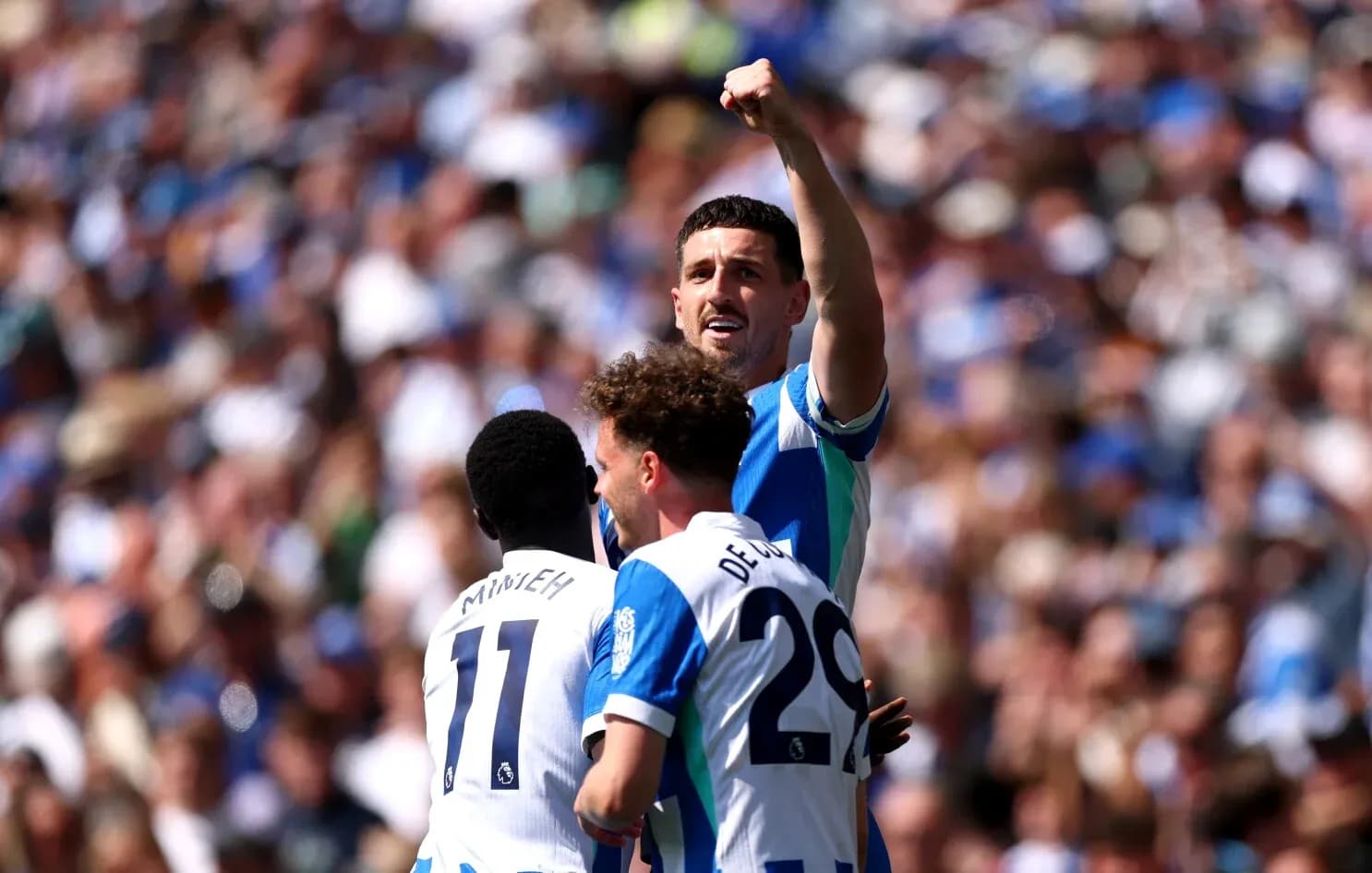
The game’s tactical script was set almost immediately. At 1', Jack Hinshelwood arrived from midfield to finish a move assisted by Maxim De Cuyper, exploiting Wolves’ unbalanced rest defence before their block had settled. Just four minutes later, at 5', Lewis Dunk converted again from a De Cuyper delivery, underlining Brighton’s intent to use their left side as a primary progression and chance-creation lane.
Discipline remained relatively light but had clear tactical implications. The first card came at 24':
- 24' Kaoru Mitoma (Brighton) — Foul
Mitoma’s booking reflected Brighton’s aggressive counter-press when possession was lost, particularly high on the left. After the break, Wolves’ attempts to raise the intensity without destabilising their structure produced two cautions:
- 49' Hwang Hee-chan (Wolves) — Foul
- 68' André (Wolves) — Foul
Total cards: Brighton 1, Wolves 2, Total 3.
Brighton’s third goal, at 86', came from Yankuba Minteh, who finished a late transition to make it 3–0 and close the contest. There were no VAR interventions listed; all three goals stood without delay.
Substitution patterns reinforced the tactical evolution. Wolves’ first change at 46' saw David Møller Wolfe (IN) came on for Hugo Bueno (OUT), an attempt to refresh the left flank against Brighton’s dominance. Later, at 67', Rodrigo Gomes (IN) came on for Pedro Lima (OUT) and Jean-Ricner Bellegarde (IN) came on for Mateus Mané (OUT), signalling a shift towards more ball-carrying and crossing threat, but without changing the fundamental 5-out defensive shape. Brighton’s key changes came at 58' when Joël Veltman (IN) came on for Kaoru Mitoma (OUT), and then a double change at 76' with Yasin Ayari (IN) came on for Carlos Baleba (OUT) and Georginio Rutter (IN) came on for Danny Welbeck (OUT), moving the side towards greater control and ball retention before late rotation at 88' introduced Charalampos Kostoulas (IN) came on for Jack Hinshelwood (OUT) and Solly March (IN) came on for Maxim De Cuyper (OUT).
II. Tactical Breakdown & Personnel
Brighton’s structure was possession-heavy and clearly pre-planned to target Wolves’ right half-space and the zones around Santiago Bueno and Yerson Mosquera. Without a formation label in the data, the roles suggest a back four of Ferdi Kadıoğlu, Jan Paul van Hecke, Lewis Dunk, and Maxim De Cuyper, with Carlos Baleba and Pascal Groß as central pivots and a fluid band of three—Yankuba Minteh, Jack Hinshelwood, Kaoru Mitoma—behind Danny Welbeck.
The early goals illustrate the central tactical idea: rapid progression via De Cuyper on the left, with Dunk and van Hecke holding a high line and Baleba/Groß offering immediate counter-pressing cover. De Cuyper’s two early assists indicate that Brighton repeatedly isolated Wolves’ wide defenders, drawing out Pedro Lima and Hugo Bueno and then exploiting the space behind. Hinshelwood’s opener at 1' reflects his licence to attack the box from midfield, arriving beyond Welbeck as Wolves’ midfield screen, anchored by João Gomes and André, was still organising.
After going 2–0 up, Brighton shifted into a more patient possession game. The 72% ball possession and 578 passes at 86% accuracy show a side comfortable circulating in front of Wolves’ mid-block, with Groß dictating tempo and switching play, and Mitoma/Minteh holding width to stretch the back line. The relatively modest shot volume—14 total shots, 6 on goal—highlights that this was controlled rather than chaotic dominance: Brighton chose their moments rather than flooding the box.
Wolves, by contrast, were structurally reactive. With Daniel Bentley behind a back line of Yerson Mosquera, Santiago Bueno, and Toti Gomes, they attempted to protect central zones and rely on transitions through Adam Armstrong, Mateus Mané, and Hwang Hee-chan. However, with only 5 total shots and 1 on target, they struggled to connect their first pass after regains. The 11 fouls and two yellow cards for Hwang Hee-chan and André underscore a side often a step late in duels, forced into contact to halt Brighton’s rotations.
Goalkeeper usage underlines the tactical story. Bart Verbruggen needed just 1 save, reflecting how effectively Brighton protected the central lane and limited Wolves to low-quality or blocked efforts (0 blocked shots recorded for Wolves). Bentley, with 3 saves, faced fewer shots than Brighton’s overall dominance might suggest, which points to Wolves keeping numbers in the box but failing to contest earlier phases of build-up, allowing Brighton to control territory and rhythm.
Hurzeler’s substitutions were coherent with game state. Bringing on Joël Veltman for Mitoma at 58' shifted Ferdi Kadıoğlu’s role and added defensive stability on the flank as Brighton moved to game management mode. Later introductions of Yasin Ayari and Georginio Rutter at 76' freshened the press and ball-carrying threat, culminating in Minteh’s 86' goal as Wolves pushed slightly higher. Rob Edwards’ later attacking changes—Angel Gomes (IN) came on for Hwang Hee-chan (OUT) and Tolu Arokodare (IN) came on for João Gomes (OUT) at 89'—came too late to influence the tactical pattern.
III. Statistical Verdict
The statistical profile matches the eye-test of Brighton’s dominance. With 72% possession, 14 shots, and 1.62 xG, they combined territorial control with a steady, if not explosive, chance creation rate. Wolves’ 28% possession, 5 shots, and 0.49 xG show a side largely restricted to sporadic counters and half-chances.
Passing numbers (578 vs 225 total passes; 498 vs 154 accurate) and accuracy (86% vs 68%) emphasise the technical gap on the day. Brighton’s ability to sustain long passing chains allowed them to compress Wolves into their own third and re-press immediately after turnovers, which in turn limited Wolves’ capacity to launch structured transitions.
Defensively, both goalkeepers posted identical “goals prevented” values of 0.25, but the context differs: Verbruggen’s low save count reflects strong collective defending, while Bentley’s 3 saves and the 3–0 scoreline show that Brighton’s finishing slightly outpaced the underlying xG. Discipline was controlled—Brighton 1 yellow, Wolves 2—supporting the view of a tactically ordered game rather than a chaotic contest. Overall, Brighton translated structural superiority and ball security into a comfortable, data-backed win.