Chelsea vs Tottenham: A Clash of Opposite Seasons
Stamford Bridge under the late-October lights staged a meeting between two sides whose seasons are pulling in opposite directions. Chelsea came into Round 8 of the Premier League in 5th place with 13 points from 8 matches, their overall goal difference a slim but telling +2 (17 scored, 15 conceded). Tottenham arrived in west London sitting 14th on 9 points, their overall goal difference -2 (8 scored, 10 conceded). It felt like a crossroads fixture: Chelsea pushing to cement Europa League ambitions, Tottenham trying to prove their mid-table status is a temporary misfire rather than a new reality.
Both managers doubled down on a shared shape: 4-2-3-1 mirrored against 4-2-3-1. Xabi Alonso’s Chelsea had been more fluid structurally over the season, favouring a 3-4-2-1 in 6 of their 8 league outings, with this back four a more recent experiment. Roberto De Zerbi’s Tottenham, by contrast, have lived almost exclusively in this system, using it in all 8 league matches.
Chelsea’s season-long profile has been defined by attacking intent and defensive volatility. Heading into this game, they were scoring an overall average of 2.1 goals per match, with a notably explosive home return of 2.8 goals at Stamford Bridge. Yet that ambition has come at a price: they were conceding an overall average of 1.9 goals, including 2.0 per match at home, and had managed only 1 clean sheet in total. Tottenham’s numbers suggested the opposite problem: an attack sputtering at an overall 1.0 goals per game, especially blunt on their travels at 0.8, but underpinned by a relatively more controlled defence conceding an overall 1.3 goals per match and just 1.0 away.
Alonso’s selection underlined both opportunity and constraint. The back four of Josh Acheampong, Maxence Lacroix, Levi Colwill and Jorrel Hato shielded young goalkeeper Mike Penders, with Moisés Caicedo and Jordan Henderson forming a double pivot. Ahead of them, Pedro Neto, Cole Palmer and Geovany Quenda supported lone forward Morgan Rogers. The absentees list told its own story: P. Chavarria, E. Emegha, J. Gittens, R. James and E. Martinez were all ruled out, stripping Chelsea of depth in wide and defensive areas. The absence of Reece James in particular removed a natural outlet on the right and a major crossing threat, forcing Acheampong into a more conservative full-back brief.
For Tottenham, De Zerbi’s hand was also heavily shaped by who was missing. R. Bentancur, suspended after a red card, joined L. Bergvall, W. Odobert, X. Simons, D. Udogie and others on the sidelines. That cluster of absences, especially Bentancur’s, robbed Spurs of a natural midfield enforcer and ball-winner. In his place, Sandro Tonali and Mateus Fernandes formed the double pivot, with Mohammed Kudus, James Maddison and Mathys Tel operating behind Omar Marmoush.
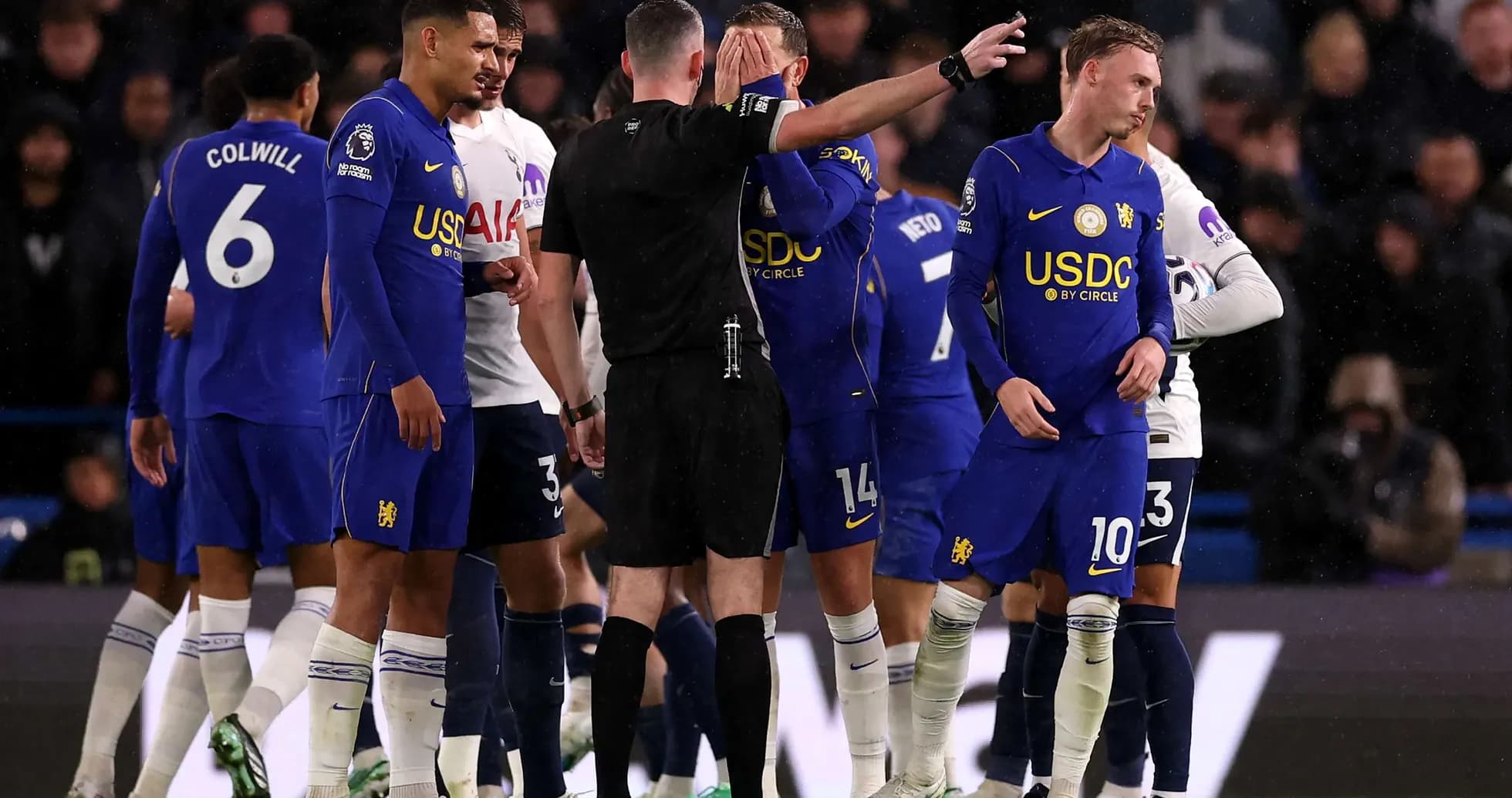
The disciplinary backdrop added another layer to the tactical picture. Chelsea’s season card profile shows a spread of yellow cards across the 90 minutes, but with a persistent late-game edge: 18.75% of their yellows arrive between 76-90 minutes, and they have already seen one red in that same late window. Tottenham’s own yellow-card pattern peaks even more sharply between 61-75 minutes, accounting for 30.77% of their cautions, with their single red card also coming between 76-90 minutes. This is a match primed for rising temperature as legs tire and spaces open.
Hunter vs Shield
In the “Hunter vs Shield” duel, Chelsea’s forward line carried the more convincing numbers. João Pedro, absent from the matchday squad but central to Chelsea’s season narrative, had already scored 5 league goals and supplied 3 assists in 6 appearances, operating as both finisher and facilitator. In his stead, Rogers, with 4 goals and 1 assist from 8 games, becomes the primary hunter. His 105 duels contested and 12 tackles underline how he leads the press from the front as much as he leads the line.
Tottenham’s shield, though not individually highlighted in the scoring charts, is collective. Away from home they had conceded only 4 goals in 4 matches, with an away average of 1.0 goals against. Micky van de Ven and Jan Paul van Hecke anchor a back line that has shown resilience when defending deeper, while Tonali’s 88% pass accuracy in league play points to a calmer, possession-based route out of pressure when they win the ball.
Engine Room
The “Engine Room” confrontation is equally compelling. For Chelsea, Palmer is the creative metronome. Heading into this fixture he had 2 goals and 3 assists in 8 league matches, with 17 key passes and 27 dribble attempts, a profile of a player who both breaks lines and commits defenders. His disciplinary edge is part of the story too: 3 yellow cards and 1 red mark him out as someone who walks the fine line between competitive and combustible.
Across from him, Maddison is Tottenham’s natural orchestrator, flanked by Kudus and Tel. Without Bentancur to mop up transitions, Tonali and Fernandes must absorb Palmer’s half-space movements and Chelsea’s tendency to overload centrally with Henderson stepping up. If they fail, Spurs’ back four can be dragged into constant emergency defending.
The statistical intersection that shapes this contest is time. Tottenham’s attack is heavily back-loaded: 57.14% of their league goals arrive between 76-90 minutes, with another 14.29% between 91-105. They are a side that comes alive late, even if they start slowly. Chelsea, meanwhile, concede fairly evenly, but their disciplinary spikes late on suggest a team that can become ragged under sustained pressure. Combine Spurs’ late surge with Chelsea’s tendency to fray in the final quarter-hour and you get a script where the visitors are most dangerous just as the hosts are most vulnerable mentally and structurally.
From a probabilistic, xG-style lens using the season shot and scoring data, Chelsea’s higher overall scoring average (2.1) and stronger home attacking output make them the more likely side to generate volume and quality of chances across the 90. Yet Tottenham’s cleaner away defensive record and their late-goal bias hint that even if Chelsea control territory and attempts, the decisive moments may belong to De Zerbi’s side in the final stretch.
In tactical terms, this fixture was always likely to hinge on whether Chelsea’s aggressive front four could punch through Spurs’ compact mid-block early, or whether Tottenham could drag the game into that chaotic final phase where their late surges and Chelsea’s discipline issues collide. On paper, the underlying numbers lean slightly towards Chelsea on chances created, but the structural and temporal trends leave the door wide open for a Tottenham smash-and-grab if the match reaches the last 15 minutes still in the balance.