Manchester United's Tactical Unraveling Against Bournemouth
Old Trafford under a grey Manchester sky, Premier League Round 8, and a scoreboard that told a brutal truth: Manchester United 0, Bournemouth 3. In a season where United’s identity already felt fragile, this was not just a defeat; it was a tactical unravelling that exposed the fault lines in Michael Carrick’s evolving project and underlined the clarity of Marco Rose’s Bournemouth blueprint.
I. The Big Picture – contrasting trajectories
Heading into this game, United were 16th with 7 points from 8 matches, their overall goal difference at -3 from 10 scored and 13 conceded. At home they had taken just 4 points from 4 games, with 6 goals scored and 7 conceded – an Old Trafford that no longer intimidates, statistically or psychologically.
Bournemouth arrived in Manchester in 13th place with 9 points from 8, their overall goal difference at -1 (12 for, 13 against). On their travels they had 1 win, 1 draw and 2 defeats, scoring 7 and conceding 9: an away side that accepts chaos but increasingly bends it to their will.
Both managers set up in a 4-2-3-1, but the systems told different stories. For United, the shape looked like a work in progress; for Bournemouth, it was the culmination of a clear, rehearsed plan.
II. Tactical voids – absences and structural strain
United’s squad sheet carried the scars of an injury-hit start. P. Dorgu (hamstring), K. Mainoo (injury), M. Rashford (hip), B. Sesko (leg), L. Shaw (injury) and M. Ugarte (knee) were all ruled out. That cluster of absences stripped United of natural width, ball-winning presence, and left-sided balance. The knock-on effect was visible everywhere.
At the back, Senne Lammens started behind a back four of Diogo Dalot, Ayden Heaven, Harry Maguire and Leny Yoro. Without Shaw’s left-footed outlet and Ugarte’s screening, the defensive unit looked exposed whenever Bournemouth broke lines. United’s season-long numbers had already warned of fragility: at home they were conceding 1.8 goals per game and had yet to keep a single clean sheet in the league. This 0–3 simply extended a pattern rather than creating a new one.
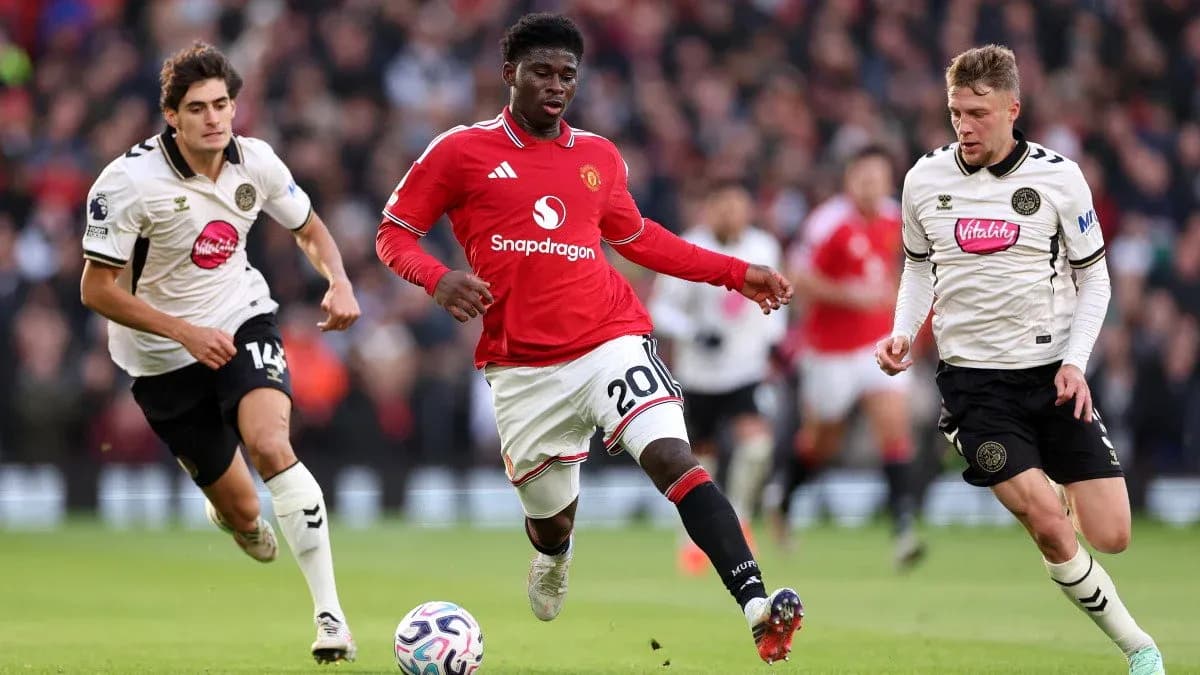
In midfield, Andrey Santos and Carlos Baleba formed the double pivot, with Mason Mount, Youri Tielemans and Amad Diallo behind Bryan Mbeumo. On paper, it is a technically rich band of four; in practice, without a natural ball-winner of Ugarte’s profile or the vertical thrust of Rashford and Sesko, United’s attacks became predictable and their rest defence brittle.
Bournemouth were not without issues of their own. J. Araujo (thigh), V. Milosavljevic (fitness), A. Scott (thigh) and A. Toth (muscle) all missed out. Yet Rose’s core remained intact: Đorđe Petrović in goal, Adam Smith and Adrien Truffert as full-backs, James Hill and António Silva at centre-back, Tyler Adams and Lewis Cook as the double pivot, and a fluid attacking quartet of Marcus Tavernier, Justin Kluivert, Rayan and Evanilson.
Disciplinary trends framed another subplot. United’s yellow cards this season have spiked late, with 37.50% coming between 76–90 minutes and a further 18.75% in added time. Bournemouth mirror that late edge, with 31.82% of their yellows also in the final quarter-hour. In a match where United were chasing and Bournemouth countered with venom, that shared late-game volatility tilted decisively towards the better-structured side.
III. Key matchups – Hunter vs Shield, Engine Room
The “Hunter vs Shield” duel was defined by two men: Bryan Mbeumo for United and Marcus Tavernier for Bournemouth.
Mbeumo entered this fixture as United’s leading scorer, with 4 goals from 8 league appearances, 19 shots (11 on target) and a 7.02 average rating. Deployed as the lone forward, he was asked to occupy Bournemouth’s central pairing of Hill and António Silva, supported by Mount, Tielemans and Diallo. Yet the service into him was sporadic, and Bournemouth’s compact 4-2-3-1 funnelled him into crowded central zones where Adams and Cook could collapse the space.
At the other end, Tavernier – Bournemouth’s standout attacker this season – was devastating. With 5 goals in 8 games, 16 shots (11 on target) and a 7.48 rating, he has become Rose’s primary hunter between the lines. Against a United defence that had conceded 7 goals at home before kick-off and had not recorded a single clean sheet all season, Tavernier’s movement from the left half-space into central pockets repeatedly pulled Dalot and Yoro into uncomfortable decisions.
His aggression out of possession is mirrored in his disciplinary profile: 3 yellow cards already this season, part of a Bournemouth side that can oscillate between controlled intensity and edgy over-commitment. Here, though, that edge was channelled perfectly into pressing triggers that suffocated United’s buildup.
The “Engine Room” battle was no kinder to United. Adams and Cook, who anchor a Bournemouth side averaging 1.5 goals per game overall and 1.8 on their travels, controlled tempo and transitions. Their positional discipline allowed Kluivert and Rayan to push high, while Evanilson – 3 goals and 4 assists so far, with 9 key passes and 47 duels won from 95 – acted as the connective tissue between midfield and attack.
United’s Santos–Baleba axis, by contrast, struggled to impose a clear identity. With the team conceding 1.6 goals per game overall and failing to keep a single clean sheet, the double pivot too often found itself firefighting rather than dictating. Tielemans and Mount dropped deeper to help, which in turn left Mbeumo isolated and Diallo receiving the ball in static positions rather than on the move.
IV. Statistical prognosis – xG shadow and defensive realities
Even without explicit xG data, the season-long profiles of both sides sketch the underlying story. Bournemouth’s attack, scoring 1.8 goals per game away, is not a fluke; it is supported by a structure that regularly creates high-quality chances for Evanilson and Tavernier. Their away defence, conceding 2.3 per game before this match, looked vulnerable in theory, but United’s blunt edge meant those weaknesses went largely untested.
United’s own attacking numbers – 1.5 goals per game at Old Trafford, 1.3 overall – suggest a side capable of creating but not yet ruthless. Their defensive baseline, conceding 1.8 at home and 1.6 overall, points to a team whose xG against is consistently too high for a side with top-half ambitions.
Following this result, the narrative is stark. Bournemouth’s 3–0 win at Old Trafford will likely be one of their standout away performances of the season, a victory built on tactical clarity, vertical threat and a disciplined engine room. United, meanwhile, are left with a familiar diagnosis: a porous defensive structure, an attack overly dependent on moments from Mbeumo and Bruno Fernandes, and an injury list that has exposed the thinness of their tactical core.
The numbers had warned this could happen. The match simply brought them to life in brutal, three-goal colour.