Egypt Advances Over Australia in Tense Round of 32 Tie
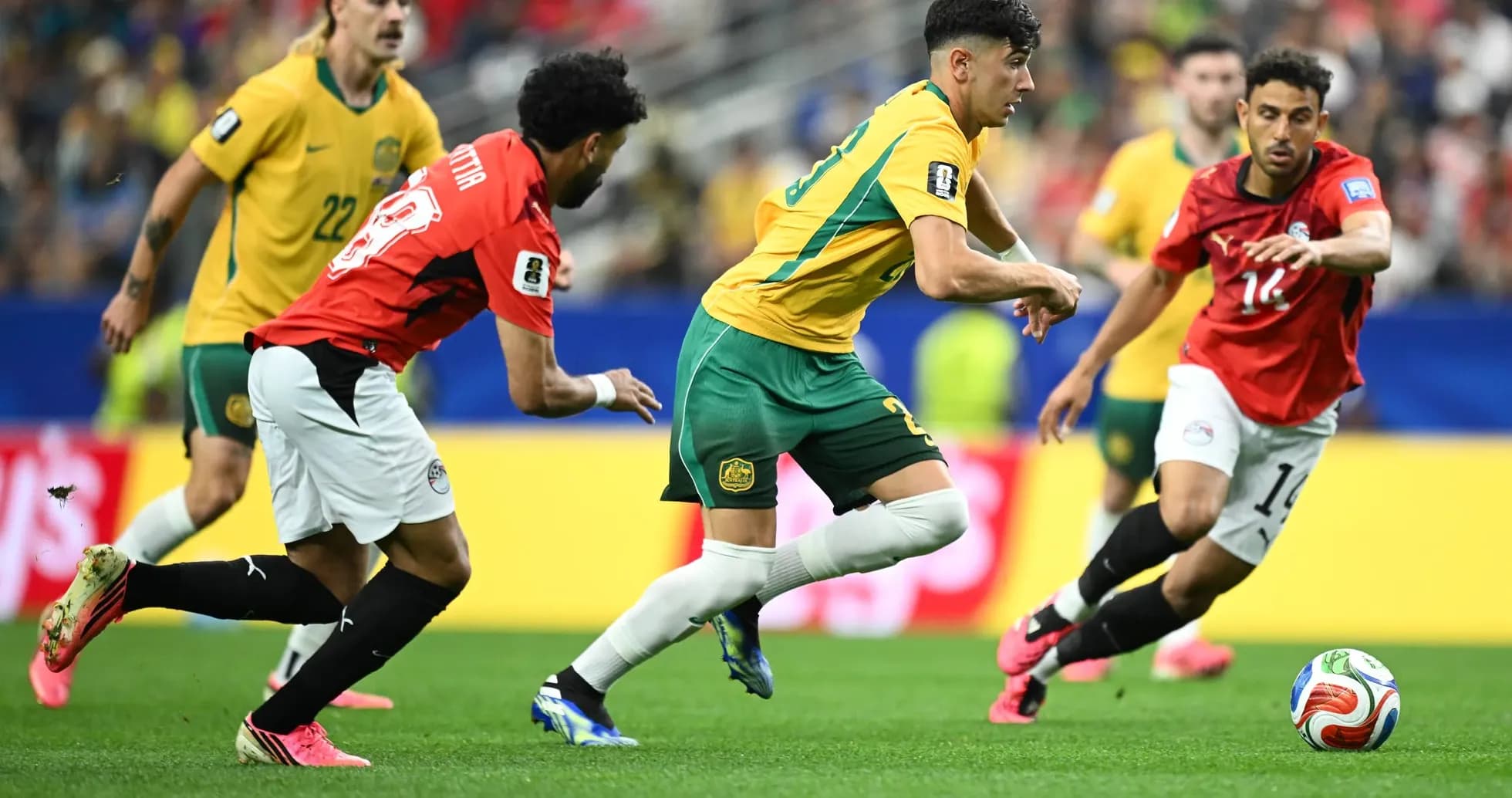
Australia and Egypt produced a tense, structurally intriguing Round of 32 tie at AT&T Stadium, one that finished 1-1 over 120 minutes before Egypt advanced 4-2 on penalties. The underlying numbers and on‑pitch patterns told a story of Egyptian territorial and technical control against a highly structured, transition‑oriented Australian 3-4-2-1, with both sides’ tactical choices clearly shaping how the game flowed and, ultimately, how it was decided.
Egypt's Tactical Approach
Egypt’s 4-4-2, with Mohamed Salah and Mostafa Ziko up front and Omar Marmoush starting wide, was built to dominate the ball and progress methodically. Their 58% possession and 723 passes, with 614 accurate at 85%, underline a clear plan: circulate through Hamdy Fathy and Marwan Attia in central midfield, use full-backs Mohamed Hany and Karim Hafez to stretch the width, and create structured attacking platforms rather than chaotic transitions. The shot profile supports this: 14 total attempts, 8 from inside the box and 4 on target, generating 1.36 xG. Egypt consistently managed to work the ball into advanced zones, often via diagonal switches from the double pivot to the wide midfielders, then combining inside with Salah and Ziko.
Australia's Reactive Strategy
Australia, by contrast, accepted a more reactive role. Tony Popovic’s 3-4-2-1, with Harry Souttar anchoring a back three and wing-backs Jordan Bos and Aziz Behich, was designed to compress central spaces and protect the half-spaces where Salah and Marmoush like to receive. Their 42% possession and 507 passes (404 accurate, 80%) reflect a side content to defend in a mid-to-low block and then break quickly through the front three of Nestory Irankunda, Cristian Volpato and Connor Metcalfe. The Socceroos still produced 16 total shots, 10 inside the box, but only 1 on target from 0.87 xG – a sign that while their structure allowed them to reach shooting positions, the final execution under pressure from Egypt’s compact back four was lacking.
Key Moments
The early goal for Egypt, scored by Emam Ashour and assisted by Karim Hafez, flowed directly from their positional superiority. With Australia’s wing-backs pinned, Egypt could overload one flank, then find Ashour arriving from the second line. The move highlighted how the 4-4-2 morphed into a 4-2-3-1 in possession, with Ashour stepping into the half-space and Salah drifting off the front line to connect play. Australia’s back three struggled initially to pass runners on the edge of the box, forcing the midfield duo of Jackson Irvine and Aiden O’Neill into deep, reactive positions.
Popovic’s adjustments after half-time were telling. The 46' substitution, with Kai Trewin (IN) coming on for Jordan Bos (OUT), nudged Australia toward a more conservative wing structure on one side, reinforcing the back line against Egypt’s wide rotations. Later, the double change at 74' – Mohamed Touré (IN) for Nestory Irankunda (OUT) and Ajdin Hrustić (IN) for Cristian Volpato (OUT) – aimed to add ball security and a more traditional penalty-box presence. Hrustić’s profile as a connector between lines helped Australia sustain a few longer phases of possession, but their main threat remained from quick surges once Egypt’s full-backs were high.
The own goal by Mohamed Hany, credited to Australia, encapsulated the risk in Egypt’s approach. With the back line pushed up and full-backs aggressive, any mis-timed clearance in a crowded box became dangerous. Australia’s insistence on getting numbers into the penalty area, even from relatively sparse possession, contributed to that defensive error. The Socceroos’ 9 blocked shots underline how often Egyptian defenders had to intervene desperately inside their own box, despite generally controlling territory.
Defensive Discipline
Defensively, Egypt’s structure was disciplined. The two yellow cards – Haissem Hassan and Yasser Ibrahim, both for “Foul” – reflect isolated moments of individual duelling rather than systemic breakdowns. Egypt committed 14 fouls to Australia’s 12, often as tactical interruptions when Australia tried to launch counters through the channels. The compactness between lines meant that Australia’s advanced midfielders, Metcalfe and Volpato, were frequently receiving under immediate pressure, forced into rushed shots or blocked efforts rather than clean looks on goal.
Goalkeeping Performance
In goal, the numbers reinforce the tactical story. Patrick Beach (Australia) and Mostafa Shobeir (Egypt) shared the 120 minutes, though Australia made a late swap at 119', with Mathew Ryan (IN) coming on for Beach (OUT) specifically for the penalty shootout. Across normal and extra time, the Australian goalkeeping unit registered 3 saves against Egypt’s 4 shots on target, with a goals prevented figure of -0.9, indicating that the one goal conceded was broadly in line with chance quality and that there was no significant overperformance. At the other end, Shobeir (Egypt) was rarely called into action – just 1 save from Australia’s single shot on target – but Egypt’s own goals prevented metric of -0.9 suggests that, like Australia, they conceded roughly what the underlying chances warranted, with the own goal skewing the perception of their defensive display.
Macro-Tactical Features
Egypt’s ball circulation was the decisive macro-tactical feature. With 7 corners to Australia’s 4 and a higher volume of passes, they repeatedly pinned the Socceroos back, forcing the 3-4-2-1 into a 5-4-1 for long stretches. Australia’s forwards were often isolated, and while their 0 offsides show they timed runs well, it also underlines how rarely they could afford to play on the shoulder; most attacks began from deeper zones. Egypt’s 3 offsides, by contrast, show a front line constantly probing behind Australia’s last line, stretching the back three and creating space for Ashour and Marmoush between the lines.
Ultimately, the statistical verdict is consistent with the eye-test implied by the data: Egypt were the more proactive, possession-dominant side, with superior xG (1.36 to 0.87), more shots on goal (4 to 1), and a higher pass completion rate (85% to 80%). Australia’s game plan – compact block, heavy blocking presence (9 blocked shots), and targeted counters – was coherent and nearly enough to edge a low-margin knockout tie, especially once the own goal brought them level. But over 120 minutes, Egypt’s capacity to control tempo, recycle possession, and repeatedly enter the final third gave them the territorial and chance-quality edge. The penalty shootout merely crystallised what the underlying structure had suggested: Egypt’s control and composure, built on a robust 4-4-2 platform, were fractionally superior to Australia’s valiant but low-volume, transition-first approach.