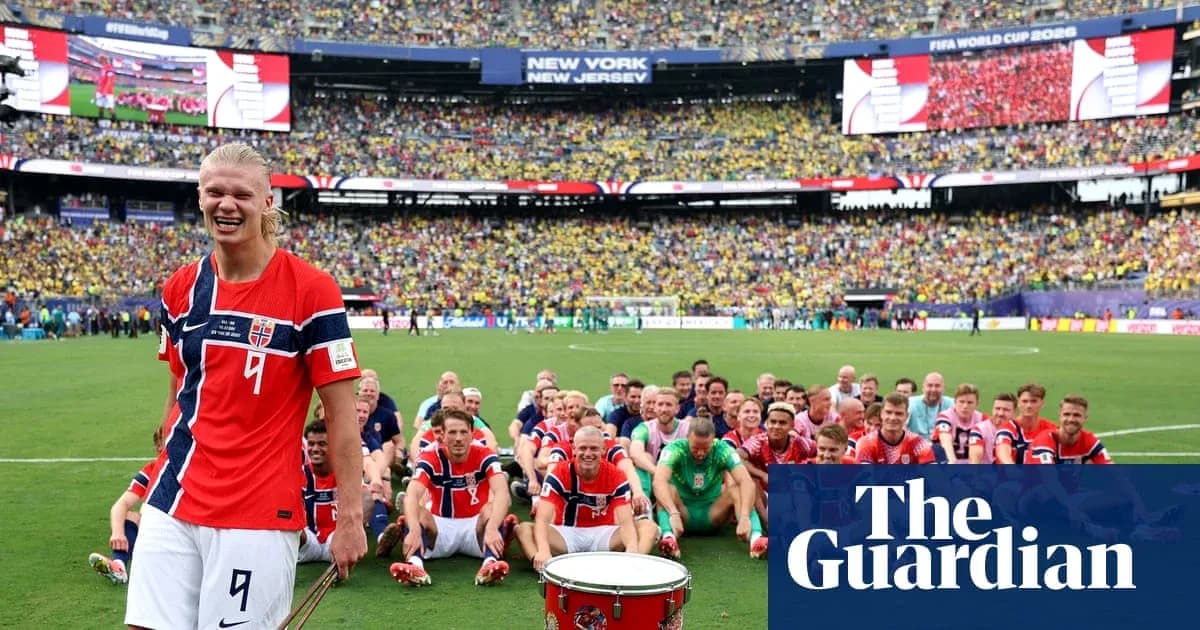
Erling Haaland: The World Cup’s Viral Sensation
Erling Haaland is chasing the Golden Boot, but he has already wrapped up another title at this World Cup: the most viral player on the planet.
The Norway striker arrived with a built‑in fanbase – adored in his homeland, idolised by the blue half of Manchester, and quietly cherished in Leeds, the city of his birth and the club he grew up supporting. Now, with Norway into the quarter-finals, the rest of the world has joined in. Not just for the goals. For the show.
The World Cup’s TikTok phenomenon
In the first week of July, “Haaland” crashed into the UK’s overall top 10 searches on TikTok. Interest didn’t just rise; it exploded, up more than 300% week on week, making him the most searched-for World Cup player in that spell.
“Haaland best moments” surged even harder, up 1,300% in the same period. Since the tournament began, more than 14,000 posts have carried #Haaland or #ErlingHaaland, an almost 500% month-on-month jump. The numbers are dizzying: around 1.4 million posts about him in total.
He is still chasing the true giants of the social era. #Messi stands at 25 million posts, #Ronaldo at 22.3 million. Haaland hasn’t reached that stratosphere yet. But his trajectory is unmistakable.
Santa suits, “raw dogging” flights and a Viking on Snapchat
The foundations of this digital storm were laid long before the World Cup. Last Christmas, Haaland pulled on a Santa suit in Manchester, went undercover and handed out gifts to children in a YouTube video that raced around social media. His Instagram stories have become regular viral fodder, not least when he joked about “raw dogging” a flight with no food, water or entertainment.
During the World Cup, that presence has gone into overdrive. His Instagram and TikTok content has taken off, while his Snapchat – where he has 4.7 million subscribers – has turned into appointment viewing for a new generation of fans.
He is not a distant superstar broadcasting from behind a velvet rope. He comments on memes about himself, joins in the joke, leans into the chaos. When an Instagram user posted a picture of a green onion with the caption: “Am I losing it or does this green onion look like Haaland?”, he responded with a meme of a dog hurriedly winding up a car window – the classic “hide and pretend you didn’t see it” gag.
It works. On Instagram alone, his following has rocketed from 40 million to 60 million during the tournament, the fastest growth of any major player. His Reels have drawn more than 683 million views since the World Cup kicked off.
The content is relentlessly shareable. A mocked-up selfie with Shrek, captioned “Selfie with my twin”. A snap of him disguised as a tourist in New York, hiding behind a baseball cap and sunglasses. A stroll through Texas with a cowboy hat replacing his now-iconic Viking helmet.
Even Google has joined the party: type his name in and an animation of Viking-helmeted rowers glides across the screen.
Viral, but not just for the jokes
It isn’t only the comedy that travels. Clips of Haaland showing small, human gestures have spread just as fast. One video of him carefully folding his shirt and handing it to a kit man while teammates fling theirs on the floor has been viewed millions of times. It is a simple act, but in a tournament clouded by controversy around Fifa and off-field decisions, those moments of respect hit home.
His friendship with former Borussia Dortmund teammate Jude Bellingham has become its own storyline. Their on-camera chemistry has lit up timelines, with some fans likening them to the two rival hockey players from HBO’s Heated Rivalry as Norway prepare to face England on Saturday.
The knock-on effect is clear. There are 1.3 million posts about Bellingham on TikTok, dwarfing England captain Harry Kane’s 277,600. Haaland’s orbit boosts those around him.
One 18-year-old TikTok creator from the Netherlands, whose video about Haaland and Bellingham has been shared more than 100,000 times, admitted she “didn’t know Haaland before this World Cup”. She usually only tunes in for World Cups and Euros when her own country plays, swept along by the national obsession. This time, her For You page dragged her deeper.
Her feed filled with Haaland’s funny moments and Snapchat stories. That was enough. She liked his “vibe”, the humour, the bromance with Bellingham – and that was what pushed her to make the video that went viral.
A lookalike, a new icon and a global wave
Haaland’s image has even created stardom in its own likeness. Russian model Anastasia Kostromitina found herself thrust into the spotlight after her mother posted a video of her mimicking his poses once people pointed out the resemblance.
Long blond hair, sharp blue eyes, tall frame – the parallels are obvious. She has called the comparisons “not bad at all”. At first she was confused by being likened to a male footballer, then she realised being compared to “such an amazing athlete” is hardly an insult. She describes him as humble and a great athlete. The association, she now says, is welcome.
“We’ve known this for years”
Back in Manchester, there is a sense of déjà vu. For City supporters, the rest of the world is simply catching up.
“He is a great asset for our club,” says Dante Friend from the 1894 fan group. They feel a connection that runs beyond the goals. “He’s very active on social media, he follows the fan accounts, he’s in touch with some of the main fans behind the scenes, so we really feel he’s one of us.”
Kevin Parker, general secretary of the Manchester City official supporters club, puts it bluntly. On the pitch, Haaland is “right up there with the best strikers, goalscorers in the world”. Off it, he is “a different sort of footballer”.
Not different because of ability. Different because of personality.
“He just seems a genuinely likable sort of guy,” Parker says, and now, with the World Cup stage amplifying every frame and post, everyone else can see the same thing City fans have watched for three seasons. For him, Haaland gives football “such a positive vibe” at a time when the sport has been dragged into uncomfortable headlines.
Howard Cohen, chair of the Manchester City Disabled Supporters Association, remembers a very different early narrative. When Haaland first arrived in Manchester, some media painted him as quiet, reserved, almost aloof. That image has not survived contact with reality.
“He’s really come out of his shell very quickly,” Cohen says. “He was clearly never that sort of quiet, reserved figure in reality, and he doesn’t take himself too seriously.”
For Cohen, that matters. Public figures, especially footballers, are scrutinised constantly. The ability to laugh, to show you are in on the joke, to enjoy yourself without tipping into arrogance – that is what people love most about Haaland off the field.
He is picking up support “around the world” and, crucially, “providing entertainment for people”. In an age when football can feel like a business first and a game second, Haaland’s blend of ruthless finishing and carefree online presence is a reminder of something simpler.
This is what the sport is supposed to be about.