Fiorentina vs Atalanta: A Season in Contrast
The final evening at Stadio Artemio Franchi felt less like a dead rubber and more like an x-ray of two seasons heading in opposite directions. Fiorentina, 15th in Serie A with 42 points and a goal difference of -9 (41 scored, 50 conceded), closed a turbulent campaign with a 1-1 draw against an Atalanta side that finishes 7th on 59 points, their +15 goal difference (51 for, 36 against) underlining a far more stable identity.
The scoreboard told of parity, but the lineups told of two very different projects. Paolo Vanoli doubled down on Fiorentina’s most-used shape, the 4-3-3 that has started 15 league games, trusting it one more time under the lights in Florence. Across from him, Raffaele Palladino stayed faithful to Atalanta’s 3-4-2-1, the framework used in 34 matches and the foundation of their push toward European qualification.
For Fiorentina, the season’s statistical DNA has been that of a side permanently on the edge: in total 38 matches, only 9 wins, 15 draws, and 14 defeats, with both home and away goals for averages locked at 1.1. At home, they scored 21 and conceded 21; away, they found 20 but shipped 29. The numbers paint a team capable of competing in spells but rarely controlling full games. Their 10 clean sheets overall and 11 matches failed to score underline the volatility.
Vanoli’s XI reflected both necessity and intent. With M. Kean (calf injury) and F. Parisi (knee injury) unavailable and L. Ranieri suspended after a red card, the back four of Dodo, P. Comuzzo, D. Rugani and R. Gosens was a pragmatic blend of athleticism and experience. O. Christensen in goal, rather than the high-profile D. de Gea on the bench, hinted at a long-term bet rather than a short-term headline.
Ahead of them, the midfield three of G. Fabbian, R. Mandragora and M. Brescianini was built less for flamboyance and more for balance. Mandragora, the left-footed pivot, offered the first pass out of pressure; Fabbian and Brescianini could shuttle to close Atalanta’s half-spaces where Palladino’s system usually thrives. Up front, J. Harrison and R. Piccoli flanked A. Gudmundsson in what looked like a narrow front three designed to attack the channels between Atalanta’s wide centre-backs and wing-backs.
Gudmundsson’s season profile – 5 goals, 4 assists and a red card in Serie A – encapsulates Fiorentina’s edge. He is both creator and finisher, and his penalty record (3 scored, 0 missed) feeds into a team that, in total this campaign, converted all 6 of their penalties. There is ruthlessness from the spot, even if open-play fluency has often been missing.
The absences mattered. Without Parisi’s thrust from left-back and Ranieri’s aggressive front-foot defending, Fiorentina lost two of their natural tone-setters. Ranieri’s disciplinary record – 8 yellow cards and 1 red in the league – and Fiorentina’s late-card profile (25.30% of their yellows and 66.67% of their reds arriving in the 76-90’ window) show a side that often finishes games with frayed nerves. The choice of the calmer Rugani and the more measured Comuzzo hinted at a desire to end the season with control rather than chaos.
On the other side, Atalanta arrived with the numbers of a team that knows exactly who it is. In total this campaign, they won 15, drew 14, and lost only 9. They scored 51 and conceded 36, with a goals for average of 1.3 overall (1.3 at home, 1.4 on their travels) and a goals against average of 0.9 overall (0.8 at home, 1.1 away). Thirteen clean sheets and only 8 matches without scoring underline their blend of defensive solidity and attacking consistency.
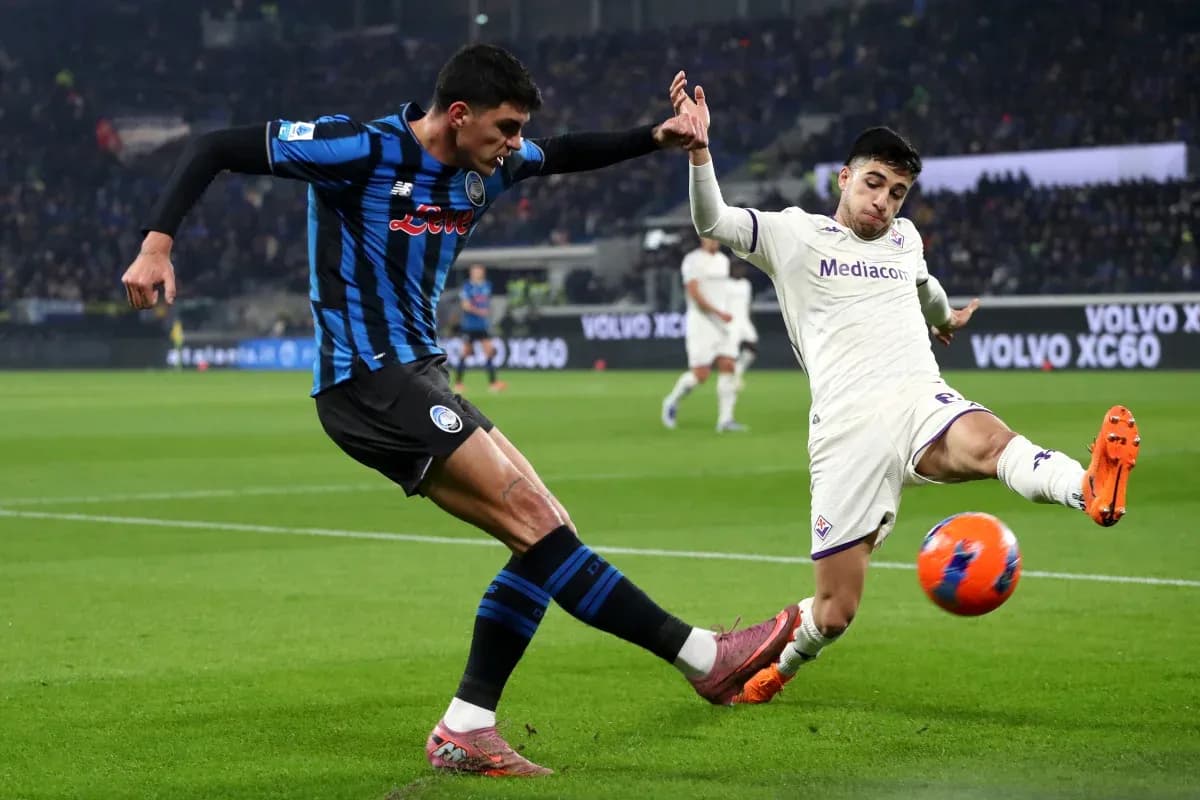
Palladino’s 3-4-2-1 in Florence was almost textbook. M. Sportiello behind a back three of G. Scalvini, I. Hien and H. Ahanor gave Atalanta height and aggression in duels. The wing-backs, R. Bellanova on the right and Y. Musah on the left, were the real accelerators, tasked with pinning back Fiorentina’s full-backs and stretching the 4-3-3.
In the “engine room”, M. De Roon and M. Pasalic formed a double pivot designed for control and second balls. De Roon’s positional discipline allowed Pasalic to time late runs into the box, especially important given that Atalanta’s top scorers, N. Krstović and G. Scamacca (both on 10 league goals), began on the bench. Ahead of them, L. Samardzic and K. Sulemana supported G. Raspadori, a mobile central forward whose movement between lines is ideal for dragging centre-backs into uncomfortable zones.
The “Hunter vs Shield” dynamic in this fixture was clear. Atalanta’s attacking spear – led by Krstović’s profile (10 goals, 5 assists, 75 shots with 34 on target) and Scamacca’s penalty-boosted tally (10 goals, including 2 from the spot) – has driven their 26 away goals, with an away average of 1.4. Fiorentina, by contrast, conceded 21 at home with an average of 1.1. On paper, Atalanta’s travelling attack had the edge over Fiorentina’s home rearguard.
Yet Fiorentina’s defensive structure at home has been more resilient than their league position suggests. Six home clean sheets and a balanced 21-21 goals record in Florence indicate that, when compact, they can suffocate visiting attacks. The selection of a hard-working midfield trio and a back four without the more card-prone Ranieri was clearly aimed at limiting transitions and avoiding the late-game disciplinary collapses that their card distribution warns about.
In the “engine room” battle, Mandragora and Brescianini versus De Roon and Pasalic was the fulcrum. De Roon’s capacity to break play and Pasalic’s timing against Fiorentina’s attempt to build through Mandragora set the rhythm. If Fiorentina’s first pass was rushed, Atalanta could compress the pitch and unleash their wing-backs; if Mandragora found angles into Gudmundsson or Harrison, Atalanta’s back three could be dragged into wide, uncomfortable duels.
From a statistical prognosis, the draw fits the underlying numbers. Atalanta’s away defensive average of 1.1 goals conceded and Fiorentina’s home scoring average of 1.1 point toward a single Viola goal as par. At the other end, Atalanta’s 1.4 away goals for average against Fiorentina’s 1.1 home goals against suggested a narrow edge for the visitors, but not a rout. The 1-1 final feels like the midpoint of those curves.
Following this result, the broader narrative is of an Atalanta side whose 3-4-2-1, supported by stable xG trends and a deep bench featuring Krstović, Scamacca and C. De Ketelaere (5 assists and 63 key passes in the league), remains a reliable platform for European nights. Fiorentina, meanwhile, close the campaign as a team that has flirted with both danger and potential: tactically flexible, disciplined from the spot, but too often living on the emotional edge suggested by their late-card surges.
The draw at the Franchi does not rewrite either season, but it crystallises them. Atalanta leave with their identity confirmed; Fiorentina leave with work to do – but also with just enough structural stability to believe that, with sharper edges in both boxes and a calmer disciplinary line, next year’s story could read very differently.