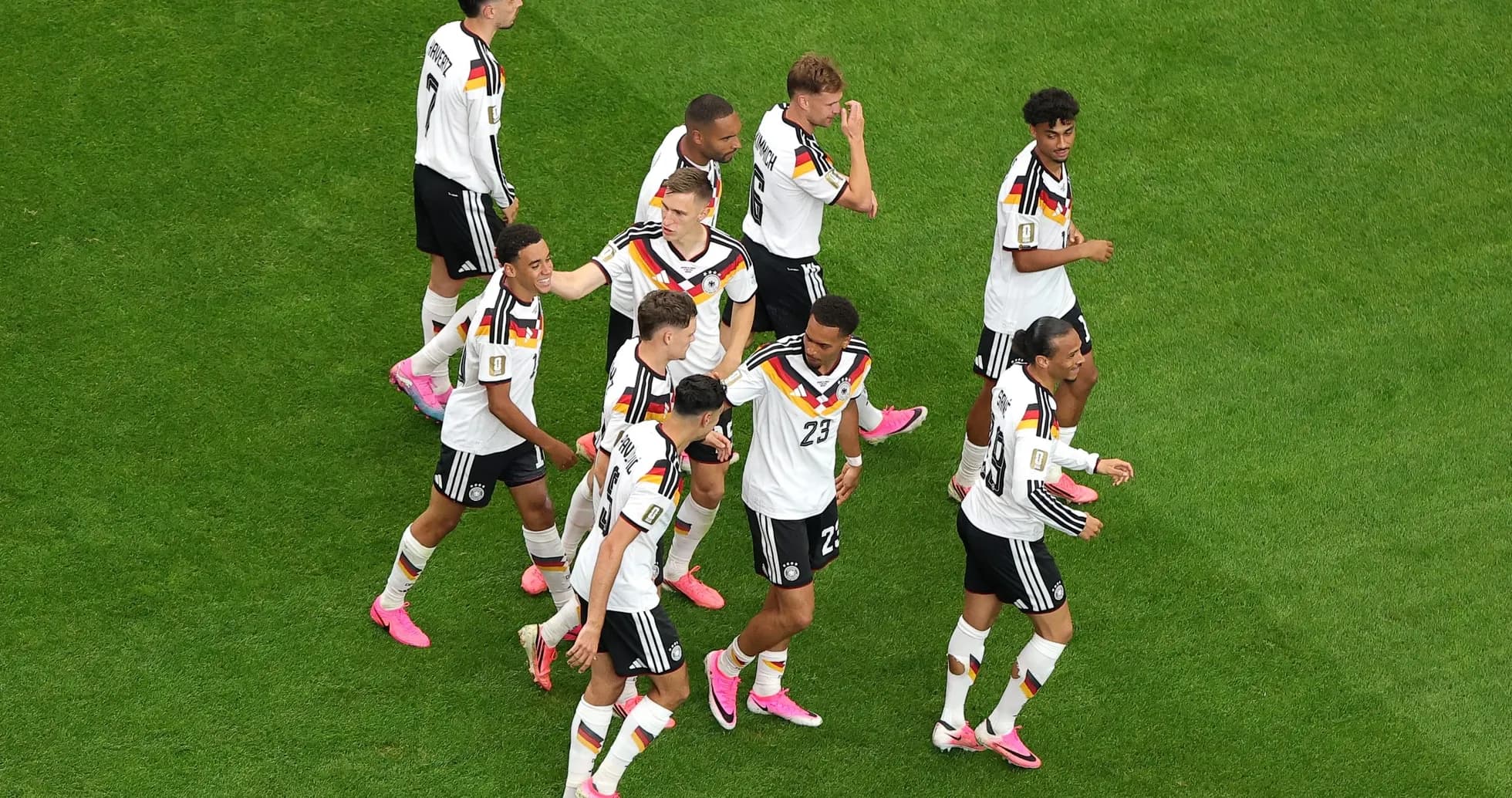
Germany Dominates Curaçao 7-1 in World Cup Opener
The World Cup’s first glimpse of Germany in 2026 felt less like a group opener and more like a statement of intent. Under the closed roof of NRG Stadium in Houston, Julian Nagelsmann’s side dismantled Curaçao 7-1, a scoreline that matched the territorial dominance and tactical clarity on display. Following this result, Germany sit 1st in Group E with 3 points and a goal difference of +6, already signposted for the Round of 32, while Curaçao, bottom on 0 points and a goal difference of -6, are left clinging to the idea that this was the group’s most brutal examination.
Tactical Setup
Nagelsmann’s 4-2-3-1 was less a formation and more a structure for controlled aggression. With M. Neuer behind a back four of J. Kimmich, J. Tah, N. Schlotterbeck and N. Brown, Germany could afford to hold a high line and compress the pitch. The double pivot of F. Nmecha and A. Pavlovic provided the platform, allowing the three technicians ahead – L. Sane, J. Musiala and F. Wirtz – to rotate and overload between the lines, with K. Havertz as the nominal striker but effectively a roaming focal point.
Statistics
The numbers from their World Cup campaign so far are extreme: in total this campaign Germany have played 1 match, scoring 7 goals and conceding 1. At home they have averaged 7.0 goals for and 1.0 against, and their biggest result is already this 7-1 demolition. There is no clean sheet yet, but the structure looked largely secure once the early nerves settled.
Curaçao, by contrast, arrived with a 4-3-1-2 under Dick Advocaat that was designed to be compact and direct. E. Room anchored a back four of S. Floranus, R. Bazoer, A. Obispo and D. Fonville, shielded by a midfield trio of L. Comenencia, L. Bacuna and J. Bacuna, with T. Chong floating as the link behind a front two of J. Locadia and S. Hansen. On paper, the narrow diamond was meant to crowd Germany’s central creators and spring quickly into the channels. In practice, the distances between lines became too stretched, and once Germany found their rhythm, Curaçao’s block was repeatedly pulled apart.
Disciplinary Record
The disciplinary sheet is clean on both sides: the season card data for Germany and Curaçao shows no yellow or red cards registered in any time range so far. That absence of aggression in Curaçao’s defensive play was telling; they rarely disrupted German build-up with tactical fouls or intense duels, allowing Nagelsmann’s team to dictate tempo without ever being dragged into a scrap.
Key Players
The “Hunter vs Shield” matchup was brutally one-sided. K. Havertz, already among the top scorers in the competition with 2 goals from his 90 minutes, operated as the central predator against a defence that, on their travels so far, has conceded 7.0 goals on average. Havertz’s finishing was immaculate – 2 shots, both on target, both converted – but his contribution was broader: 41 passes at 92% accuracy, dropping off to combine with Wirtz and Musiala, then timing his surges into the box. Behind him, Germany’s total penalty record in this World Cup stands at 1 taken and 1 scored, a 100.00% conversion, adding another layer of threat when they break into the area.
For Curaçao, the shield was never truly set. R. Bazoer and A. Obispo were repeatedly exposed by Germany’s rotations. With the full-backs pinned by Sane and Brown’s high starting positions, the centre-backs were dragged into wide areas and forced to defend space rather than just bodies. E. Room was left facing waves rather than isolated chances, and the away side’s overall defensive numbers tell the story: in total this campaign they have conceded 7 goals in 1 match, with an away average of 7.0 goals against and no clean sheets.
Midfield Dynamics
In the “Engine Room” battle, Germany simply had more gears. J. Musiala’s profile from this match underlines his influence: 1 goal, 5 dribbles attempted with 4 successful, 14 duels contested and 9 won. He did not just glide between lines; he also pressed and tackled, registering 3 tackles and drawing 2 fouls. Around him, Wirtz linked play with subtlety, while Sane stretched the pitch horizontally. Behind them, Nmecha and Pavlovic kept the ball circulating and ensured Germany’s rest defence was sound whenever possession was lost.
Defensive Contributions
On the flanks, N. Brown quietly produced one of the game’s defining performances. The left-back is already among the top scorers and top assist providers for Germany, with 1 goal and 1 assist in his 73 minutes. He completed 36 passes at 88% accuracy, created 3 key passes and contributed defensively with 2 tackles and 1 interception. His high positioning effectively turned Germany’s 4-2-3-1 into a 3-2-5 in possession, pinning Curaçao’s right side and forcing S. Floranus and L. Comenencia into constant retreat.
Substitutions Impact
The substitutions only deepened Germany’s dominance. D. Undav, who [IN] replaced one of the starters from the front line, has already emerged as the World Cup’s leading assist provider. In just 26 minutes he scored 1 goal and delivered 2 assists, with 3 key passes and a perfect 1 shot on target from 1 attempt. His movement across the front, drifting into half-spaces and dragging defenders out of shape, turned a comprehensive win into a rout. J. Kimmich, meanwhile, underlined his status as a creative full-back: 73 passes at 89% accuracy, 5 key passes and 2 assists from right-back, constantly underlapping and overloading Curaçao’s left.
Future Projections
From a statistical prognosis perspective, this match projects two very different trajectories. Germany’s overall profile – 7 goals for, 1 against, a goal difference of +6 and a perfect penalty record – suggests an attack that will generate high xG in almost every group game, backed by a structure that limits opponents largely to transitional moments. Curaçao, with 1 goal scored and 7 conceded, a goal difference of -6 and no clean sheets, will likely see their defensive xG against remain high unless they tighten distances between lines and commit more aggressively to disrupting build-up.
Tactically, the intersection that will define their next outings is clear: Germany’s capacity to flood the final third with five and sometimes six players, led by Havertz, Musiala, Sane, Wirtz, Brown and the late impact of Undav, against opponents who struggle to maintain compactness for 90 minutes. For Curaçao, the challenge is to turn their 4-3-1-2 into a true shield – compressing central zones, using L. Bacuna and J. Bacuna to screen more aggressively, and allowing Chong to spring transitions rather than chase shadows.
Following this result, Germany look every inch a contender whose numbers and eye test align. Curaçao, bruised but not yet eliminated, must treat this as a harsh calibration to World Cup level, where any structural flaw is not just punished, but illuminated on the scoreboard.