Liverpool's Tactical Mastery Over Brighton: A 2-0 Victory
Anfield, under a cold October sky, staged a meeting of two of the Premier League’s most modern, aggressive interpretations of 4-2-3-1. By full time, Liverpool had not only beaten Brighton 2-0; they had bent the narrative of the early season, reasserting themselves as a Champions League contender while exposing fissures in one of the league’s most explosive attacks.
I. The Big Picture – Two Contenders, One Statement
Heading into this game, the table told a story of fine margins. Brighton arrived third with 16 points from 8 matches, built on a ferocious attacking return of 23 goals overall and a goal difference of 16 (23 scored, 7 conceded). Liverpool, just one point behind in fourth on 15, were more balanced: 11 goals for and 8 against overall, a goal difference of 3.
The underlying profiles were stark. On their travels, Brighton had been breathtaking going forward, averaging 2.5 goals per game away with 10 scored in 4 matches, but that came with a defensive tax: 6 conceded away at an average of 1.5. Liverpool, by contrast, had been oddly more ruthless on their travels than at Anfield. Away, they averaged 1.8 goals scored and just 0.8 conceded; at home, the numbers were more modest, 1.0 scored and 1.3 conceded per game.
So this fixture – Regular Season - 8, under the watch of referee Samuel Barrott – was as much about identity as points. Could Liverpool reimpose the aura of Anfield? Could Brighton’s high-octane football travel into one of the league’s most hostile arenas without losing its nerve?
II. Tactical Voids – The Missing Pieces
Both coaches walked a tactical tightrope shaped by absences.
Liverpool’s list was long and structurally significant: C. Bradley (knee), H. Ekitike (Achilles), J. Frimpong (muscle), G. Leoni (knee), V. Munoz (knee), A. Nallo (leg) and D. Szoboszlai (muscle) all ruled out. The most telling was Szoboszlai, whose absence forced Andoni Iraola to lean harder on Alexis Mac Allister and Ryan Gravenberch as the double pivot, with creativity funneled through Florian Wirtz and Cody Gakpo higher up.
Brighton were missing an entire layer of vertical threat: F. Azeez (abdominal strain), E. Ferguson (ankle), Y. Minteh (leg), K. Mitoma (hamstring), S. Tzimas (knee), M. Wieffer (knee) and Z. Yohanna (injury), while P. Struijk was out for rest. That stripped F. Hürzeler of some of his most direct runners and a key aerial outlet in Ferguson, pushing more responsibility onto Charalampos Kostoulas and Maxim De Cuyper to stretch the pitch.
Discipline also loomed large in the pre-match calculus. Liverpool’s season card profile showed a dramatic yellow-card spike between 46-60 minutes, with 47.37% of their cautions arriving just after half-time, and a single red card between 61-75. Brighton, meanwhile, spread their yellows more evenly, but carried the memory of a red between 46-60 minutes. Both sides knew that the third quarter of the game would be a psychological and tactical stress test.
III. Shapes and Matchups – Where the Game Was Won
On the board, both teams mirrored each other: 4-2-3-1 versus 4-2-3-1.
For Liverpool, Alisson anchored a back four of Miloš Kerkez, Virgil van Dijk, Jérémy Jacquet and Ronald Araújo. Ahead, Mac Allister and Gravenberch formed the double pivot, with a fluid three of Gakpo (left), Wirtz (central) and Bradley Barcola (right) behind Alexander Isak.
Brighton countered with Bart Verbruggen in goal; a back line of Olivier Boscagli, Lewis Dunk, Luka Vušković and Ferdi Kadıoğlu; Pascal Groß and Chema Andrés as the deeper pair; Diego Gómez, Yasin Ayari and De Cuyper supporting Kostoulas up front.
Hunter vs Shield
The headline duel was Alexander Isak against a Brighton defence that, overall, had been one of the league’s stingiest, conceding just 7 goals in 8 games at an average of 0.9. Yet that solidity had been skewed by their home dominance; away, they were more vulnerable, conceding 6 in 4 at 1.5 per match.
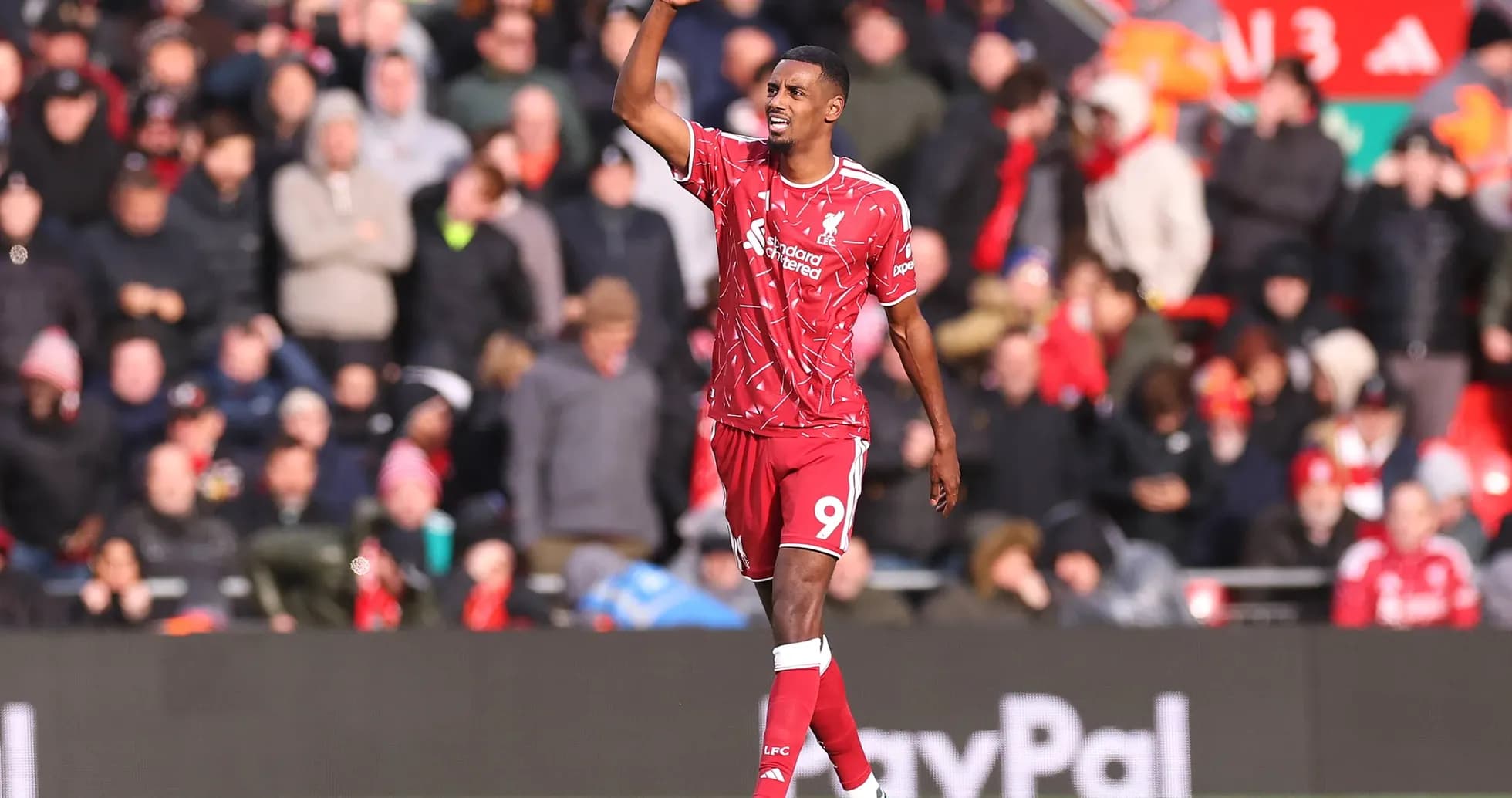
Isak arrived as one of the league’s most efficient finishers: 6 goals overall from 7 appearances, with 17 shots (9 on target) and a rating of 7.54. His movement between the lines and capacity to attack the space either side of Dunk were central to Liverpool’s plan. Against a Brighton back four that likes to squeeze high, Isak’s ability to run the channels and occupy both centre-backs forced Vušković and Dunk into constant recalibration.
At the other end, Brighton’s “hunter” was more collective. Kostoulas, with 3 goals and 2 assists overall and 20 shots (8 on target), offered a chaotic, duel-heavy presence – 95 duels contested, 38 won – ideal for unsettling centre-backs. But here he ran into Van Dijk’s command and the aggression of Araújo and Jacquet, who could step in behind an assertive midfield press.
Engine Room – Groß vs Mac Allister and Gravenberch
The most intricate battle unfolded in midfield. Pascal Groß, one of the league’s premier orchestrators, came in with 3 goals, 4 assists and a remarkable 23 key passes from 473 total passes at 86% accuracy. He is Brighton’s compass: dropping between centre-backs to build, stepping into the half-spaces to feed runners like De Cuyper and Kostoulas.
Liverpool’s counter was a double pivot with complementary profiles. Mac Allister, the metronome, and Gravenberch, the carrier and disruptor, had to both screen and spring. Gravenberch’s defensive numbers – 8 tackles, 7 interceptions and 1 blocked shot overall – underlined his role as the enforcer. His presence, combined with Wirtz’s press from the 10 space, aimed to suffocate Groß’s time on the ball and force Brighton to build through less comfortable channels.
On the flanks, the duel between De Cuyper and Barcola on one side, and Gakpo against Kadıoğlu and Boscagli on the other, shaped territory. De Cuyper, with 2 goals, 2 assists and 19 key passes overall, is effectively an auxiliary playmaker from wide left. But each foray left space behind for Barcola and Araújo to exploit in transition.
IV. Statistical Prognosis and Tactical Verdict
From a season-long statistical lens, Brighton’s attack carried the heavier punch: 2.9 goals per game overall versus Liverpool’s 1.4. Yet Liverpool’s defensive profile, especially away but increasingly as a structural identity, suggested a side comfortable in controlling game states, with 4 clean sheets overall and only 1.0 goal conceded per match.
At Anfield, that balance tilted decisively in Liverpool’s favour. The 2-0 full-time scoreline echoed their biggest home win profile (2-0) and, crucially, bucked their early-season home trend of conceding 1.3 per match. Against one of the league’s most potent forward units, Liverpool’s back four and double pivot reduced Brighton’s patterns to sterile possession, with Alisson rarely exposed.
Brighton’s away fragility – 1.5 goals conceded per game on their travels heading into this fixture – resurfaced. The high line that had powered their attacking avalanche left seams for Isak and Wirtz to attack, while Gakpo’s creativity (3 assists overall before this match) and pressing from the left helped Liverpool trap Brighton’s build-up in uncomfortable zones.
Discipline never boiled over, despite both teams’ histories of second-half volatility, but the psychological residue of previous reds in the 46-60 window seemed to temper some of Brighton’s aggression after the interval – precisely when Liverpool traditionally pick up nearly half of their yellows. Instead of chaos, there was control, and that suited Iraola’s side.
Following this result, the tactical verdict is clear: Liverpool’s 4-2-3-1, even shorn of Szoboszlai and Frimpong, has matured into a structure that can mute elite attacks while still harnessing the cutting edge of a striker like Isak. Brighton remain one of the division’s most thrilling outfits, but their away defensive metrics and reliance on Groß’s orchestration were ruthlessly exposed on a day when Anfield demanded, and received, a statement.