Napoli 2-3 Bologna: Tactical Breakdown of a Fascinating Contest
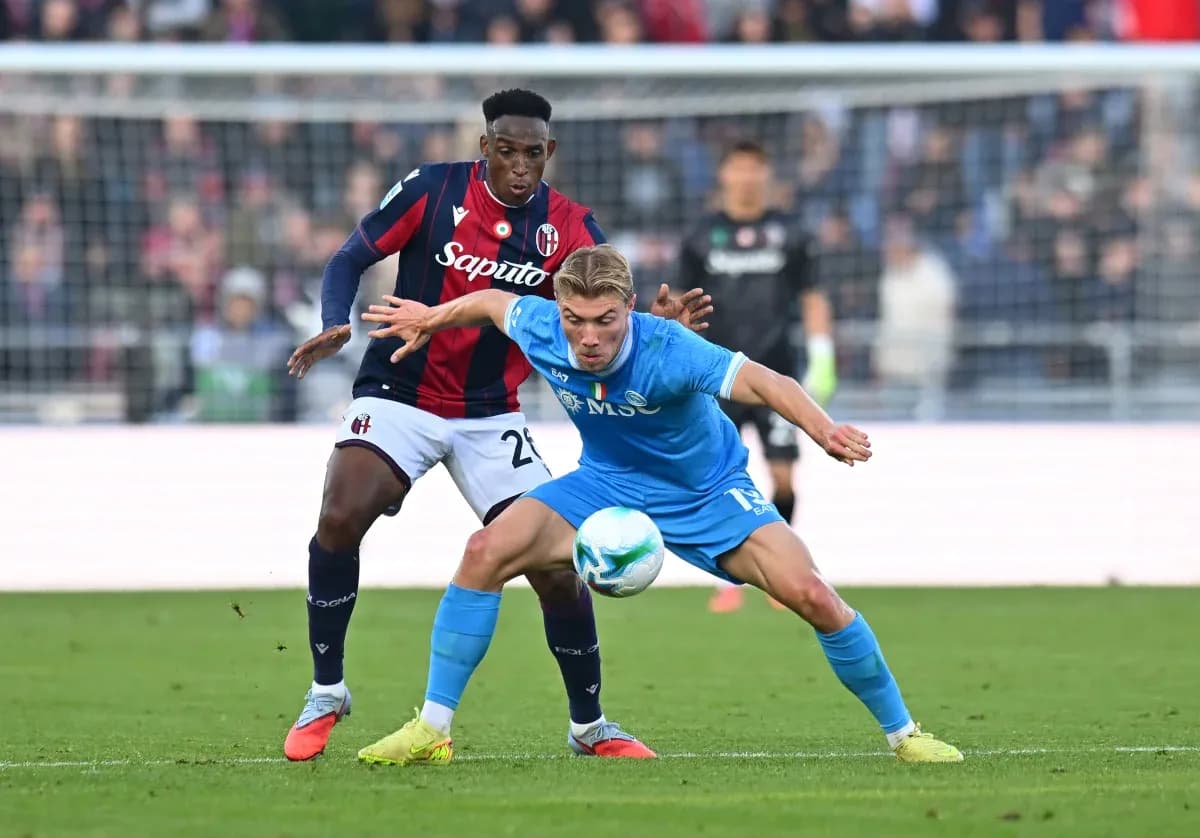
Napoli’s 2-3 defeat to Bologna at Stadio Diego Armando Maradona unfolded as a structurally fascinating contest: Conte’s 3-4-2-1 tried to dominate territory and volume, while Italiano’s 4-3-3 leaned on vertical clarity and superior box management. Despite Napoli edging possession 52% to 48% and outshooting Bologna 14-10, the visitors’ cleaner attacking patterns and sharper execution inside both penalty areas aligned closely with the underlying numbers: 0.75 xG for Napoli against Bologna’s 1.32.
Executive Summary
The match followed the scoreboard almost perfectly: Bologna were more efficient and more dangerous when they did arrive in advanced zones, while Napoli’s possession and passing superiority – 484 passes, 425 accurate (88%) versus Bologna’s 458 passes, 386 accurate (84%) – did not translate into sustained high-quality chances. Both goalkeepers posted negative goals prevented figures, underlining that defensive structures, rather than shot-stopping heroics, decided the game. Bologna’s 3-2 away win was a tactical victory built on compactness, directness, and intelligent game management after the interval.
Scoring Sequence & Disciplinary Log
Goals (all minutes in chronological order):
- 10' Federico Bernardeschi (Bologna) — assisted by Juan Miranda
- 34' Riccardo Orsolini (Bologna) — Penalty (no assist)
- 45' Giovanni Di Lorenzo (Napoli) — (no assist)
- 48' Alisson Santos (Napoli) — assisted by Rasmus Hojlund
- 90' J. Rowe (Bologna) — (no assist)
These five goals match the final 2-3 scoreline (Napoli 2, Bologna 3).
There was one VAR intervention: at 33', a potential penalty for Bologna involving Juan Miranda was checked and “Penalty confirmed”. It directly preceded Orsolini’s conversion at 34', shaping the early two-goal cushion.
Disciplinary log (all cards, in exact order):
- 38' João Mário (Bologna) — Foul
- 47' Federico Bernardeschi (Bologna) — Foul
- 58' Eivind Helland (Bologna) — Foul
- 69' Jhon Lucumí (Bologna) — Foul
- 84' Matteo Politano (Napoli) — Foul
Card totals: Napoli: 1, Bologna: 4, Total: 5. These are the only bookings; no reds were issued.
Tactical Breakdown & Personnel
Conte’s 3-4-2-1 was clearly designed to pin Bologna’s full-backs and overload the half-spaces. V. Milinkovic-Savic started behind a back three of A. Buongiorno, Amir Rrahmani and Giovanni Di Lorenzo, with M. Gutierrez and Matteo Politano as wing-backs and a central pair of S. Lobotka and Scott McTominay. Giovane and Alisson Santos supported Rasmus Hojlund up front.
In possession, Napoli built with three plus Lobotka dropping, forming a 3+1 base against Bologna’s front three. The idea was to progress via diagonal switches to Politano and Gutierrez, then attack the channel between Bologna’s full-backs and centre-backs. The numbers back up the territorial intent: 11 of Napoli’s 14 shots came from inside the box and they forced 7 corners to Bologna’s 1. However, the xG of 0.75 exposes that many of those efforts were either from poor angles or heavily contested.
Bologna’s 4-3-3 under Vincenzo Italiano was compact and vertical. M. Pessina in goal sat behind a back four of Joao Mario, E. Fauske Helland, Jhon Lucumí and Juan Miranda. The midfield trio of T. Pobega, Remo Freuler and Lewis Ferguson screened central lanes, while Riccardo Orsolini, S. Castro and Federico Bernardeschi formed a flexible front line.
Out of possession, Bologna narrowed their midfield three to block Lobotka and McTominay, forcing Napoli to circulate wide where 1v1 duels favoured Italiano’s side. The early 10' goal – Bernardeschi arriving from the left to finish a move assisted by Miranda – showed their plan: win the ball, break quickly into the vacated wing-back space, and flood the box with three forwards. The 34' penalty, confirmed by VAR at 33', again came from direct attacking into Napoli’s defensive line, with Orsolini punishing the hosts from the spot.
Napoli’s response was structural rather than chaotic. Di Lorenzo’s 45' goal reflected the benefit of having a defender step into advanced zones; Bologna’s back line was pinned by Hojlund and the two support forwards, allowing the right-sided centre-back to exploit space. Immediately after the break, at 48', Alisson Santos’ equaliser, assisted by Hojlund, showcased the intended synergy of the front three: Hojlund’s movement across the line disorganised Lucumí and Helland, freeing Alisson Santos to attack the box.
Yet, with the score at 2-2, Bologna adjusted more effectively. Italiano’s substitutions were clearly targeted:
- 64' N. Zortea (IN) came on for Joao Mario (OUT)
- 73' J. Rowe (IN) came on for F. Bernardeschi (OUT)
- 81' N. Moro (IN) came on for T. Pobega (OUT)
- 81' S. Sohm (IN) came on for L. Ferguson (OUT)
- 82' T. Heggem (IN) came on for E. Fauske Helland (OUT)
These moves injected fresh legs on the flanks and in midfield, keeping Bologna’s block aggressive in pressing wide areas and maintaining depth in transition. Rowe, in particular, became the decisive outlet, eventually scoring the 90' winner after Napoli had committed numbers forward.
Conte’s changes aimed at adding creativity and width:
- 76' E. Elmas (IN) came on for Giovane (OUT)
- 76' B. Gilmour (IN) came on for S. Lobotka (OUT)
- 85' L. Spinazzola (IN) came on for M. Politano (OUT)
- 87' P. Mazzocchi (IN) came on for M. Gutierrez (OUT)
Elmas and Gilmour were intended to increase line-breaking passes and late box arrivals, while Spinazzola and Mazzocchi refreshed the flanks. But Bologna’s compact 4-5-1 off the ball, after the substitutions, reduced central access and forced Napoli into more hopeful deliveries rather than crafted chances.
Goalkeeper reality is instructive. Milinkovic-Savic made only 1 save and posted -0.82 goals prevented, indicating that Bologna’s three goals came from chances he might statistically be expected to do slightly better with, but more importantly that Napoli’s defensive screen allowed high-quality looks. On the other side, Pessina made 3 saves but also recorded -0.82 goals prevented, meaning Napoli’s two goals were well taken and the few clear chances they generated were difficult to stop. Neither keeper was the protagonist; the defensive structures in front of them defined the outcome.
The Statistical Verdict
The statistical profile reinforces the tactical reading. Napoli’s 52% possession and superior passing volume (484 passes, 425 accurate, 88%) show territorial control, but their xG of 0.75 and only 5 shots on target reveal a lack of incision. Bologna, with slightly less of the ball and fewer total shots (10), generated 1.32 xG and 4 shots on target, underscoring a more efficient, better-constructed attacking plan.
Discipline also tells a story: Bologna’s 12 Fouls and 4 yellow cards – all for “Foul” – reflect an aggressive, often last-ditch defending of wide and central spaces, while Napoli’s 10 Fouls and single booking for Matteo Politano suggest less disruptive defending in key transitions. With both goalkeepers underperforming marginally relative to xG on target, the match boiled down to who created the better chances. Bologna did, and their 3-2 away win is entirely consistent with both the event timeline and the underlying metrics.