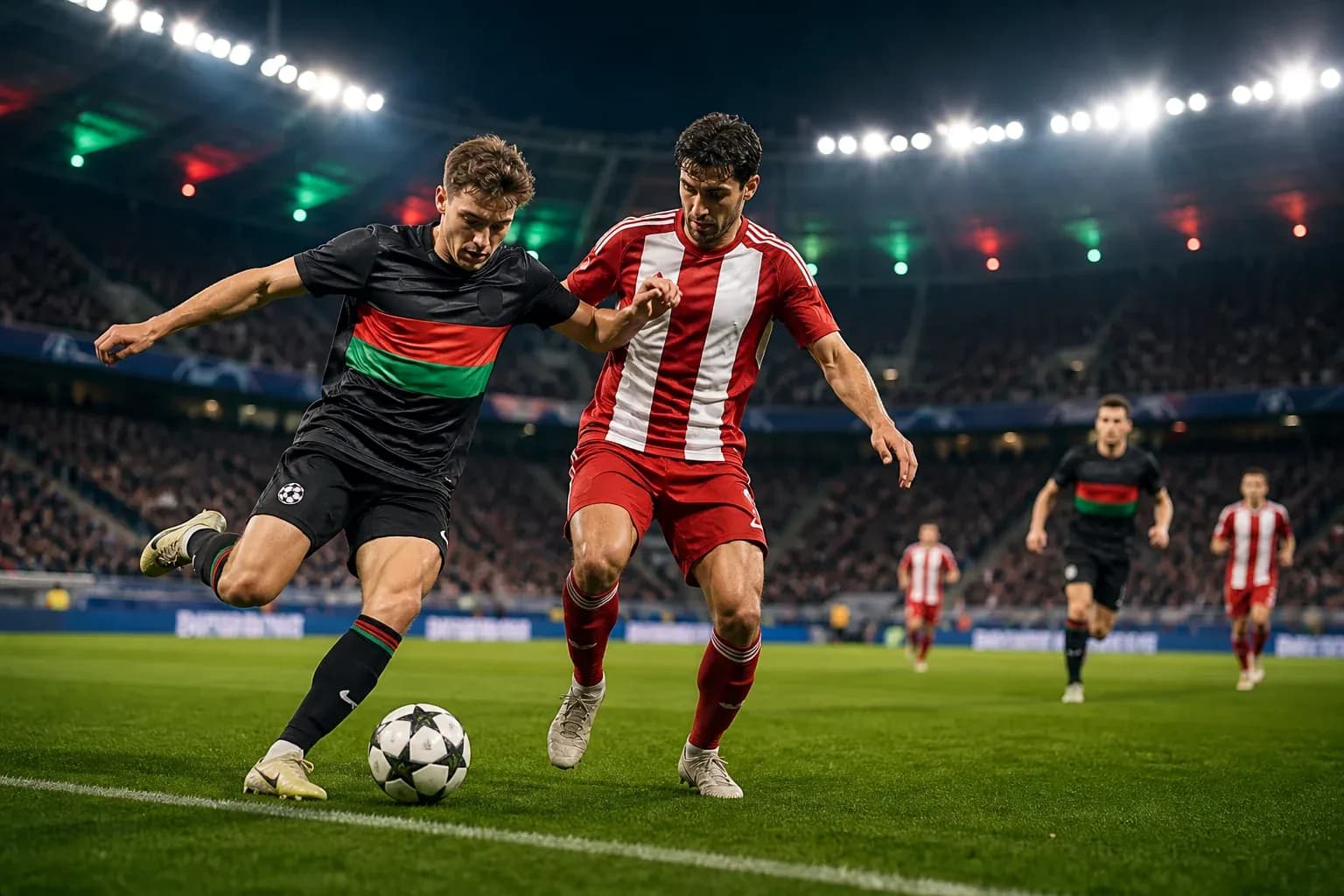
NEC Nijmegen Triumphs 2-1 Against Olympiakos in Extra Time
NEC Nijmegen’s 2-1 extra‑time win over Olympiakos Piraeus at Stadion de Goffert was built on structural clarity and superior control of territory and tempo. Over 120 minutes in this UEFA Champions League 3rd Qualifying Round tie, Dick Schreuder’s 3-1-4-2 gradually imposed itself on Luis Mendilibar Jose’s 4-2-3-1. The hosts combined a high passing volume with sustained pressure between the lines, turning a 0-1 deficit into a 2-1 victory after extra time. Olympiakos’ early second-half breakthrough and later red card forced them into a reactive, low-block posture, and although they briefly threatened in transition, they were ultimately out-shot, out-passed and out-possessed as NEC’s structure and bench changes tilted the tie.
NEC’s Tactical Dominance
NEC’s 3-1-4-2 was ball-dominant from the outset. With 54% possession and 603 total passes (457 accurate, 76%), they built patiently from the back three of T. Storm, P. Sandler and D. Fonville, using D. Nejasmic as the single pivot to connect into a four-man midfield band. The shape created natural overloads in central zones against Olympiakos’ double pivot of D. Garcia and S. Hezze. N. Lebreton and D. Tadic operated as advanced interiors, while S. Ouaissa and C. Bischoff (before his substitution) offered width and underlaps. This allowed NEC to progress into the final third with regularity, reflected in 16 total shots, 11 from inside the box and 7 on target.
Olympiakos’ Struggles
In contrast, Olympiakos’ 4-2-3-1 was designed for verticality and transitions rather than long spells of possession. They finished with 46% of the ball and 505 passes (350 accurate, 69%), a clear indication that NEC forced them into longer, lower-percentage phases. The back four of Rodinei, P. Retsos, L. Pirola and B. Onyemaechi were often pinned deep by NEC’s two forwards, T. Chery and B. Linssen, and the wide midfielders G. Martins and Jota Silva (later replaced by K. Fortounis) were pushed back into auxiliary full-back roles for long stretches. Their attacking plan revolved around quick releases into A. El Kaabi and the half-spaces for G. Sa and G. Martins, which yielded 10 total shots (6 inside the box, 2 on target) but limited sustained pressure.
Tactical Changes and Key Moments
The match’s tactical hinge points came via substitutions and discipline. At 15', Jota Silva (OUT) was replaced by K. Fortounis (IN) for Olympiakos, a move that initially added creativity between the lines. NEC answered at 30' with E. Mor (IN) for S. Ouaissa (OUT), adding direct dribbling from deeper zones. At 34', B. Pereira (IN) replaced P. Sandler (OUT), slightly altering the right side of the back three and giving NEC more thrust on that flank.
Olympiakos struck first at 46', when A. El Kaabi finished a transition move to make it 0-1. Tactically, this allowed them to drop the block and look for counter-attacks, but NEC’s structure held. The hosts continued to funnel play through Tadic and Lebreton, and their pressure told at 70': B. Linssen scored from a D. Tadic assist to level at 1-1. That goal crystallised NEC’s superiority between the lines, with Tadic finding pockets behind the Olympiakos double pivot and Linssen exploiting gaps between centre-back and full-back.
Mendilibar attempted to refresh his midfield at 61' with C. Mouzakitis (IN) for G. Sa (OUT), and at 72' L. Scipioni (IN) for D. Garcia (OUT) plus J. Roca (IN) for G. Martins (OUT). These changes shifted Olympiakos towards a more conservative, workmanlike midfield, sacrificing some ball progression for legs and defensive coverage. However, the turning point came with discipline: after a VAR “Card upgrade” check at 79' on Kostas Fortounis, the midfielder was shown a straight Red Card for “Foul” at 80'. Reduced to ten men, Olympiakos were forced into a compact 4-4-1, with El Kaabi isolated and transitions becoming rarer and more desperate.
NEC’s Bench Impact
NEC’s bench then became decisive. At 88', K. Sierhuis (IN) replaced C. Bischoff (OUT), adding a more penalty-box oriented presence alongside Linssen. Although a potential goal by Kaj Sierhuis was disallowed by VAR at 90+4', his impact was immediate: his movement and physicality created chaos in the Olympiakos box. In extra time, Schreuder rotated his front line again: at 95', E. Mor’s earlier introduction paid off as he scored to put NEC 2-1 up, assisted by K. Sierhuis. Later, at 106', J. Monteiro (IN) for B. Linssen (OUT) and B. Nuytinck (IN) for N. Lebreton (OUT), plus K. Kers (IN) as an additional forward, allowed NEC to lock in a fresh, physically strong structure to protect their lead while still carrying threat in transition.
Defensive Resilience
Defensively, NEC’s back three plus Nejasmic managed Olympiakos’ limited forays well. The hosts committed 17 Fouls, using tactical fouling to disrupt counters, while Olympiakos’ 19 Fouls reflected their increasing struggle to cope with NEC’s rotations. The card profile underlines this: Olympiakos received 4 Yellow Cards and 1 Red Card, NEC 2 Yellow Cards. Chronologically: Dani García (Olympiakos) was booked at 12' for “Foul”, Rodinei at 55' for “Foul”, Gustavo Sá at 59' for “Foul”, Fortounis sent off at 80' for “Foul” after VAR intervention, and Lorenzo Scipioni booked at 111' for “Argument”. For NEC, Brayann Pereira saw Yellow at 88' for “Foul”, while Kaj Sierhuis was cautioned at 90+4' (reason not specified).
Goalkeeper Performances
In goal, G. Crettaz (NEC Nijmegen) faced only 2 shots on target and made 1 save, reflecting how well NEC limited high-quality chances despite conceding once. At the other end, B. Popovic (Olympiakos Piraeus) was far busier, making 5 saves as NEC racked up 7 shots on goal. That disparity underscores the territorial tilt: NEC not only had more of the ball but converted it into significantly more penalty-area activity (11 shots inside the box to Olympiakos’ 6).
Statistical Overview
Statistically, the verdict is clear. NEC out-shot Olympiakos 16-10, generated more efforts on target (7-2), and produced more blocked shots (3-2), indicating sustained pressure against a retreating defence. Their superior passing volume and accuracy, combined with more offsides (4-2), point to a side constantly probing the last line. Olympiakos’ lower pass accuracy and higher foul count reflect a team increasingly on the back foot, especially after the red card. With expected goals and goals prevented not provided, the raw shot and possession profiles still align tightly with the narrative: NEC’s structured, high-possession 3-1-4-2 systematically wore down a 4-2-3-1 that became a reactive, undermanned block, justifying the 2-1 extra-time outcome at Stadion de Goffert.