Osasuna vs Espanyol: A Clash of Uneven Seasons
Under the grey Pamplona sky of a late-season Sunday, Estadio El Sadar staged a game that felt like a verdict on two very different campaigns. Osasuna, 16th in La Liga with 42 points and a goal difference of -5, came into this Round 37 fixture carrying the bruises of a “LLLLW” form line. Espanyol arrived 11th on 45 points, their own -12 goal difference a reminder that progress has been uneven, even if “WWLLD” hinted at a side still capable of sharp bursts.
Following this result – a 2-1 away win for Espanyol – the story of both seasons crystallised neatly into 90 minutes.
Osasuna’s seasonal DNA has been clear: far stronger at home than on their travels. At El Sadar they have won 9 of 19, scoring 31 goals and conceding 24. The averages underline it – 1.6 goals for at home against 1.3 conceded, a fragile but recognisable home edge. Overall, 11 wins from 37 and 44 goals scored against 49 conceded paint a picture of a side living on fine margins, often undone by lapses rather than systemic collapse.
Espanyol’s profile is the mirror image. On their travels they have 5 wins, 5 draws and 9 defeats from 19, scoring 22 and conceding 31. The away averages – 1.2 goals for, 1.6 against – belong to a team that suffers defensively but carries enough threat to nick points. Overall, 12 wins, 9 draws and 16 losses with 42 goals scored and 54 conceded confirm them as an open, high-variance side: vulnerable, but never harmless.
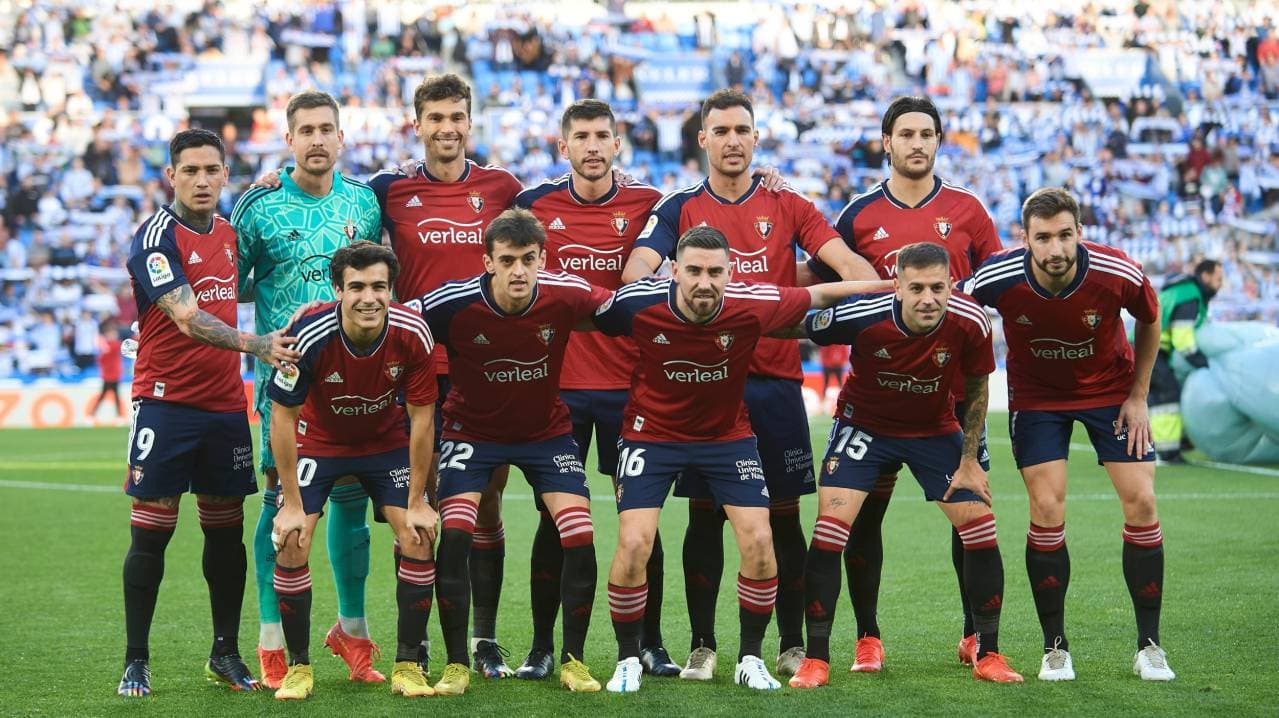
Into that context stepped two coaches leaning into their identities. Alessio Lisci set Osasuna up in a 4-2-3-1, the shape that has been his default – used 22 times this season. Sergio Herrera stood behind a back four of V. Rosier, Alejandro Catena, F. Boyomo and A. Bretones. In front, L. Torro and Jon Moncayola formed the double pivot, with R. Garcia, A. Oroz and V. Munoz supporting lone striker Ante Budimir.
Manolo Gonzalez answered with Espanyol’s 4-4-2, one of the systems he has trusted all year (12 league uses). M. Dmitrovic anchored a defence of O. El Hilali, C. Riedel, L. Cabrera and C. Romero. The midfield line of T. Dolan, U. Gonzalez, Pol Lozano and Pere Milla sat behind the front pair of Edu Expósito and K. Garcia.
Both sides had to negotiate important absences. Osasuna were again without R. Moro, listed as “Missing Fixture” through injury. For a team that has failed to score in 11 league games overall – and in none of their 19 at home – every creative option matters, and his absence narrowed Lisci’s options between the lines.
Espanyol’s attacking depth was hit harder. C. Ngonge and J. Puado, both out with knee injuries, stripped Gonzalez of two profiles that could have stretched a defence already dealing with Budimir’s aerial presence and Moncayola’s late surges. It meant greater responsibility on K. Garcia’s runs and on Pere Milla’s ability to arrive from midfield.
Discipline has been a defining undercurrent to both campaigns, and it coloured the tactical tone here. Osasuna’s season-long card profile shows a clear late-game spike: 21.35% of their yellow cards arrive between 76-90', with another 14.61% between 91-105'. Red cards are similarly concentrated, with 28.57% each in the 31-45', 76-90' and 91-105' windows. This is a side that often finishes games on the edge, sometimes beyond it.
Espanyol are no calmer. A striking 30.00% of their yellows land in the 76-90' range, and their reds cluster between 46-60' (40.00%) and 76-90' (40.00%). In a contest like this, the final quarter-hour was always likely to become a storm of tackles, protests and pauses that could break rhythm or open space.
Within that chaos, certain individual duels defined the narrative.
The “Hunter vs Shield” confrontation was unmistakable: Ante Budimir against Espanyol’s porous away defence. Budimir’s season has been ruthlessly efficient – 17 league goals from 36 appearances, with 88 shots and 41 on target. He has also carried penalty responsibility, scoring 6 but missing 2; Osasuna’s season-long spot-kick record may be a perfect 6 from 6, but Budimir’s personal ledger includes those two misses, a reminder that even their spearhead has lived with fine margins.
Opposite him, Espanyol’s back line has conceded 31 goals away from home. L. Cabrera’s leadership and C. Riedel’s positioning had to withstand a constant aerial and physical barrage, especially with V. Munoz and A. Oroz feeding crosses and cut-backs. The fact that Osasuna managed just one goal on the day will feel like a small victory for Gonzalez’s defensive structure.
In midfield, the “Engine Room” battle pitted Moncayola and L. Torro against Pol Lozano and Edu Expósito. Moncayola’s season – 35 appearances, 4 assists, 1,369 passes with 38 key passes – has been about steady, vertical progression, while also bringing 52 tackles and 6 blocks. Lozano, though, is Espanyol’s metronome and enforcer rolled into one: 945 passes at 87% accuracy, 23 key passes, 38 tackles and 22 interceptions. His 11 yellow cards and one yellow-red underline how close to the disciplinary line he lives, but his presence gives Espanyol control in the central corridor.
Alongside him, Expósito is the creative nerve. With 6 assists and 80 key passes from 965 total passes, he has been one of La Liga’s most productive chance creators this season. His 51 tackles and 22 interceptions show that he is no luxury player; he works, bites and then breaks lines. Against an Osasuna double pivot that can be conservative, his ability to find pockets between Torro and the centre-backs was always going to tilt the game. That he started as one of the two forwards in the 4-4-2 only accentuated his threat between lines.
Behind them, the defensive “blocks” that define individual defenders came into focus. Catena, who has blocked 32 shots this season, again had to stand in the line of fire. His 1,673 passes at 85% accuracy and 33 interceptions mark him as Osasuna’s organiser from the back, but his 11 yellow cards and one red underline how often he is forced into emergency defending. Against the movement of K. Garcia and the late arrivals of Pere Milla – 7 league goals, 47 shots, 20 on target – Catena’s timing was always going to be tested.
On the flanks, O. El Hilali’s duel with V. Munoz and A. Bretones was another hinge. El Hilali has made 72 tackles, blocked 15 shots and intercepted 40 passes this season, an aggressive full-back who pushes high but must then recover quickly. His 9 yellow cards speak to the risk in that style. Every time Osasuna broke Espanyol’s first press, the space behind him became a potential runway for counter-attacks.
Statistically, the prognosis for this kind of game was always tight. Heading into this game, Osasuna’s overall scoring average of 1.2 goals per match against 1.3 conceded suggested a team living in one-goal margins. Espanyol’s 1.1 goals scored overall and 1.5 conceded pointed to a similar profile, but with more defensive volatility. Both teams have respectable clean-sheet numbers – Osasuna with 7 overall, Espanyol with 10 – yet neither has the defensive solidity to lock games down early.
In Expected Goals terms, the underlying patterns would likely have leaned towards a narrow contest: Osasuna’s strong home output versus Espanyol’s lively but leaky away record. The 2-1 scoreline fits that script. Espanyol’s sharper edge in the Engine Room, through Lozano and Expósito, and their ability to turn half-chances into full ones through Pere Milla and K. Garcia, ultimately outweighed Osasuna’s reliance on Budimir and set-piece moments.
Following this result, Osasuna’s season feels like a warning: a team with a reliable home punch but too little margin for error, too often dragged into late, card-heavy chaos. Espanyol, meanwhile, leave Pamplona with a win that encapsulates their campaign – imperfect, occasionally wild, but driven by a midfield that can out-think and out-play opponents when the game opens up.