Norway Upsets Brazil in World Cup 1/8 Final
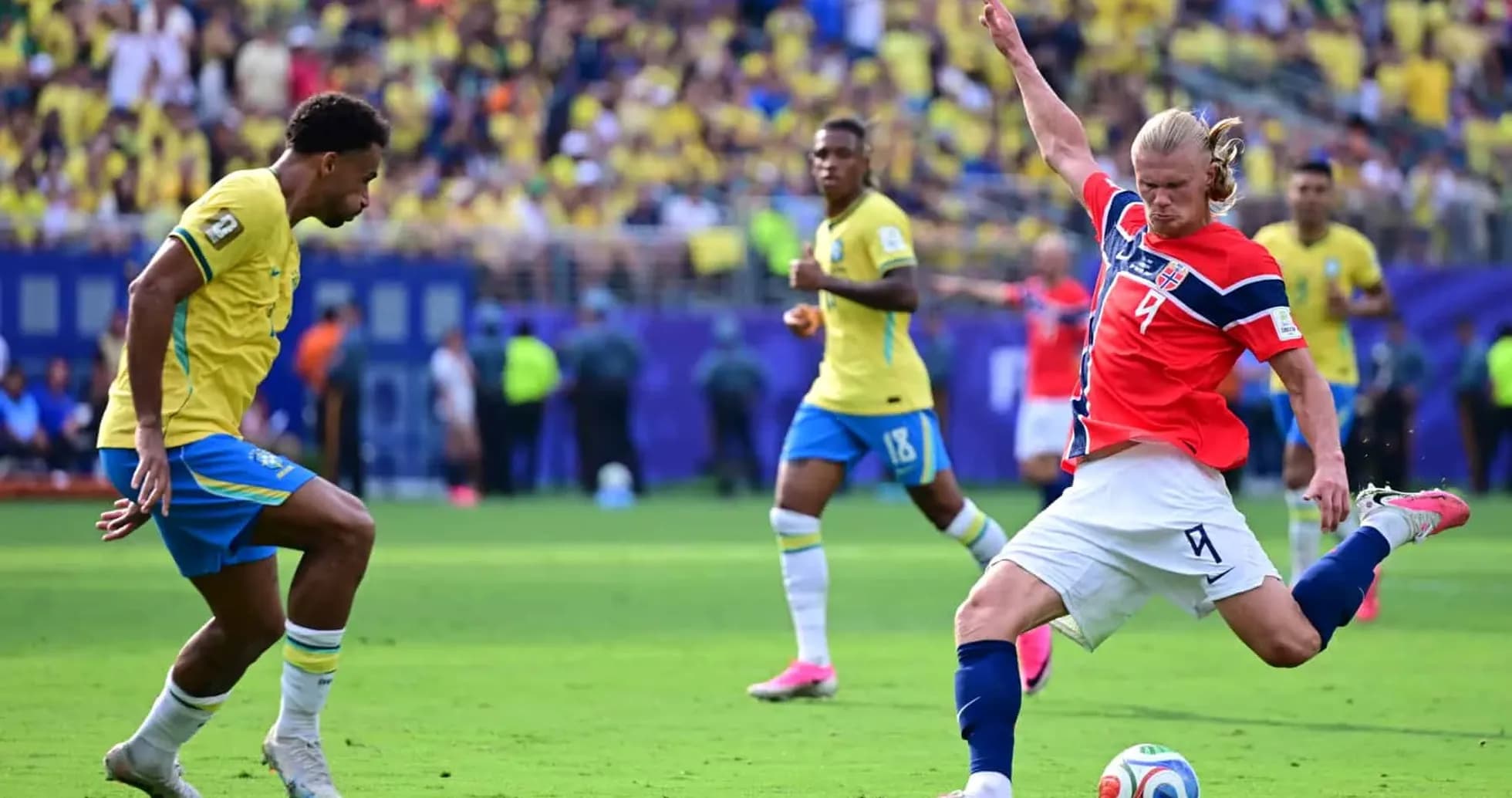
MetLife Stadium in East Rutherford staged a World Cup 1/8 final that felt like a narrative pivot for both nations. Brazil, group winners from Group C and serial tournament heavyweights, walked in with seven points and a goal difference of 6 from three group matches, their all‑round record built on 7 goals for and only 1 against. Norway, second in Group I with six points and a goal difference of 1 (8 scored, 7 conceded), arrived as the dangerous outsider. Over 90 minutes, the 2–1 Norwegian win flipped the script: the underdog’s high‑octane front line out‑punched a Brazil side whose structural choices and absences left them a step behind.
I. The Big Picture – Styles Collide in the Knockout Cauldron
Heading into this game, Brazil’s tournament profile was that of a controlled aggressor. Across all venues they had played 5 matches, winning 3, drawing 1 and losing 1. Their attack had been steady rather than explosive: 10 goals in total, with 7 at home and 3 on their travels, for a total scoring average of 2.0 goals per match. Defensively, they had been parsimonious, conceding only 4 overall (4 at home, 0 away), an overall average of 0.8 per match.
Norway’s arc was more volatile and more dangerous. Across their 5 matches, they had 4 wins and 1 defeat, with no draws. They had scored 12 in total (4 at home, 8 away), an overall average of 2.4 goals per game, but conceded 9 (6 at home, 3 away), an overall average of 1.8. The numbers painted a clear contrast: Brazil, the balanced operator; Norway, the front‑foot brawler willing to trade blows.
The lineups sharpened those identities. Carlo Ancelotti set Brazil in a 4‑4‑2, a notable shift from the 4‑3‑3 that had been his most used shape (3 previous starts) and the occasional 4‑2‑3‑1. Stale Solbakken stayed loyal to Norway’s 4‑3‑3, the system that had underpinned 4 of their 5 matches.
II. Tactical Voids – Brazil’s Missing Links and Discipline Edges
Brazil’s squad sheet contained two absences that mattered structurally as much as emotionally. Raphinha was ruled out with a hamstring muscle injury, removing a natural right‑sided outlet who could stretch the pitch and threaten diagonally. Lucas Paquetá, also sidelined by a hamstring injury, stripped Ancelotti of his most natural hybrid between an 8 and a 10, the midfielder who links Casemiro’s security with the front line’s improvisation.
Without Paquetá, the central band became more functional: Casemiro anchored, Bruno Guimarães orchestrated, and Rayan added energy from the right of midfield. G. Martinelli, listed as a midfielder but operating high on the left, was asked to provide width and penetration that Paquetá might otherwise have supported between the lines.
Disciplinary trends also framed the risk profile. Brazil’s campaign had been combative: their yellow cards were spread, but with clear spikes. They picked up 25.00% of their yellows between 31–45 minutes and another 25.00% between 61–75, with additional pockets in the opening quarter‑hour and late on. Casemiro, with 2 yellows in 5 matches, and Danilo, also on 2, embodied that edge. Crucially, Brazil had not seen a red card in this tournament despite that aggression.
Norway, by contrast, had a surprisingly tidy card record for such an attacking side: only two yellow‑card windows of note, 50.00% of their yellows in the first 15 minutes and 50.00% between 46–60. Their defenders and midfielders had walked the line without tipping into reds, allowing Solbakken to keep his core intact.
One more detail: Brazil’s penalty record hinted at occasional wastefulness under pressure. They had earned 2 spot kicks, scoring 1 and missing 1, a split that could haunt in knockout margins. Norway’s lone penalty had been missed, a 0% conversion that underlined how little they could rely on set‑piece charity; their route out of trouble had to be from open play.
III. Key Matchups – Hunter vs Shield, Engine Room vs Enforcer
The headline duel was always going to be Erling Haaland against Brazil’s defensive shield. Haaland entered this tie as the tournament’s most ruthless finisher: 7 goals in 4 appearances, all from open play, from 15 shots with 12 on target. His 8.3 average rating, 37 total duels with 18 won, and the fact he had played every minute of his 4 starts made him not just a scorer but a constant physical reference point.
Opposite him stood a Brazilian back four of Danilo, Marquinhos, Gabriel and Douglas Santos, with Casemiro screening. Brazil’s defensive record – only 4 goals conceded overall across 5 games – suggested a unit adept at limiting clear‑cut chances. Casemiro’s 14 tackles, 4 successful blocks and 6 interceptions underlined his role as the plug in front of the centre‑backs, while Marquinhos and Gabriel were tasked with managing Haaland’s movement between and beyond them.
Yet Norway’s front three structure made this more than a single duel. Alexander Sørloth’s presence as a second striker in the right half‑space and Antonio Nusa’s width on the opposite flank created three separate vertical lanes of threat. That stretched Brazil’s 4‑4‑2 horizontally, asking Martinelli and Rayan to track deep, which in turn could isolate Matheus Cunha and Vinicius Junior upfield.
On the other side, Brazil’s “hunter” was more collective. Vinicius Junior arrived with 4 goals and 1 assist in 5 appearances, 14 shots (11 on target), and a dribbling volume of 36 attempts with 16 successful. He was the chaos agent tasked with destabilising Norway’s back line, especially J. Ryerson and D. Wolfe in the full‑back zones. Matheus Cunha, with 3 goals from 10 shots and a work rate that included 6 tackles and 3 interceptions, complemented him as a pressing forward.
In the engine room, Bruno Guimarães versus Martin Ødegaard was the cerebral duel. Bruno’s 4 assists, 10 key passes and 191 completed passes at 86% accuracy framed him as Brazil’s metronome. Ødegaard, with 3 assists, 4 key passes and an even higher 90% pass accuracy from 263 passes, was Norway’s conductor, knitting transitions and feeding Haaland and Nusa in advanced pockets. Whoever imposed their rhythm would tilt the match’s tempo.
IV. Statistical Prognosis – Why Norway’s Punch Landed
On paper, Brazil’s more frugal defence and slightly lower scoring average suggested a controlled, possibly xG‑favourable performance, especially in a neutral‑venue knockout where risk is often trimmed. Their overall attacking average of 2.0 goals per match, combined with conceding only 0.8, pointed toward a side that usually wins the territory and chance quality battle.
Norway, however, brought a profile that often breaks xG logic in one‑off ties: a high‑output attack (2.4 goals per match overall) paired with a leaky defence (1.8 conceded). Their inability to keep a clean sheet – 0 in 5 matches – meant they were almost certain to give Brazil chances. But with Haaland’s finishing efficiency and Ødegaard’s supply line, they only needed a handful of good looks to tilt the scoreboard.
The 2–1 full‑time scoreline reflected that trade‑off. Brazil’s structural tweaks – shifting to 4‑4‑2 without Paquetá, leaning on wide creativity from Martinelli and Vinicius – produced pressure but not the multi‑goal cushion their underlying control often brings. Norway, by contrast, leaned into their identity: accepting defensive exposure to create the sort of open‑field, direct attacks where Haaland and his supporting cast are at their most ruthless.
In narrative terms, this 1/8 final became the night when Norway’s high‑risk, high‑reward blueprint outgunned Brazil’s more balanced design. The statistics had warned of that possibility: a team that always scores, never keeps a clean sheet, and carries the tournament’s most prolific striker is perfectly built for knockout chaos. In East Rutherford, that chaos was enough to send Norway through – and to send Brazil home wondering whether a different structure, and different personnel, might have contained the hunter in red.