Wolves vs Tottenham: Tactical Insights from a Relegation Battle
Molineux under grey Midlands skies has rarely felt as heavy as it did for this relegation scrap. Following this result, a 1–0 defeat to Tottenham in Round 34 of the Premier League season, Wolves remain rooted to the bottom in 20th with 17 points and a goal difference of -38, their season-long frailties once again exposed despite a reshaped, energetic XI. Tottenham, 18th with 34 points and a goal difference of -10 heading into this game, arrived with all the pressure of a giant staring at the drop, yet left with exactly the kind of cold, controlled away performance their campaign has lacked.
This was a meeting of two damaged squads, and the absentees told as much of the tactical story as those on the pitch. Wolves were stripped of L. Chiwome and E. Gonzalez through knee injuries, S. Johnstone with a knock, L. Krejci with a neck injury and, crucially, Y. Mosquera suspended for yellow cards. Mosquera’s absence was a structural void: a defender who has appeared 23 times, committed 25 fouls and collected 11 yellow cards, but also blocked 13 shots and won 130 of 226 duels. Without him, Rob Edwards’ decision to lean into a 3-4-2-1 felt like both necessity and gamble, with Toti asked to anchor a back three already under siege all season by an average of 1.9 goals conceded at home.
Tottenham’s casualty list was even longer. B. Davies (ankle), M. Kudus (muscle), D. Kulusevski and W. Odobert (both knee), C. Romero (knee), P. M. Sarr (shoulder), D. Udogie (injury) and G. Vicario (groin) all missed out. That stripped Roberto De Zerbi of his first-choice goalkeeper, his most aggressive centre-back and several of his most direct wide threats. It forced a back four of P. Porro, K. Danso, M. van de Ven and D. Spence in front of A. Kinsky, with the double pivot of R. Bentancur and Y. Bissouma tasked with stabilising a side whose home form has been fragile but whose away record – 6 wins, 5 draws and 6 defeats, with 23 goals for and 23 against – has been just about respectable.
Edwards’ Wolves XI was built for survival-mode aggression. J. Sa sat behind a back three of M. Doherty, S. Bueno and Toti, with a hard-working midfield line of Pedro Lima, Joao Gomes, Andre and H. Bueno. Ahead of them, R. Gomes and M. Mane floated behind lone striker A. Armstrong. On paper, it was a blend of industry and vertical running, an attempt to mask the fact that at home this season Wolves average just 1.0 goal scored and 1.9 conceded, with 7 home matches where they failed to score at all.
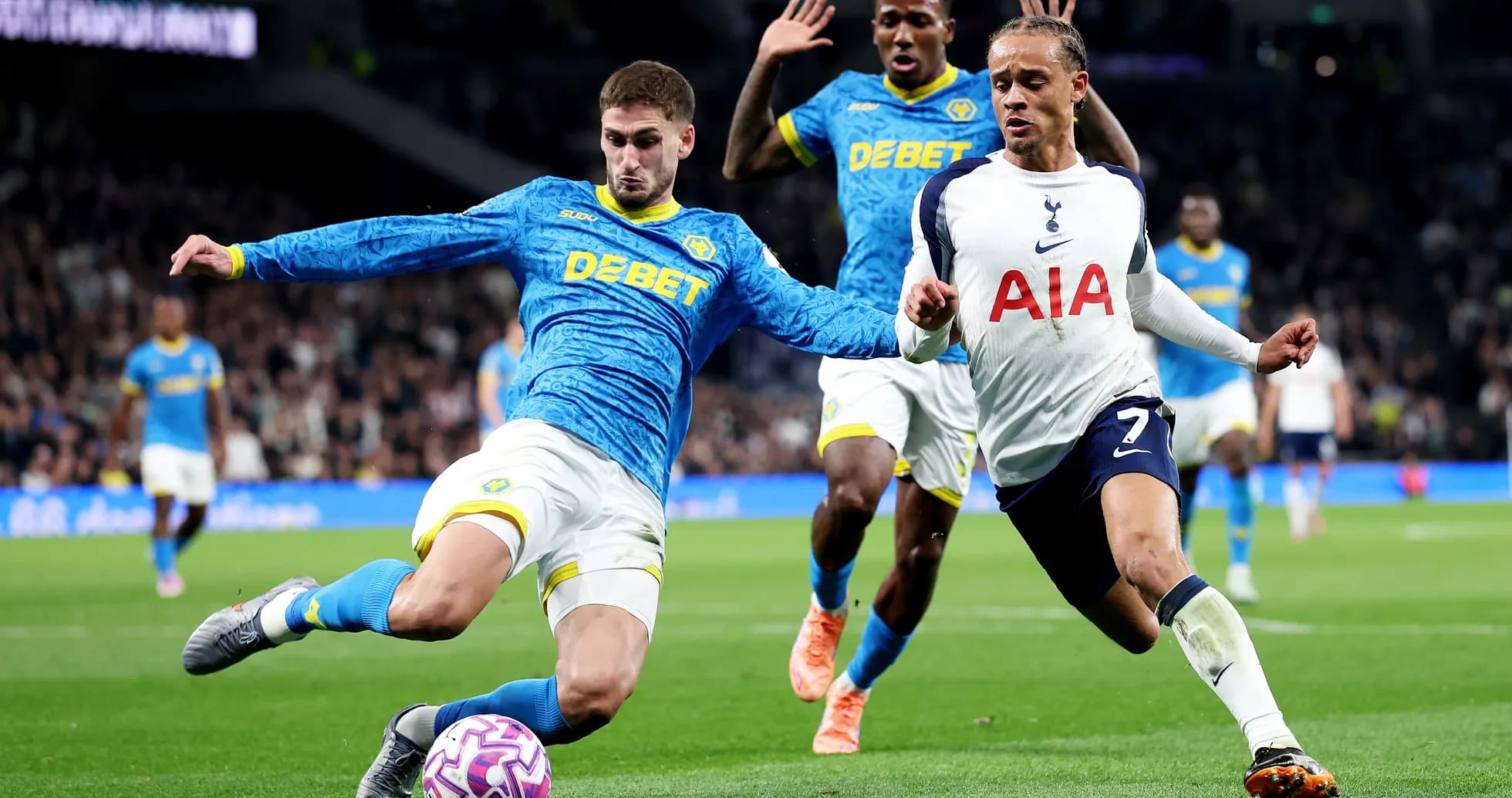
Tottenham’s 4-2-3-1, by contrast, was about restoring their season’s DNA: structured possession and aggressive rotations between the lines. R. Kolo Muani, C. Gallagher and X. Simons operated behind D. Solanke, with Simons – the league’s 17th-ranked player by rating and Spurs’ top assist provider with 5 – the nominal creator-in-chief. His 803 passes at an 82% accuracy and 35 key passes this season underline his role as the side’s primary connector.
The “Hunter vs Shield” matchup tilted towards Tottenham from the outset. Wolves, with only 24 goals in total and an all-venues scoring average of 0.7, simply lack a reliable hunter. Armstrong’s movement into the channels and the support runs of R. Gomes and Mane were honest and energetic, but this is a team that has failed to score in 18 league matches and leans heavily on rare set-piece moments or penalties – and even those are limited, with just 2 penalties total this campaign, both scored.
Tottenham, by contrast, carry multiple threats even when understrength. Richarlison, their leading scorer with 9 league goals and 4 assists, began on the bench but loomed over the contest as the late-game weapon. His 38 shots (22 on target) and 17 key passes mark him as the purest “hunter” in this squad, and his eventual introduction tilted the game’s psychology even if he did not dominate the ball.
The “Engine Room” battle in midfield was fierce and defined the tempo. For Wolves, Joao Gomes and Andre tried to drag the game into a scrap. Joao Gomes arrives with 97 tackles, 33 interceptions and 63 fouls committed this season; Andre adds 75 tackles, 10 blocks and 26 interceptions, with a 90% pass accuracy that hints at more composure than their league position suggests. Together they tried to compress the central spaces where Simons and Gallagher thrive.
Opposite them, Bentancur and Bissouma were the enforcers of control rather than chaos. Their remit was clear: absorb Wolves’ surges, recycle possession, and keep Simons high enough to receive in pockets. Spurs’ season-long card profile – with yellow peaks at 61–75 minutes (25.29%) and a notable early spike between 16–30 minutes (11.49%) – reflects a side that often has to foul to reset their shape, and this match followed that pattern: calculated interventions, then quick resets into their 4-2-3-1 shell.
Defensively, the absence of Romero placed extra responsibility on M. van de Ven. The Dutchman has blocked 21 shots this season and, even as a high-line defender, has the recovery pace to bail Spurs out when their press is broken. Alongside Danso, he formed a back line that was content to let Wolves have sterile possession wide, trusting that a Wolves side averaging only 1.0 home goal and often failing to generate clear chances would not consistently break them down.
Wolves’ own discipline issues lurked beneath the surface. Their yellow-card distribution is most intense between 46–60 minutes (28.00%) and then 61–75 and 76–90 (both 20.00%), pointing to a team that tires and fouls as matches stretch. Without Mosquera’s controlled aggression, the back three had to walk a tightrope: step out and risk being rolled by Simons or Kolo Muani, or drop off and invite pressure on Sa’s box.
In the end, the narrative followed the numbers. Tottenham, a team that on their travels averages 1.4 goals for and 1.4 against, produced the kind of narrow-margin away win that their underlying profile suggests is always available when they defend cleanly. Wolves, who have kept only 3 home clean sheets and conceded 32 at Molineux, once again found themselves on the wrong side of a one-goal margin.
From an xG and defensive-solidity perspective, the prognosis this season remains stark. Wolves’ chronic inability to create high-quality chances, combined with a leaky defence and late-game disciplinary spikes, keeps them pinned in the relegation zone. Tottenham, even with a patched-up spine, still possess the more coherent attacking structure and the higher ceiling in both chance creation and game management.
Following this result, the tactical lesson is brutally simple: structure and a defined attacking hierarchy – embodied by Simons between the lines and Richarlison as the penalty-box reference – will usually edge out honest endeavour without a finisher. At Molineux, that difference was the thin line between another point of hope and another step towards the Championship.