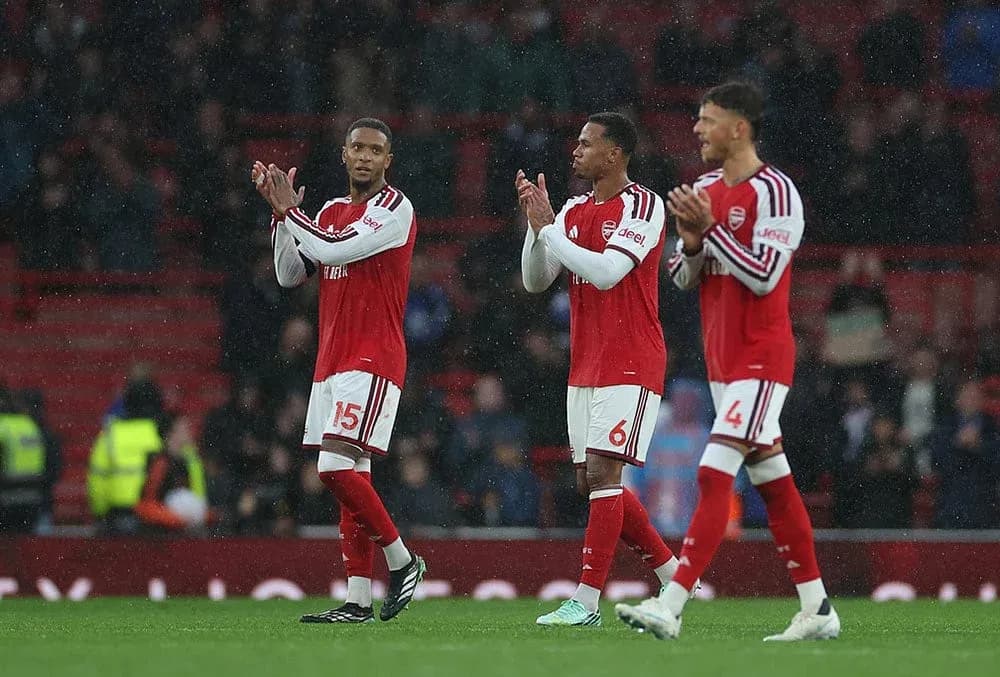
Arsenal's Tactical Mastery Over Everton in 2-0 Victory
Under the grey October sky at Emirates Stadium, this felt less like a routine league outing and more like a stress test of Arsenal’s evolving identity. By full time, a 2–0 win over Everton had underlined why Mikel Arteta’s side sit 2nd in the Premier League after 8 matches, with 21 points and a goal difference of 8, while Everton’s 11th place and goal difference of -1 told a quieter, more tentative story.
I. The Big Picture – Arsenal’s control vs Everton’s resistance
Both teams lined up in a mirrored 4-2-3-1, but the symmetry ended on the tactical board. Arsenal arrived with one of the division’s most balanced profiles: overall they had scored 13 goals and conceded 5 in 8 league games, averaging 1.6 goals for and 0.6 against per match. At home, they had been even more ruthless, winning all 4 games, scoring 9 and conceding just 2, an average of 2.3 goals for and 0.5 against.
Everton, by contrast, came to London as a side that survives on margins. Overall, they had 8 goals for and 9 against in 8 matches, averaging 1.0 scored and 1.1 conceded. On their travels, they had drawn 3 of 4 and lost 1, scoring 3 and conceding 5, with a modest 0.8 goals for and 1.3 against away from home. Their season had been defined by stubbornness rather than incision.
The match itself unfolded along those statistical fault lines. Arsenal’s season-long attacking surge between 46–60 minutes (35.71% of their league goals before this game) and 61–75 minutes (21.43%) again framed the contest: this is a side that emerges from the dressing room after half-time with a clear plan and the tools to execute it. Everton, whose defensive wobble is most pronounced from 46–60 minutes (33.33% of their goals conceded) and then 61–90 (a combined 44.44%), were always going to be under siege once the interval passed.
II. Tactical Voids – Life without Saka and Saliba
What made Arsenal’s control more impressive was who they did not have. Bukayo Saka, one of the league’s most efficient wide threats with 3 goals, 1 scored penalty and a 7.38 average rating, was ruled out with a thigh injury. William Saliba, the usual defensive metronome, missed out with a back injury, while Christos Tzolis was also absent.
Arteta’s response was revealing. In defence, E. Konsa stepped in alongside Gabriel Magalhães, with M. Lewis-Skelly at left-back and B. White on the right. The back four in front of David Raya was not his first-choice unit, yet Arsenal’s season-long defensive profile suggested they could absorb this: only 5 goals conceded overall, and 5 clean sheets, with no late collapses (they had not conceded a league goal after the 60th minute heading into this game).
Everton were closer to full strength, but their issues are more structural than medical. D. Moyes trusted J. Pickford behind a back four of M. Röhl, J. Tarkowski, J. O'Brien and V. Mykolenko, with H. Armstrong and J. Garner as the double pivot. The disciplinary profile of that midfield pair was always going to matter: Garner had already collected 3 yellow cards in the league, and Armstrong likewise 3, emblematic of a side that often defends reactively rather than proactively.
Over 90 minutes, Arsenal’s discipline and Everton’s reliance on last-ditch work both surfaced. Arsenal’s yellow-card spread this season is heaviest in the 46–60 window (27.27%) and then spikes dramatically in stoppage time (36.36%), reflecting a team that pushes the game to the edge late on. Everton’s yellows are more evenly scattered but peak at 76–90 minutes (25.00%), often when they are chasing or hanging on. This match followed that emotional pattern: Arsenal controlling territory, Everton absorbing, clipping, and scrambling.
III. Key Matchups – Hunter vs Shield, Engine Room battles
The “Hunter vs Shield” narrative centred on T. Barry and the makeshift Arsenal defence. Barry had arrived at Emirates Stadium as Everton’s leading scorer with 3 goals from 8 appearances, taking 20 shots with 12 on target and winning 56 of 118 duels. At 195 cm, he is a classic focal point, but against Konsa and Gabriel he found the airspace crowded and the channels smothered. Arsenal’s defensive line, even without Saliba, behaved like a unit that had conceded only 5 league goals all season.
In midfield, the “Engine Room” duel defined the match’s rhythm. Declan Rice, one of the league’s leading creators with 4 assists, 574 completed passes at 91% accuracy and 15 key passes, anchored Arsenal’s double pivot. Alongside him, Mikel Merino provided the connective tissue, allowing M. Ødegaard to float between lines as the advanced playmaker.
Opposite them, Garner and Armstrong brought industry and edge. Garner’s 18 tackles and 4 interceptions this season, plus 1 blocked shot, show his value as a breaker of play, but his 8 fouls committed and 3 yellow cards hint at the cost. Armstrong’s 15 tackles, 4 blocks and 6 interceptions painted him as Everton’s young enforcer, yet both were often a step late against Arsenal’s circulation.
Rice dictated tempo, switching play into the half-spaces where N. Madueke and E. Eze could isolate full-backs. With Saka absent, Madueke’s ability to receive wide and drive inside was crucial, while Eze’s drifting into central pockets drew Everton’s midfield out of shape, opening lanes for V. Gyökeres to attack. White’s presence high on the right, already responsible for 3 league assists this season, added an overlapping threat that pinned Mykolenko back and limited Everton’s counter-attacking routes.
IV. Statistical Prognosis – Why 2–0 felt inevitable
When you overlay the seasonal data on the ninety minutes we saw, the 2–0 scoreline feels less like a snapshot and more like a confirmation. Arsenal’s attacking timings – a strong early presence (28.58% of goals between 0–30 minutes) and a ferocious burst after half-time (57.14% between 46–75 minutes) – matched almost perfectly with Everton’s vulnerability from 46–90, where they had conceded 7 of 9 league goals.
Defensively, Arsenal’s habit of conceding early (60% of their goals against arriving before half-time) but locking things down after the break again shaped the narrative: once ahead, this side rarely lets teams back in. Everton, who had failed to score in 3 of 8 league games and averaged only 0.8 goals on their travels, never looked likely to overturn the tide once Arsenal established control.
From an xG and defensive solidity perspective, this is the profile of a contender handling its business. Arsenal create enough volume and quality, especially in those explosive post-interval phases, to justify a multi-goal margin most weeks, while their structure without the ball – even with key absences – reflects a team that has already kept 5 clean sheets this campaign.
For Everton, the lesson is harsher but clear. Their away resilience, built on three draws and one narrow defeat, can keep games alive, but without sharper edge in the final third and more controlled aggression from the double pivot, matches like this will continue to tilt from “stubborn” to “inevitable.” At Emirates Stadium, the numbers and the narrative aligned: a top-two side, at home, playing to type – and an opponent whose margins finally ran out.