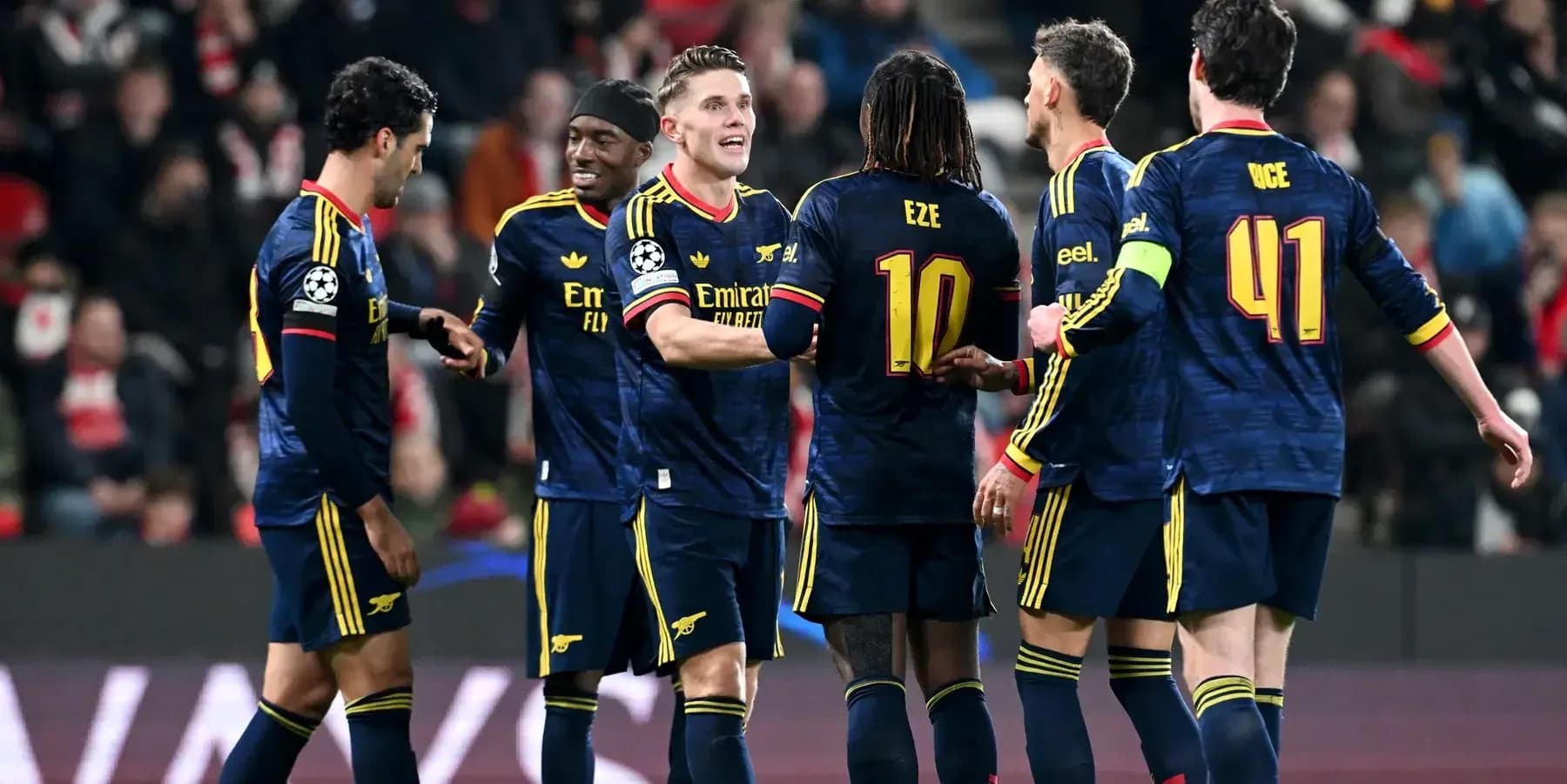
Arsenal Defeats Slavia Praha 2–1 in Champions League Clash
Under the lights of Sinobo Stadium, this was the archetypal Champions League clash of worlds: Slavia Praha, 34th in the league stage standings with 1 point from 4 matches, against an Arsenal side cruising in 3rd with 10 points and an unbeaten record. By full time, the scoreboard read 1–2, a result that matched the broader seasonal storylines as much as the 90 minutes themselves.
Slavia came into the night with a fragile European profile. Overall this campaign they had played 4 matches, with 0 wins, 1 draw and 3 defeats, scoring 5 and conceding 9 for a goal difference of -4. At home they had lost both fixtures, scoring 3 and conceding 5. The numbers painted a team that can hurt opponents going forward – 1.5 goals at home on average – but pays a heavy defensive price, with 2.5 goals conceded at home and 2.3 overall. Arsenal, by contrast, arrived as a fully formed Champions League machine: 4 matches, 3 wins and 1 draw, 8 goals scored and only 3 conceded for a goal difference of +5. On their travels they had 2 wins and 1 draw, 5 goals scored and 3 conceded, a blend of control and cutting edge that would be visible from the opening whistle.
Both coaches mirrored each other on the tactical board. Jindrich Trpisovsky set Slavia in a 4-2-3-1, a departure from the three-at-the-back shape he has also used this campaign, while Mikel Arteta continued to lean into Arsenal’s now-familiar 4-2-3-1. The symmetry in systems, though, concealed very different interpretations.
For Slavia, the back four of O. Kubiak, D. Zima, T. Holes and T. Vlcek in front of N. Domchak was less about building from deep and more about survival and compactness. With key defensive figure I. Ogbu ruled out by an Achilles tendon injury and A. Ouanda also missing through injury, Trpisovsky had to trust Zima and Holes to anchor the line. The double pivot of D. Moses and M. Sadilek was designed as a shield first, platform second – a necessity for a side that has yet to keep a clean sheet in this European campaign and has conceded 4 goals on their travels and 5 at home.
Ahead of them, the trio of E. Ayaosi, M. Suleiman and D. Sturm supported lone forward W. Nowak. The idea was clear: absorb, then spring. Slavia’s season numbers support that identity; they have failed to score in only 1 of their 4 matches overall, and at home they have always found the net. But the price of that ambition has often been indiscipline and late fatigue. Their yellow cards this season are spread evenly, with 25.00% of bookings coming in each of the 16–30, 46–60, 61–75 and 76–90 minute windows, suggesting a side that is constantly firefighting rather than controlling tempo. They have also seen a red card in the 46–60 minute range, a reminder that emotional management is as much a battle as the tactical one.
Arsenal, even without B. Saka – missing with a thigh injury – arrived with an embarrassment of control and creativity. D. Raya in goal sat behind a back four of B. White, E. Konsa, Gabriel and P. Hincapie, a line built for both aggression and rest defence. In front, the double pivot of M. Zubimendi and D. Rice is the heart of Arsenal’s territorial dominance. Zubimendi’s metronomic passing and Rice’s range and duels give Arteta the freedom to push the band of three – N. Madueke, M. Merino and E. Eze – high and narrow, rotating around V. Gyokeres as the spearhead.
This is where the “Hunter vs Shield” dynamic tilted decisively. Arsenal’s attack, scoring 2.0 goals per match overall and 1.7 on their travels, faced a Slavia defence conceding 2.5 at home and 2.0 away. The pattern of the match – Arsenal racing into a 0–2 half-time lead – was the statistical script made flesh. Slavia’s back line, already weakened by absences, struggled to contain the constant half-space runs of Eze and Madueke, while Gyokeres pinned centre-backs and opened lanes for Merino to arrive late.
In the “Engine Room” battle, Zubimendi and Rice had the edge over Moses and Sadilek. Arsenal’s midfield pairing could both receive under pressure and break lines, whereas Slavia’s double pivot was often forced into hurried clearances. With Arsenal yet to fail to score in any Champions League match this season and boasting 2 clean sheets overall, the onus was always on Slavia to produce something close to perfect in both boxes.
Discipline added another layer. Arsenal’s yellow cards in this Champions League run are evenly spread through most phases – 14.29% in each 0–15, 16–30, 31–45, 46–60 and 61–75 – with a late spike of 28.57% between 91–105 minutes, hinting at a side that occasionally frays only when closing out intense contests. Crucially, they have no reds in Europe this season, a contrast to Slavia’s single dismissal and a factor that helps explain Arsenal’s ability to manage leads like the 0–2 advantage they took into the break in Prague.
By the time Slavia found a way back to 1–2 in the second half, the structural gap between the teams was already imprinted on the night. Arsenal’s defensive record – 0.8 goals conceded on average overall, 1.0 on their travels – underpinned a controlled retreat, with Konsa and Gabriel attacking crosses and Zubimendi and Rice dropping closer to form a temporary back six when required. Slavia’s late push was brave, consistent with a side that has scored in every home outing, but the earlier damage was irreversible.
Following this result, the trajectories feel locked in. Slavia remain a side whose courage with the ball is undermined by defensive fragility and disciplinary risk. Arsenal, even when rotated and without Saka, look like a team built for the latter stages: a balanced 4-2-3-1, a midfield that dictates, and an attack that punishes exactly the kind of defensive numbers Slavia carry into Europe. In tactical and statistical terms alike, 1–2 in Prague felt less like an upset or a near-miss, and more like the Champions League hierarchy asserting itself.