Canada vs Bosnia & Herzegovina: Tactical Analysis of 1-1 Draw
Canada’s 1-1 draw with Bosnia & Herzegovina at BMO Field unfolded as a classic contrast of approaches: Canada’s territorial, wing-driven 4-4-2 against a compact, physically assertive Bosnian 4-4-2 built to absorb and counter. Across 90 minutes, the statistical profile – 61% possession, 13-8 shots and a 1.25 to 0.98 xG edge in Canada’s favour – underlined a match where Jesse Marsch’s side controlled the ball but had to adjust structurally and personnel-wise to finally break down Sergej Barbarez’s disciplined block.
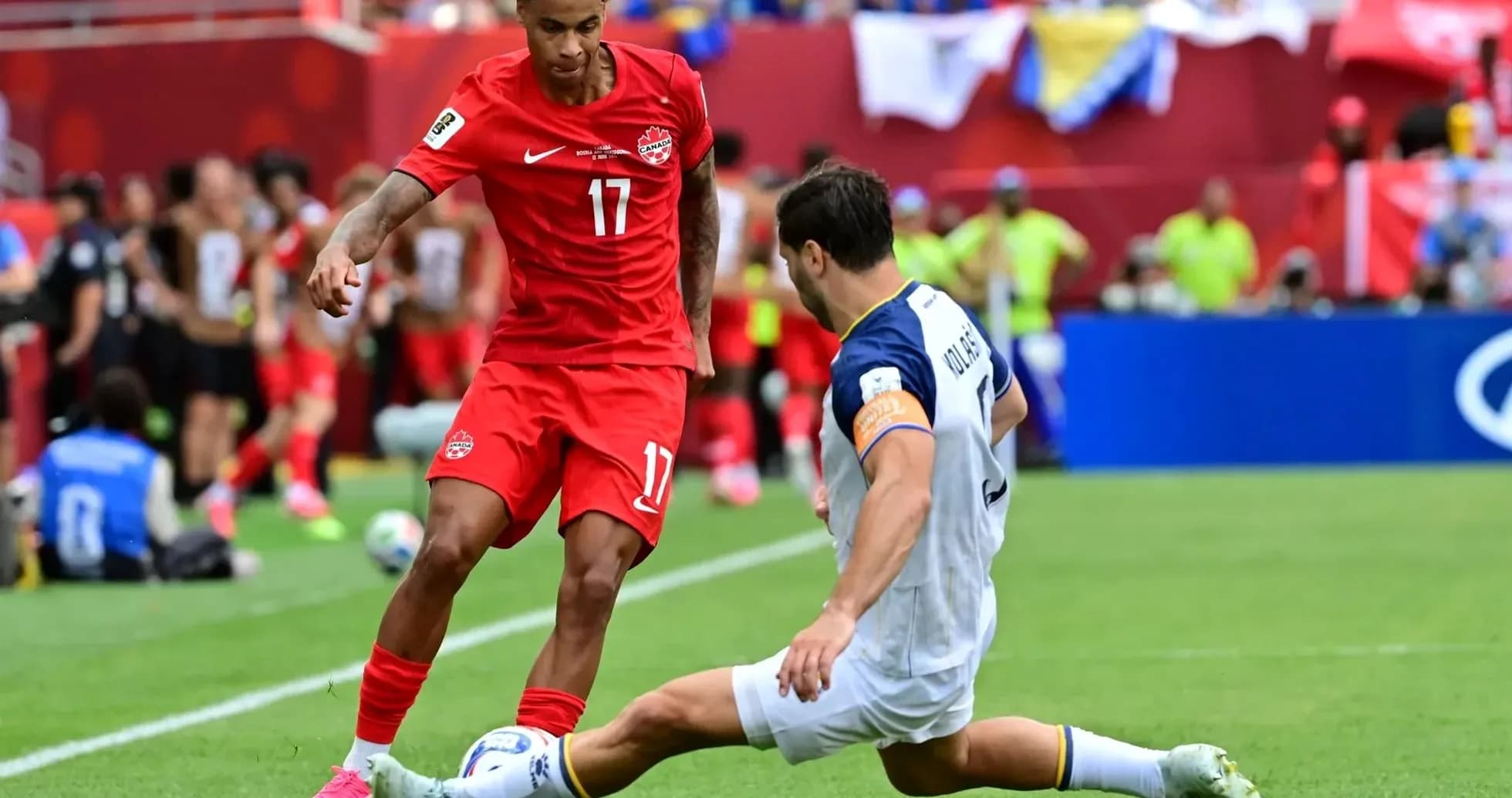
Bosnia & Herzegovina struck first, and their goal in the 21st minute neatly encapsulated their early tactical success. With both teams mirroring 4-4-2 shapes, Bosnia & Herzegovina focused on strong full-back play and quick vertical links into the front two. Sead Kolašinac, starting as the left-back, stepped aggressively into space to provide an overlapping threat, and his delivery or involvement from that side created the assist line for Jovo Lukić’s opener. The move reflected a recurring pattern: Bosnia & Herzegovina were willing to let Canada have the ball in non-threatening zones but sprang forward decisively once they could progress down the flanks.
Canada’s initial 4-4-2, with Tajon Buchanan and Liam Millar wide and Jonathan David alongside Tani Oluwaseyi, aimed at stretching Bosnia & Herzegovina horizontally. However, Bosnia & Herzegovina’s midfield four – Esmir Bajraktarević, Benjamin Tahirović, Ivan Bašić and Amar Memić – stayed narrow and compact, funnelling Canada outside and trusting the back four to handle crosses. The foul count (20 for Bosnia & Herzegovina versus 10 for Canada) shows how Barbarez’s side accepted physical duels to disrupt rhythm, especially as Canada tried to accelerate combinations in the half-spaces.
The disciplinary pattern also reveals the game’s physical tenor. For Canada, Alistair Johnston’s 11' yellow card for “Foul” came as he stepped high to counter Bosnia & Herzegovina’s early direct balls into the channels, a sign of Canada’s intention to keep the back line aggressive and compact. Later, Luc De Fougerolles’ 53' yellow, also for “Foul”, reflected a similar dynamic: Canada’s centre-backs often had to defend forward into Bosnia & Herzegovina’s strikers dropping short, and any mistiming drew punishment.
For Bosnia & Herzegovina, the three yellows – Ermedin Demirović at 44' (“Foul”), Jovo Lukić at 45+1' (“Foul”), and Nikola Katić at 90+3' (“Foul”) – underline how much defensive work the forwards and centre-backs had to do. Demirović and Lukić repeatedly tracked back to disrupt Canadian build-up, and their bookings came from late or forceful challenges trying to break Canada’s passing rhythm. Katić’s late yellow at 90+3' was emblematic of a side under sustained pressure in the closing stages, forced into last-ditch interventions to protect the point.
Tactical Changes
The key tactical inflection point arrived just after the hour. At 61', Marsch executed a triple substitution that reshaped Canada’s attacking dynamics: Promise David (IN) came on for Jonathan David (OUT), Ali Ahmed (IN) came on for Tajon Buchanan (OUT), and Jacob Shaffelburg (IN) came on for Liam Millar (OUT). These changes injected fresh running and more direct wide threat. Ahmed and Shaffelburg, both comfortable attacking from wide or half-space positions, allowed Canada to increase tempo and vary the angles of their entries into the box, while Promise David offered a different profile up front – more vertical, aggressive in attacking space behind.
Bosnia & Herzegovina responded with their own structural tweaks. At 62', Samed Baždar (IN) came on for Jovo Lukić (OUT), and Armin Gigović (IN) came on for Ivan Bašić (OUT), moves that nudged the visitors toward a slightly more conservative posture, with extra energy in midfield and a fresh runner up front. Later double changes at 74' – Kerim Alajbegović (IN) for Amar Memić (OUT) and Ivan Šunjić (IN) for Esmir Bajraktarević (OUT) – further tilted Bosnia & Herzegovina into a protect-the-lead mode, reinforcing central areas and reducing wide ambition. The 84' substitution of Dženis Burnić (IN) for Sead Kolašinac (OUT) removed one of their main progressive outlets on the left, signalling a clear shift toward game management.
Canada, by contrast, doubled down on attacking presence. At 76', Cyle Larin (IN) came on for Tani Oluwaseyi (OUT), adding a penalty-box specialist with strong hold-up play. This change proved decisive. In the 78th minute, Canada’s equaliser arrived: Cyle Larin finished a move assisted by Promise David, the substitute partnership validating Marsch’s reshuffle. The goal reflected Canada’s improved occupation of central zones – with Promise David linking and Larin pinning centre-backs, Bosnia & Herzegovina’s previously compact block was forced to defend deeper, and second-phase pressure eventually told.
Goalkeeping Performance
In goal, Maxime Crépeau (Canada) and Nikola Vasilj (Bosnia & Herzegovina) had relatively light but high-leverage workloads. Canada recorded 4 shots on goal and Bosnia & Herzegovina 3, with Crépeau making 2 saves and Vasilj 1. Both goalkeepers posted a goals prevented figure of -0.26, indicating that, relative to xG, each conceded slightly more than the shot quality might have predicted. For Crépeau (Canada), this aligns with Bosnia & Herzegovina’s opener being a well-worked, high-quality chance rather than a speculative effort. For Vasilj (Bosnia & Herzegovina), Canada’s equaliser came amid a period of sustained pressure, where defensive breakdowns in front of him limited his ability to significantly outperform the underlying shot quality.
Possession and Shot Profiles
Possession and passing numbers underline Canada’s structural dominance in the middle and final thirds. Canada completed 415 passes, with 310 accurate at a 75% success rate, compared to Bosnia & Herzegovina’s 270 passes, 172 accurate at 64%. This gap reflects Canada’s more patient, circulation-heavy approach, especially after going behind. The 9-4 advantage in corner kicks further highlights how often Canada pinned Bosnia & Herzegovina back and forced defensive set-pieces.
Shot profiles also support the tactical story. Canada’s 13 total shots included 10 from inside the box and 4 blocked efforts, suggesting they were able to work the ball into dangerous central areas but often faced a crowded penalty area. Bosnia & Herzegovina’s 8 shots, 5 inside the box and only 1 blocked, point to a more selective, counter-oriented attack, picking moments to commit numbers forward rather than sustaining long spells of pressure.
The late substitution of Jonathan Osorio (IN) for Stephen Eustaquio (OUT) at 90' was a final attempt by Marsch to add an extra line-breaking presence between the lines, even as Bosnia & Herzegovina retreated deeper. By then, though, the match had settled into a pattern: Canada probing with structured possession, Bosnia & Herzegovina defending with numbers and fouls when necessary, and both sides ultimately accepting a draw that, on balance of play and xG, slightly flattered the visitors but rewarded their defensive organisation and game management.