Colombia Dominates Ghana in World Cup Knockout Stage
Colombia’s 1-0 win over Ghana at Arrowhead Stadium in this World Cup Round of 32 tie was a clinic in territorial control and structure. Nestor Lorenzo’s side imposed their 4-3-3 from the opening minutes, translating 61% possession, 20 total shots and 12 efforts inside the box into a steady grip on the game. Ghana, set up by Carlos Queiroz in a 4-1-4-1, were largely pinned back, restricted to 8 shots with none on target and forced to rely on counter-attacks and set pieces that never truly materialised into clear chances.
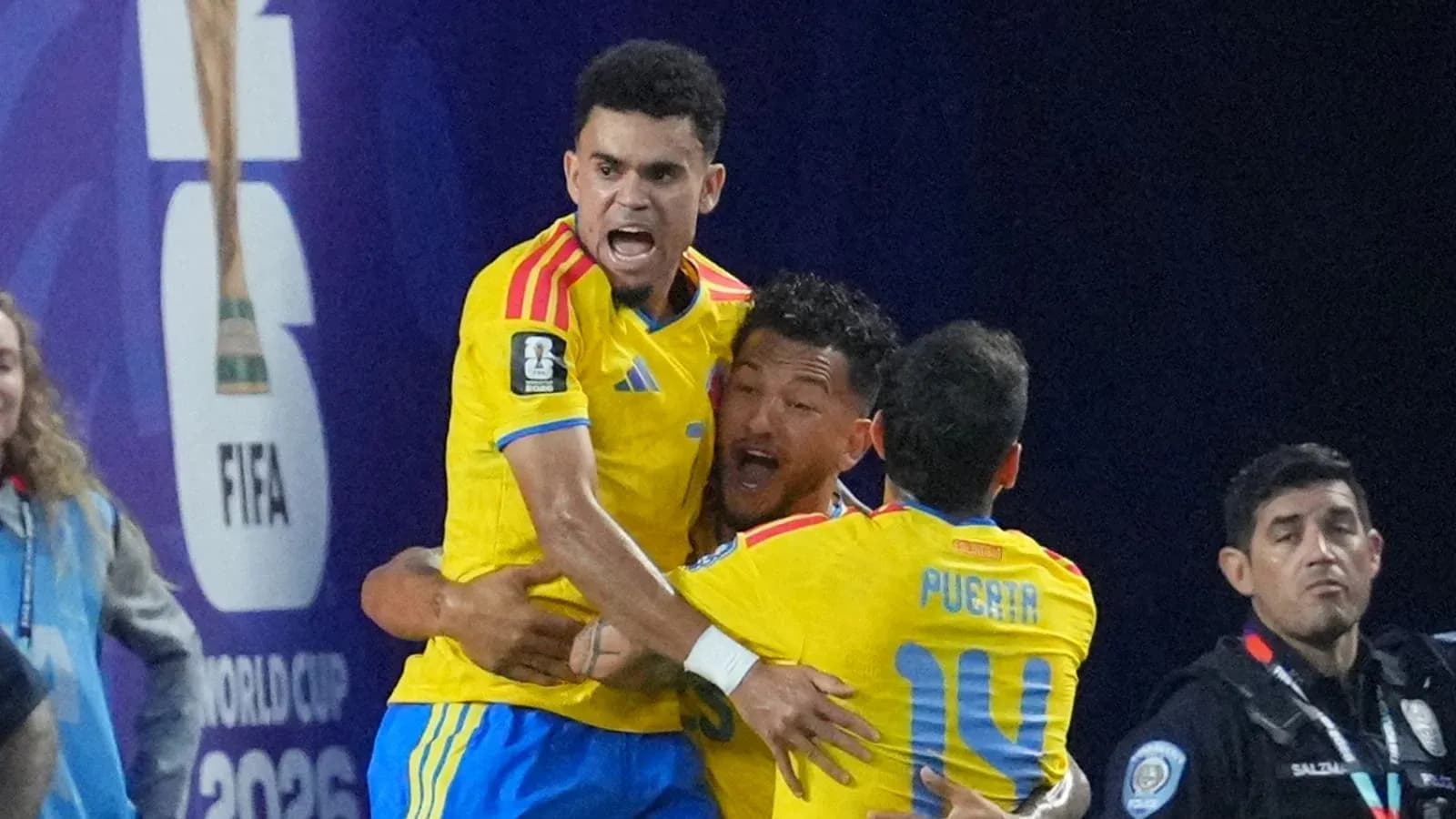
The decisive moment came early and was emblematic of Colombia’s positional play. After an 8th-minute change that saw Luis Javier Suárez (IN) come on for Jhon Córdoba (OUT), Colombia immediately gained more mobility between the lines. At 14', Jhon Arias arrived from midfield to finish a move assisted by Suárez, a pattern that underlined Colombia’s intent to use their interior midfielders as late runners into the box rather than static playmakers.
Lorenzo’s 4-3-3 was built on a high, stable base. The back four of Daniel Muñoz, Davinson Sánchez, Jhon Lucumí and Johan Mojica held an aggressive line, allowing the team to compress the pitch. With 586 passes, 532 accurate at 91%, Colombia circulated the ball with patience, constantly shifting Ghana’s 4-1-4-1 block. Gustavo Puerta and Jefferson Lerma anchored the midfield, providing security in rest defence and enabling Arias to push higher as a third attacker. James Rodríguez, starting nominally as a forward, operated more as a roaming creator between the lines, further overloading the central corridor.
The early substitution of Córdoba for Suárez at 8' was a significant tactical tweak rather than an ordinary rotation. Suárez’s tendency to drift wide and attack depth stretched Ghana’s centre-backs, opening pockets for Luis Díaz and James to receive between full-back and centre-back. This movement directly contributed to the 14' goal: Suárez’s involvement as provider reflected his role as a channel runner who could then cut the ball back into the half-spaces where Arias was arriving.
Out of possession, Colombia’s press was coordinated and front-footed. With Ghana attempting to build from a 4-1-4-1 base featuring Thomas Partey as the single pivot, Colombia used James to screen Partey while Suárez and Díaz closed the centre-backs. Behind them, Arias, Lerma and Puerta stepped aggressively onto Ghana’s advanced midfield line of Caleb Yirenkyi, Kwasi Sibo and Antoine Semenyo. The result was a Ghana side that rarely found clean central progression, forced instead into longer passes and speculative balls towards Jordan Ayew.
The statistical profile underlines Colombia’s control: 4 blocked shots show how often their defensive line stepped out to contest efforts at source, while 12 shots inside the box speak to their ability to repeatedly access dangerous zones. Their xG of 2.18 suggests the margin could and perhaps should have been greater, especially considering a potential second goal for Luis Díaz was disallowed by VAR for offside at 56', a reminder of how consistently Colombia were breaking Ghana’s last line.
Ghana’s 4-1-4-1, in contrast, never fully stabilised. Partey was often isolated in front of the defence, tasked with both screening and initiating play. With Colombia’s front three and advanced eight (Arias) pressing in unison, Ghana’s first pass out was frequently compromised. The early substitution of Marvin Senaya for Alidu Seidu at 13' hinted at an attempt to add more defensive aggression on the flank, but it did little to change the territorial pattern.
Carlos Queiroz’s in-game adjustments were aimed at injecting dynamism rather than altering the structure. At 62', a double substitution saw Iñaki Williams (OUT) replaced by Abdul Fatawu Issahaku (IN) and Kwasi Sibo (OUT) replaced by Elisha Owusu (IN). This effectively refreshed the right side and central midfield, with Fatawu adding directness and Owusu providing additional legs alongside Partey. Later, at 79', Jordan Ayew (OUT) made way for Ernest Nuamah (IN) and Caleb Yirenkyi (OUT) for Prince Kwabena Adu (IN), moves designed to introduce pace and vertical threat. Yet Ghana’s shot map—only 2 attempts inside the box, 6 from outside, and 0 on target—shows that these changes did not translate into genuine penetration.
Lawrence Ati Zigi (Ghana) was central to keeping the scoreline respectable. Ghana faced 8 shots on goal and he registered 7 saves, a figure that, combined with a goals prevented value of 1.92, indicates several high-quality interventions. His shot-stopping underlined the fragility of Ghana’s defensive structure: while the back four plus Partey and later Owusu tried to hold a compact shape, Colombia repeatedly found ways to isolate Díaz and Suárez against individual defenders or to release late runners from midfield.
On the Colombian side, Camilo Vargas (Colombia) had a largely quiet night in terms of direct actions, with 0 recorded saves. That number is less a reflection of his quality and more a testament to the collective defensive control in front of him: Ghana’s xG of 0.26 and complete absence of shots on target show how effectively Colombia’s first and second lines suffocated any build-up before it reached the penalty area.
The disciplinary pattern also carried tactical implications. Jhon Arias (Colombia) was booked for Tripping at 12', but continued to play on the edge, pressing high and breaking lines. On the Ghanaian side, three yellow cards—Caleb Yirenkyi for Holding at 49', Abdul Fatawu Issahaku for Unsportsmanlike conduct at 66', and Alidu Seidu for Tripping at 76'—reflected a team increasingly stretched and forced into reactive challenges as Colombia circulated the ball. Richard Ríos (Colombia), who entered for James Rodríguez (OUT) at 46', was also booked for Tripping at 78', a sign of Colombia’s willingness to break up any nascent Ghana transitions.
Ríos’ introduction for James at half-time subtly rebalanced Colombia’s midfield. With Ríos alongside Lerma and Puerta, the structure became more double-pivot oriented, prioritising control and counter-pressing over pure creativity. This helped Colombia lock Ghana in even more after the break, at the cost of some final-third flair. Later, Juan Fernando Quintero (IN) for Jhon Arias (OUT) at 73' and Jaminton Campaz (IN) for Luis Díaz (OUT) at 90' added fresh technical quality and ball retention to manage the closing stages rather than chase additional goals.
Statistically, Colombia’s dominance was comprehensive. Their 61% possession, 586 total passes with 91% accuracy, and 20 shots to Ghana’s 8 paint the picture of a side in full command. The xG differential—2.18 to 0.26—aligns with the eye test: Colombia generated sustained, high-quality pressure, while Ghana’s sporadic forays rarely threatened. Ghana’s 376 passes at 83% accuracy underscore a team that could circulate the ball in deeper zones but struggled to progress through Colombia’s compact mid-block.
Defensively, Colombia’s ability to keep Ghana to 0 shots on goal and force 5 of their 8 attempts to be blocked highlights the effectiveness of their line-stepping and box protection. Offensively, the combination of wide threats, interior runners and a flexible forward line produced enough volume and quality that only a standout performance from Ati Zigi and the disallowed Díaz strike kept the margin at 1-0.
In tactical terms, this was a controlled, professional knockout performance from Colombia: assertive without being reckless, structurally sound, and adaptable through intelligent substitutions. Ghana, despite disciplined phases and an excellent display from their goalkeeper, never solved the problems Colombia’s 4-3-3 posed between their lines and in their defensive half.