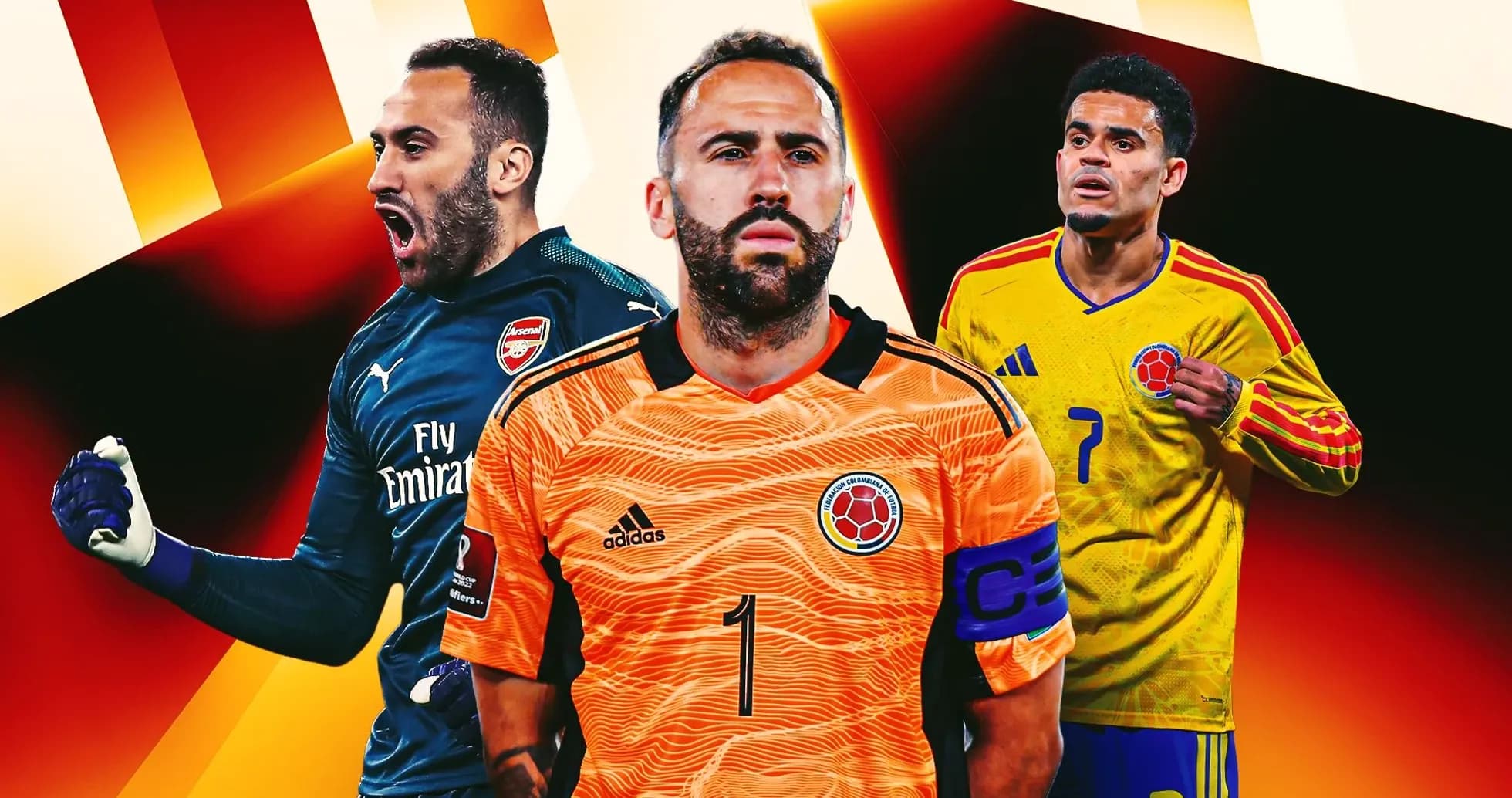
David Ospina: A Journey from Nice to Colombia's World Cup Hope
David Ospina is 37 now. He will be 38 by the time the next World Cup dust settles. Goalkeepers do not usually reinvent themselves on that stage at that age. They almost never stretch a career a decade beyond it.
He has tried anyway. And he has enjoyed the ride.
The story did not begin with the World Cup, or with Arsenal, but with a Nice side clinging to Ligue 1 life in 2013-14. That team could not score – 30 goals in 38 games – and lived on the edge every week. Ospina kept them there. Thirteen clean sheets, countless interventions, and a relegation battle that stayed just the right side of disaster because their goalkeeper refused to blink.
That form travelled with him to Brazil. Scouts had already noticed his work in France. The World Cup confirmed it. Four goals conceded in 450 minutes, a calm, commanding presence behind a daring Colombia team, and the call came from north London. Arsenal wanted him. He signed.
“Having belonged to a team like Arsenal was a dream come true. Living that experience was something magnificent in my career,” he said.
He walked into Arsenal at a strange juncture. Arsène Wenger’s era was winding down, the football still easy on the eye but the spending no longer enough to keep pace with the Premier League’s new money and new power. The title felt more like a memory than an objective.
It was an awkward moment for goalkeepers, too. The position was being rewritten in real time. Nobody flicked a switch overnight and demanded that every keeper become a playmaker, but the evolution was obvious by the time Ospina arrived in England. He had to adapt or be left behind.
“I’ve had the opportunity to witness all the transitions across different generations. Today, our position has taken on a much more significant role, largely because we are now expected to be far more involved with our feet - something that wasn't nearly as necessary in the past,” he said.
Does he enjoy that responsibility? Enjoyment hardly comes into it. It is simply what the job is now, and at nearly 40 he understands that tactics and roles never stop shifting.
“Possessing technical proficiency is crucial, as it allows us to initiate attacking sequences right from the back. The goalkeeper has truly become an integral part of the starting eleven - no longer merely the player who prevents goals, but also the one capable of orchestrating a transition quickly and precisely,” he said.
His Arsenal chapter never quite became what it threatened to be. Injuries checked his momentum. Then Petr Cech arrived from Chelsea and the path narrowed. A Colombian goalkeeper trying to dislodge one of the Premier League’s greats was always going to find the margins unforgiving.
Yet those years still mattered. Wenger, meticulous and demanding, became a mentor. Ospina also watched Mikel Arteta, then the captain, from close quarters.
“I had the opportunity to have him as a teammate when I first arrived at Arsenal. Even back then, he demonstrated his leadership and showed what he could contribute to the game over the course of his career,” Ospina said.
So it is no shock to him that Arteta now stands in the technical area. Whether he is the man to finally drag Arsenal over the line in the league, after a sequence of near-misses, is another question.
“They have a massive opportunity to win the Premier League, led by an excellent manager and featuring young players who are performing exceptionally well. So, let's hope they can achieve that milestone. It would make me very happy to see Arsenal win the Premier League title,” he said.
Ospina watches that chase from a distance now. He is back home with Atlético Nacional, the boyhood club that shaped him, far from the noise and scrutiny of a Premier League title race. There is comfort in that distance. It also clears space for the thing that still drives him most: Colombia.
This World Cup cycle feels like the crest of a remarkable generation. James Rodríguez now plays his club football for Minnesota United in Major League Soccer, but the talent pool around him remains deep. Luis Díaz has exploded again under Vincent Kompany at Bayern Munich. Luis Suárez has settled quickly at Sporting CP in Portugal.
“We have players at major clubs in Europe, such as Lucho Suarez and Luis Diaz, who are incredibly important figures. We also count on a player like James Rodriguez, with his experience and quality, as well as Davinson Sanchez, who has been playing in top-tier leagues for quite some time now,” Ospina said.
Behind them, another wave is forming. Richard Ríos, Juan Cabal, Daniel Muñoz, and potentially Jhon Durán – if bridges are rebuilt – bring energy and edge. For once, Colombia can look across the pitch and see genuine options in every role.
“We have players with a great deal of experience, as well as young players who are eager to do things right. There are others among us, those with a bit more experience, who can make very positive contributions to the national team,” Ospina said.
They will not arrive at the World Cup as favourites. They will arrive as something more dangerous: a side nobody will want to draw. Win the group, catch a kind path, find form at the right moment, and a semi-final is not fantasy. Colombia’s football has always thrived on energy, on rhythm, on a collective mood that can sweep through a tournament. Ospina understands that better than most.
His own status adds another layer. He will be fighting for the No. 1 shirt in a squad carrying real expectation. That profile has made him a natural face for campaigns around the tournament, including a World Cup push with Modelo.
“Modelo brings people together, allowing them to experience unique moments anywhere in the world - even right from their own homes- and to share those moments with friends and family,” he said.
For Ospina, 2026 looks like the last great opening on the international stage. His résumé is rich with deep runs and big nights, but the defining moment, the one that turns memories into medals, is still missing. One more World Cup, one more shot at something bigger than a brave exit.
“The expectations are very high,” he said. “Both for what we ourselves aim to achieve, and for what we hope to accomplish for our country.”
If Colombia can match those words with deeds, the veteran who once kept Nice alive and carried Arsenal dreams might yet see his greatest work come in the twilight.