Everton vs Manchester United: A Tactical Analysis of the 2-2 Draw
Hill Dickinson Stadium felt like a litmus test for both projects. Everton arrived as an unbeaten, quietly efficient unit, sitting 8th with 5 points from 3 matches, their overall goal difference a tidy +2 (5 scored, 3 conceded). Manchester United, 11th with 4 points and a goal difference of +1 (7 scored, 6 conceded), brought more volatility: higher ceilings, sharper edges, and more structural questions. The 2-2 draw in regular time underlined exactly that contrast – Everton’s collective clarity against United’s star-led chaos.
I. The Big Picture – Two 4-2-3-1s, two very different identities
Both sides mirrored each other on the tactical board with a 4-2-3-1, but the personalities of those shapes could hardly be more different.
Everton’s season profile is built on control and balance. Heading into this game they had played 3 league matches, winning 1 and drawing 2, with no defeats. At home they had played 2, winning 1 and drawing 1, scoring 4 and conceding 2. Their averages tell the story: 2.0 goals scored at home and 1.0 conceded, 1.7 scored overall and 1.0 conceded overall. It is not spectacular, but it is sustainable.
Leighton Baines leaned into that identity. J. Pickford anchored a back four of M. Rohl, J. Tarkowski, J. Branthwaite and V. Mykolenko – a line designed more for solidity than adventure. Ahead of them, the double pivot of H. Armstrong and J. Garner offered legs and distribution, while the trio of B. Johnson, K. Dewsbury-Hall and T. George supported lone forward T. Barry.
United, by contrast, are front-loaded. Overall they had 7 goals from 3 league games heading into this fixture, with a total average of 2.3 goals scored per match but 2.0 conceded. At home they had been explosive (5 scored, 2 conceded in 1 match), but on their travels they were fragile: 2 goals scored and 4 conceded across 2 away fixtures.
Michael Carrick kept faith with his 4-2-3-1 template that has already been used 3 times this season. S. Lammens started in goal behind a back four of D. Dalot, H. Maguire, L. Martinez and L. Shaw. In midfield, K. Mainoo and Y. Tielemans formed the base, with B. Mbeumo and M. Rashford flanking Bruno Fernandes behind centre-forward M. Cunha. It is a line-up built to hurt you between the lines and in transition, but one that can leave the back door ajar.
II. Tactical Voids – Absences and discipline shaping the contest
Both squads were trimmed by notable absentees. Everton were without C. Norgaard, ruled out through injury. His absence removed a potential screening specialist from Baines’s options, placing more defensive responsibility on Armstrong and Garner.
United’s list was longer and more structural: C. Baleba (ankle injury), A. Diallo, T. Heaton, M. Ugarte (knee injury) and M. de Ligt were all missing. The absence of Ugarte and de Ligt is particularly telling. Without a pure destroyer in front of the defence or a dominant organiser at centre-back, United’s 4-2-3-1 becomes more technical than combative in the central lane, and more vulnerable to sustained pressure.
Disciplinary patterns across the season add another layer. Everton’s yellow cards are spread almost evenly across the game: 20.00% of their bookings have come in each of the 0–15, 31–45, 46–60, 61–75 and 91–105 minute windows. That points to a side that fouls to manage moments rather than collapsing in specific phases.
United, however, show a clear late-game edge to their aggression. While they have a booking spike between 31–45 (20.00%) and 61–75 (20.00%), the real surge comes from 76–90 minutes, where 40.00% of their yellows arrive, with another 20.00% between 91–105. This is a team that pushes the limits when chasing or defending a result late on – a risk against an Everton side that tend to stay in matches and rarely lose control.
III. Key Matchups – Hunter vs Shield, and the engine room duel
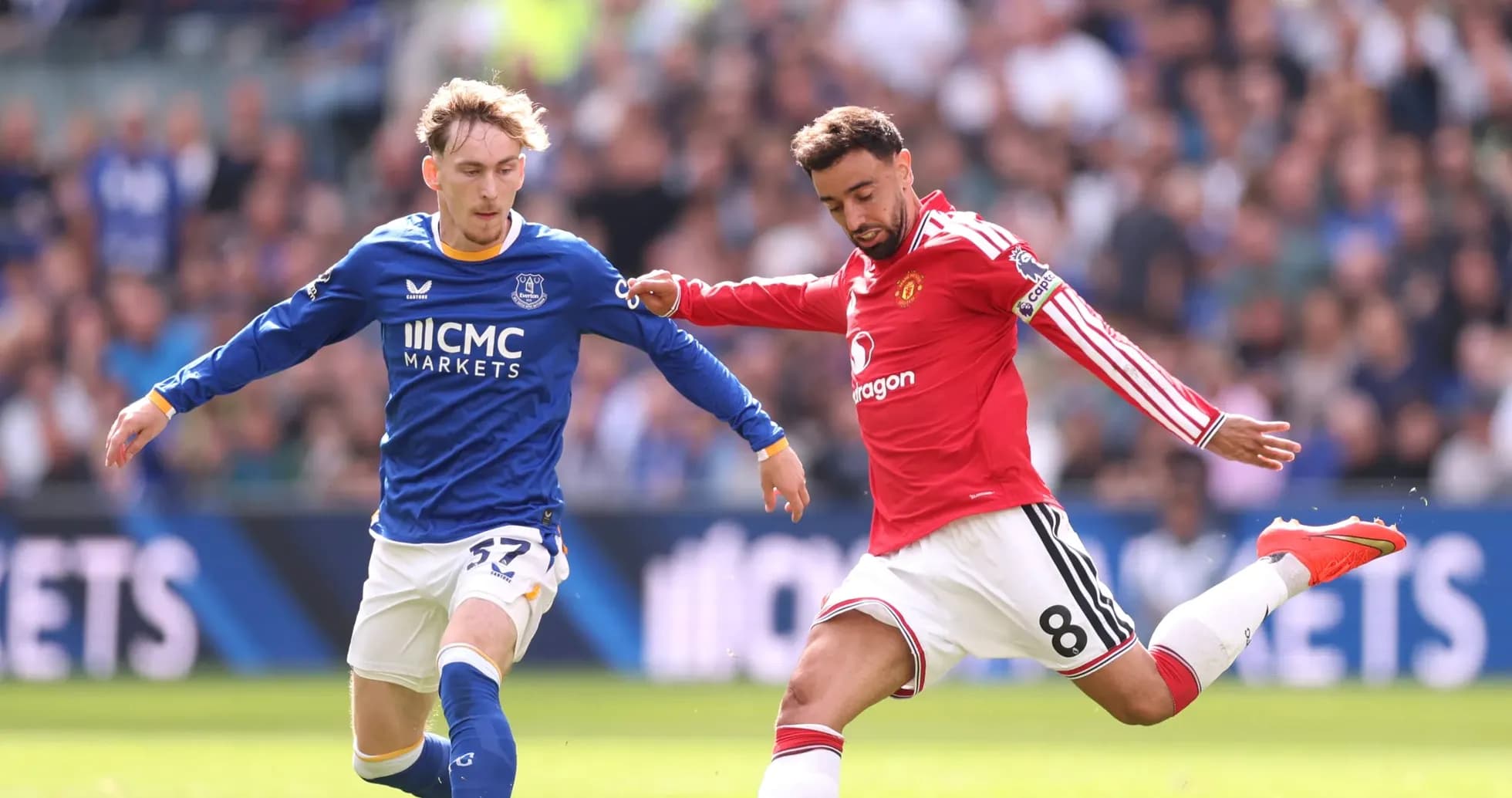
The headline duel is obvious: Bruno Fernandes as the hunter against Everton’s defensive shield. Fernandes came into this match as one of the league’s leading attacking forces: 3 goals and 1 assist in 3 appearances, with 9 shots (4 on target), 203 completed passes at 84% accuracy and 8 key passes. He is also a volume playmaker, threading passes between the lines and attacking the half-spaces.
Everton’s response is collective rather than individual. Tarkowski and Branthwaite form a rugged central pairing, but the real containment job falls on Armstrong and Garner. With United’s central double pivot of Mainoo and Tielemans more inclined to progress play than to destroy it, the battle becomes whether Everton’s two can screen Fernandes while still stepping out to engage United’s deeper midfielders.
Out wide, the flanks are a chessboard of pace and discipline. On one side, B. Mbeumo – already with 2 goals, 5 key passes and 7 shots (4 on target) this season – attacks the channel outside Mykolenko and in front of Branthwaite. On the other, Rashford’s direct running asks serious questions of M. Rohl’s positioning and recovery speed.
B. Johnson is a key counterweight for Everton. Though his attacking numbers this season are modest, he has 2 key passes, 2 tackles, 1 blocked shot and 2 interceptions in 100 minutes, plus a yellow card that underlines his willingness to work without the ball. His job is double: pin Shaw back when Everton have possession and track United’s left-sided rotations when they do not.
The “engine room” confrontation pits Everton’s more workmanlike pairing against United’s technical double pivot. Mainoo’s press resistance and Tielemans’s range of passing are designed to feed Fernandes and release Cunha early. Everton will try to compress that space, forcing United to circulate wide and cross into a penalty area patrolled by Tarkowski and Branthwaite.
IV. Statistical Prognosis – Margins, xG logic and defensive solidity
Even without explicit xG numbers, the shot and goal profiles point towards a relatively balanced attacking contest but a structural edge for Everton’s defensive platform at home.
Everton’s season to date shows no defeats in 3 matches, with only 3 goals conceded overall and 2 at home. They have already kept 1 clean sheet at home and have yet to fail to score, either home or away. United, by contrast, have not kept a clean sheet in the league so far and have conceded 4 goals on their travels from just 2 away fixtures. They have already failed to score once away from home.
Layer on top United’s late-card surge and the absence of key defensive players like de Ligt and Ugarte, and the pattern is clear: United will create, especially through Fernandes, Mbeumo and Rashford, but are likely to offer Everton presentable chances, particularly as the match stretches in the final quarter.
The 2-2 scoreline ultimately reflects the statistical and tactical equilibrium: Everton’s home solidity and collective structure against United’s higher individual attacking ceiling but shakier defensive core. On another day, with slightly sharper finishing or a calmer final 15 minutes from United’s back line, the expected-goals balance might tilt either way. As it stands, the draw feels like a fair expression of two evolving identities – one grounded in control, the other in volatility – meeting exactly in the middle.