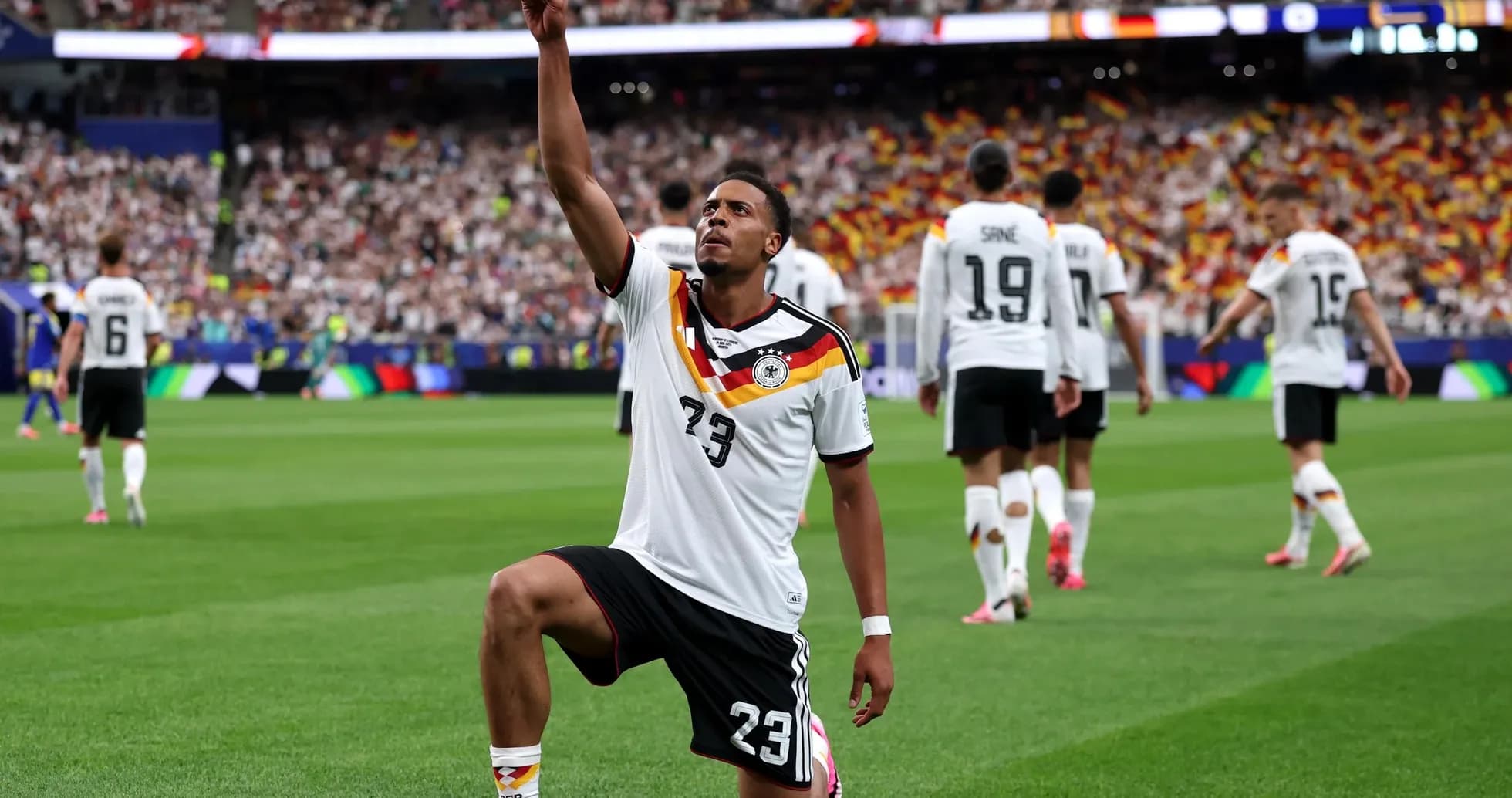
Germany's Tactical Masterclass in 7-1 Victory Over Curaçao
Germany’s 7-1 dismantling of Curaçao at NRG Stadium was the product of a clear structural mismatch and ruthless execution of Julian Nagelsmann’s positional play. In a 4-2-3-1, Germany pinned Curaçao’s 4-3-1-2 deep, stretching them horizontally and vertically until the central block collapsed. The half-time score of 3-1 already reflected territorial domination; the second-half avalanche turned control into humiliation as Germany repeatedly attacked the same weak points with minor variations.
Out of possession, Curaçao’s narrow front two and single No. 10 were immediately outnumbered by Germany’s first line of build-up. Manuel Neuer (Germany) had little to do in terms of shot-stopping, but his role as an extra outfield player was key to establishing 65% possession and 633 total passes. Jonathan Tah and Nico Schlotterbeck split wide, Joshua Kimmich and Nathaniel Brown provided full-width, and the double pivot of Felix Nmecha and Aleksandar Pavlović formed a stable 2+2 base that Curaçao’s first pressing line could not disrupt. With Curaçao staying compact centrally, Germany consistently progressed down the flanks, especially the left.
Offensive Structure
Nagelsmann’s offensive structure revolved around a clear left-sided overload and interior rotations. Brown advanced aggressively from left-back, often forming a wide triangle with Florian Wirtz and Jamal Musiala between Curaçao’s right-back and right central midfielder. Nmecha, notionally part of the double pivot, frequently stepped into the right half-space, becoming a late runner and adding a fifth player between the lines. The opening goal at 6’ – Felix Nmecha finishing from a Wirtz assist – encapsulated this: Germany drew Curaçao’s midfield narrow, then attacked the seam just outside the box with a free runner arriving untracked.
Curaçao’s 4-3-1-2 was designed to protect the middle, but their horizontal shifting was too slow. With only 35% possession and 336 passes, they spent long stretches defending in a low block. The three central midfielders were pinned by Germany’s No. 10 (Musiala), the dropping movements of Kai Havertz, and the aggressive positioning of Wirtz. Once the midfield line was fixed, full-backs Sherel Constancio Floranus and Deveron Fonville were left in repeated 2v1 situations against wide-midfielder-plus-full-back combinations. Germany’s 22 shots inside the box show how often these wide wins were converted into cut-backs and low crosses into dangerous central zones.
Set Pieces and Restarts
Set pieces and restarts further underlined the structural superiority. Germany’s 8 corner kicks to Curaçao’s 1 reflected their territorial dominance. Schlotterbeck’s 38’ goal, assisted by Brown, came from Germany’s ability to maintain pressure after initial deliveries, keeping Curaçao penned in and forcing repeated defensive actions. The 45+5’ penalty converted by Havertz was the logical extension of constant box entries and duels; Curaçao’s defenders were repeatedly forced into last-ditch interventions as the back line was pulled apart by rotations and underlapping runs.
Second Half Adjustments
In the second half, Nagelsmann used substitutions to both refresh and re-weaponise the same patterns. At 46’, Jeremy Antonisse (IN) came on for Sontje Hansen (OUT) for Curaçao, attempting to add pace up front. But Germany immediately reasserted control: Musiala’s 47’ goal, assisted by Kimmich, came from another wide-to-central combination, with the right-back stepping high to provide the final ball once the block was shifted.
The German changes on 64’ and 73’ were as much about maintaining pressing intensity as they were about game management. Deniz Undav (IN) came on for Jamal Musiala (OUT) at 64’, and Jearl Margaritha (IN) for Jürgen Locadia (OUT) for Curaçao the same minute, but the pattern remained: Germany dictating, Curaçao reacting. Brown’s 68’ goal, assisted by Undav, highlighted how fresh legs attacked tired full-backs; the left channel again became the entry point, with Undav drifting wide to combine before Brown arrived to finish.
At 73’, Nagelsmann reshaped his back line and midfield: David Raum (IN) for Brown (OUT), Antonio Rüdiger (IN) for Tah (OUT), and Leon Goretzka (IN) for Nmecha (OUT). The structure, however, stayed recognisably 4-2-3-1. Raum continued the high, aggressive full-back role, while Goretzka added vertical power from midfield, ensuring Germany could keep stepping onto second balls and sustain pressure. The pressing remained coordinated, with the first line closing passing lanes into Curaçao’s midfield and the back four holding a high line to compress space.
Final Goals
The 78’ goal by Undav, again assisted by Kimmich, was a textbook example of Germany’s rest-attack: after regaining possession high, they immediately exploited a disorganised back line with a direct vertical action. Kimmich, still operating as an advanced full-back before his substitution, provided quality delivery from the right. At 83’, Waldemar Anton (IN) replaced Kimmich (OUT), slightly lowering the attacking output from right-back but maintaining defensive stability. Simultaneously, Gervane Kastaneer (IN) came on for Tahith Chong (OUT) for Curaçao, but with Germany in full control, these changes had limited tactical impact on the flow.
The final blow came at 88’, when Havertz scored again from an Undav assist. This sequence underlined Germany’s ability to create central finishing positions late in the game through intelligent movement rather than sheer numbers alone. Undav dropped into the half-space, drawing a centre-back out, and Havertz attacked the vacated channel, a pattern repeated throughout the second half as Curaçao’s defensive line lost compactness.
Statistical Analysis
From a statistical perspective, the 7-1 scoreline slightly exceeded Germany’s xG of 3.91, indicating elite finishing and some defensive frailty from Curaçao, whose xG of 0.4 matched their limited attacking presence. Germany’s 12 shots on goal from 27 total shots, with 8 blocked, show how consistently they forced Curaçao to defend deep in their own box. Curaçao managed only 8 total shots and 2 on goal, underlining how rarely they could transition through Germany’s counter-press.
In goal, Manuel Neuer (Germany) was credited with 1 save, reflecting how well the outfield structure protected him. Eloy Room (Curaçao) made 4 saves, but the goals prevented figure of -2.47 for both teams highlights that neither goalkeeper overperformed their underlying shot quality faced; Germany’s attackers simply generated and finished chances at a level Curaçao could not match. Passing data reinforces the tactical story: Germany’s 633 passes, 550 accurate at 87%, against Curaçao’s 336 passes, 276 accurate at 82%, show a game controlled by German possession and spacing rather than mere intensity.
Ultimately, this was a clinic in how a well-drilled 4-2-3-1 with high, attacking full-backs and fluid attacking midfielders can systematically dismantle a narrow 4-3-1-2. Germany’s use of width, rotations in the half-spaces, and relentless pressing after loss left Curaçao with almost no stable platforms to build from, turning the opening group-stage fixture into a tactical and numerical rout.