Liverpool and Nottingham Forest Share Points in Thrilling 2-2 Draw
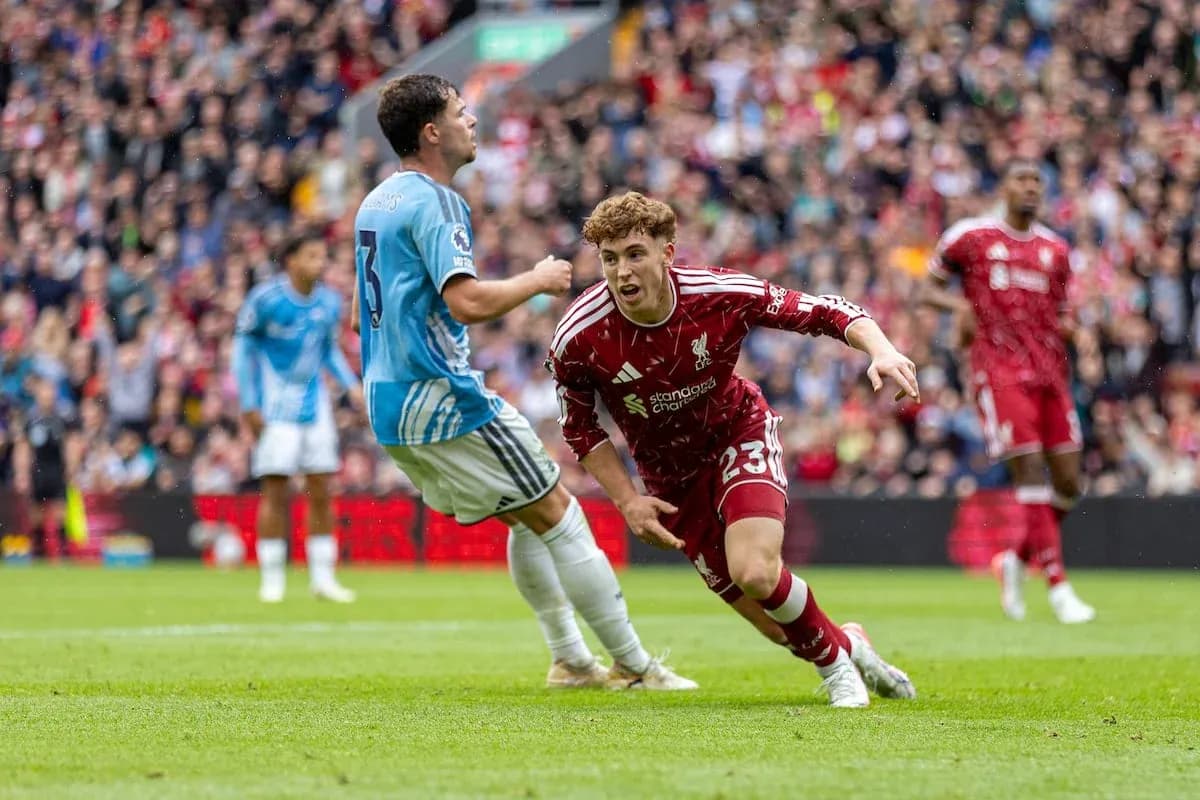
Anfield felt restless at full time. Liverpool had chased the game, turned it on its head, and still watched Nottingham Forest escape with a 2-2 draw. For Andoni Iraola, two points from two matches and a goal difference of 0 (4 scored, 4 conceded in total) is a fair reflection of a side still learning its new shape. For Oliver Glasner, a point on their travels, after a home defeat, keeps Forest’s early-season story one of stubborn survival rather than crisis: one point from two, 2 goals for and 3 against overall, a goal difference of -1.
This was billed as a stylistic clash and the lineups confirmed it. Liverpool stayed loyal to Iraola’s 4-2-3-1: Alisson behind a back four of Jeremie Frimpong, V. van Dijk, J. Jacquet and Milos Kerkez, with Dominik Szoboszlai and Alexis Mac Allister as the double pivot. Ahead of them, a fluid band of three – Cody Gakpo, Florian Wirtz and Víctor Muñoz – fed Alexander Isak as the lone striker.
Forest arrived in a 3-4-2-1 that bore all of Glasner’s fingerprints: Matz Sels in goal, a back three of Murillo, Nikola Milenkovic and Cunha, wing-backs Ola Aina and Neco Williams flanking a central pair of Xaver Schlager and James McAtee. Morgan Gibbs-White and Dan Ndoye supported Igor Jesus up top. On paper, Liverpool’s structure promised width and overloads between the lines; Forest’s promised density, counters and a constant threat from Gibbs-White drifting into pockets.
Injury absences sharpened those tactical choices. Liverpool were without S. Bajcetic, C. Bradley, Federico Chiesa, H. Ekitike, J. Gomez and G. Leoni – a significant chunk of depth across defence and attack. It forced Iraola to trust the new core: Kerkez and Frimpong as aggressive full-backs, Wirtz as the main creative hub, and Muñoz as the wild card between lines. Forest missed I. Sangare and N. Savona in midfield, reducing Glasner’s options for a pure destroyer in front of the back three and pushing even more responsibility onto Schlager’s shoulders.
The disciplinary profile of both sides framed the contest’s edge. Heading into this game, Liverpool had collected most of their yellows in the 16-30, 46-60 and 76-90 minute ranges, each accounting for 28.57% of their bookings, a sign of a team that tackles aggressively right after tactical adjustments and in the closing stretch. Forest’s bookings were front-loaded between 16-60 minutes, with 25.00% of their yellows in both the 16-30 and 31-45 windows, and 50.00% between 46-60, illustrating how their intensity spikes around half-time can easily spill into fouls.
On the Pitch
On the pitch, the “Hunter vs Shield” duel was clear. Liverpool’s attack had been reliable if not ruthless: 4 goals in total across 2 fixtures, averaging 2.0 goals per match both at home and on their travels, and crucially, they had not failed to score yet. Isak, with 1 league goal and 5 shots (3 on target) in total, is a penalty-box predator who thrives on quick service; Gakpo, also with 1 goal and 1 assist overall, is the hybrid runner-creator who stitches transitions together. Wirtz, with 1 assist and 85 passes at 81% accuracy, is the metronome between lines.
Against them, Forest’s defensive record told a story of fragility when stretched: 3 goals conceded in total, 1.0 at home and 2.0 away on average. Their away sample is small but revealing – 2 goals shipped in their only previous outing on their travels. Yet the individuals in that back line are built for last-ditch resistance. Milenkovic brings aerial dominance, Murillo offers recovery pace, and Aina – already on 2 yellow cards this season – is both an outlet and a liability, a wing-back whose duels (20 in total, 10 won) and 7 attempted dribbles show how often he lives on the edge.
The engine room battle was more nuanced. Mac Allister and Szoboszlai, though not featured in the individual stat leaders, are the platform that allows Liverpool’s front four to roam. They had to outthink Schlager and McAtee, a pairing that combines pressing intelligence with forward running. Gibbs-White, though listed as an attacker, effectively formed a third midfielder at times. His numbers underline his importance: 1 goal, 1 assist, 57 passes at 82% accuracy and 8 dribble attempts with 4 successes. He is Forest’s creative axis and emotional leader, the one who turns a clearance into a counter.
Ndoye, too, was central to the visitors’ plan. With 1 goal from 3 shots and 5 dribble attempts (2 successful) overall, he is the chaos agent attacking the channels outside van Dijk. Iraola’s decision to field a high full-back in Frimpong, who has already contributed 4 key passes and 4 tackles in total, left space behind that Forest were eager to attack with direct balls towards Ndoye and Igor Jesus.
Liverpool’s defensive numbers heading into the match mirrored their attacking ones: 4 conceded in total, 2.0 per game both at Anfield and away, and no clean sheets yet. That symmetry – 4 scored, 4 conceded – speaks to a side that is thrilling but open. The presence of Ronald Araújo on the bench, already with 2 successful blocks and a 92% pass accuracy in limited minutes, hints at a possible future tweak: shifting towards a more conservative back line when game state demands control rather than chaos.
From a statistical prognosis, the draw felt almost pre-written. Liverpool’s attack, with its 2.0 goals per game at home and a 100.00% conversion from the spot so far, was always likely to find a way through Forest’s back three. But Forest’s own output on their travels – 2 goals scored and 2 conceded away, averaging 2.0 for and 2.0 against – suggested they would not arrive at Anfield simply to survive. Their lack of a clean sheet, like Liverpool’s, pointed to mutual vulnerability.
In the end, 2-2 encapsulated both teams’ early-season DNA. Liverpool are a side of high tempo, heavy rotation in the half-spaces, and a front four of Isak, Gakpo, Wirtz and Muñoz that can hurt anyone, but they are yet to find a defensive lock. Forest, under Glasner, are organised and opportunistic, leaning on Gibbs-White’s invention and Ndoye’s directness to punch up against bigger sides.
Following this result, Liverpool sit 13th with 2 points, Forest 15th with 1. The table says mid-table noise; the performance hints at something more volatile. For Iraola, the next step is clear: keep the attacking verve, but turn that 0 clean-sheet count into something more respectable. For Forest, the mission is simpler but no less demanding: maintain this away resilience, tighten the spaces around Gibbs-White, and let their 3-4-2-1 continue to be the awkward puzzle that even Anfield could not quite solve.