Manchester Derby Analysis: City’s Tactical Superiority Over United
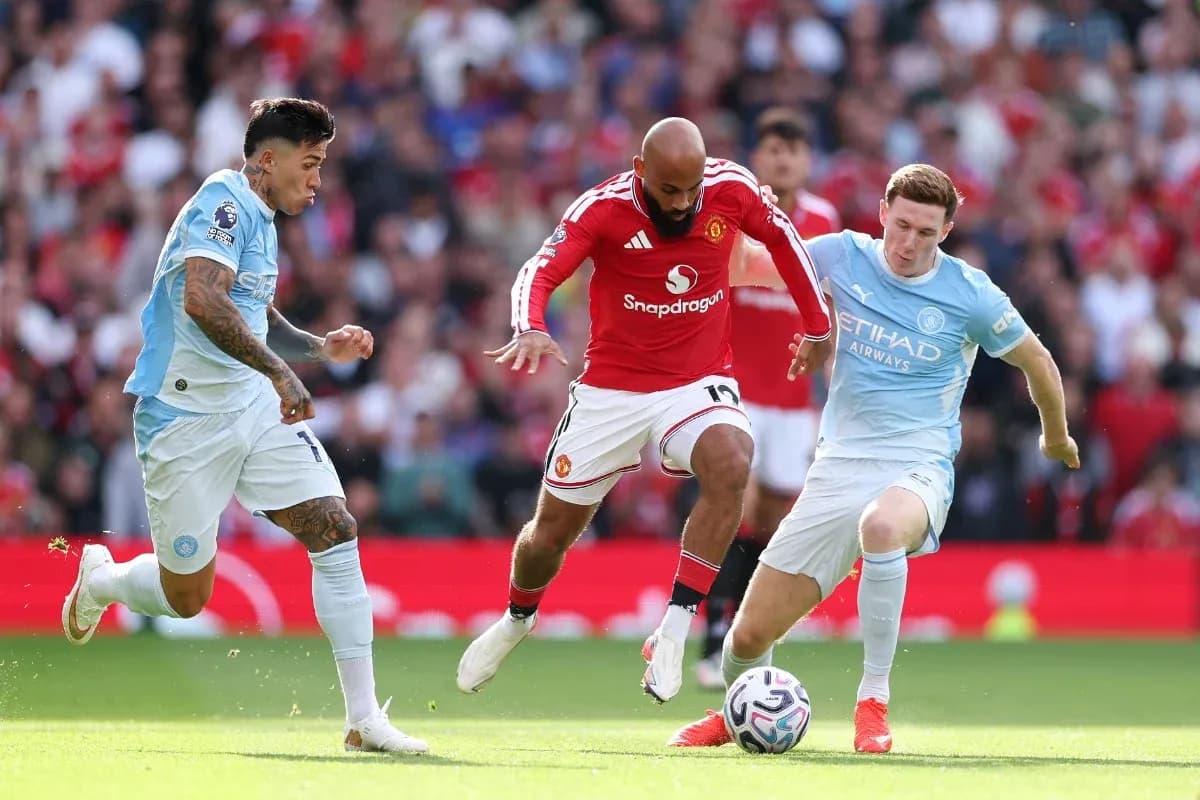
Old Trafford under grey Manchester skies, a 15:30 kick-off, and a derby that underlined the widening tactical gap between two neighbours on very different trajectories. Manchester City left with a 1-0 win and a perfect Premier League record intact; Manchester United slipped deeper into early-season uncertainty, their four points from four games and goal difference of 0 (7 scored, 7 conceded) a stark contrast to City’s 12 points from four, eight scored and only two conceded for a goal difference of 6.
I. The Big Picture – Two 4-2-3-1s, worlds apart
Both managers named a 4-2-3-1, but the systems carried very different identities.
Michael Carrick’s Manchester United lined up with S. Lammens behind a back four of Diogo Dalot, H. Maguire, Lisandro Martínez and P. Dorgu. In front, Y. Tielemans and K. Mainoo formed the double pivot, with B. Mbeumo, Bruno Fernandes and M. Rashford supporting Matheus Cunha as the lone forward.
Enzo Maresca mirrored the shape for Manchester City: G. Donnarumma in goal, a defensive line of Matheus Nunes, M. Guéhi, Rúben Dias and J. Gvardiol. The midfield base paired E. Fernández with E. Anderson, while P. Foden, R. Cherki and A. Semenyo floated behind E. Haaland.
Heading into this game, the numbers already hinted at the story. At home, United had scored 5 and conceded 3 in 2 matches, an attacking average of 2.5 goals for and 1.5 against that suggested chaos more than control. City, on their travels, had scored 5 and conceded just 1 in 2 away games, averaging 2.5 goals for and only 0.5 against. This was a meeting of volatility against machine-like efficiency, and the 0-1 scoreline felt like City imposing their rhythm rather than a smash-and-grab.
II. Tactical Voids – Absences and discipline
United arrived shorn of a spine that would have suited a derby. M. de Ligt (back injury) and M. Ugarte (knee injury) were both missing, removing a dominant aerial presence and a natural ball-winner in front of the defence. L. Shaw’s injury left Carrick turning to P. Dorgu at left-back, altering United’s usual left-side build-up patterns. Higher up, A. Diallo’s absence reduced the wide rotation options, and C. Baleba’s ankle injury further thinned the midfield pool. Even the goalkeeping department felt the strain with T. Heaton out.
City’s only listed absentee was J. Doku with a calf injury, a loss of direct one‑v‑one threat but not a structural blow given Maresca’s wealth of creative options.
Disciplinary trends fed directly into the tactical tone. United’s yellow-card distribution this season shows a late-game surge: 50.00% of their bookings arriving between 76-90 minutes, and another 16.67% between 91-105. That pattern speaks of a team increasingly desperate as games slip away, lunging to salvage territory. City, by contrast, have a more spread but still late-leaning profile: 42.86% of their yellows between 76-90 and 28.57% between 46-60, with a notable red card already on P. Foden’s record. Yet here, City’s control of tempo kept them largely out of those frantic, card-heavy exchanges.
III. Key Matchups – Hunter vs Shield, Engine Room battles
The headline duel was clear: E. Haaland, the league’s leading scorer with 4 goals from 4 appearances, against a United defence anchored by H. Maguire and Lisandro Martínez. Haaland’s 15 shots and 9 on target this season underline his relentlessness; he does not need volume of possession, only zones and service. United’s overall defensive record – 7 conceded in 4, averaging 1.8 goals against per game overall – suggested a unit still searching for cohesion.
Maguire’s profile is double-edged. He has won 21 of 34 duels and blocked 1 shot this season, but he has also committed 7 fouls and picked up 2 yellow cards. Against Haaland’s physicality and movement across the line, that tendency to get drawn into contact was always going to be a fault line. City’s wide and half-space creators – R. Cherki with 2 goals and 2 assists, and P. Foden with 2 assists and 7 key passes – were relentless at dragging United’s centre-backs into uncomfortable areas. Each rotation between Foden drifting inside, Semenyo attacking the channel, and Cherki finding pockets between the lines forced Maguire and Martínez to decide between stepping out or holding the box for Haaland.
In midfield, the “Engine Room” battle pitted Bruno Fernandes and Y. Tielemans against E. Fernández and E. Anderson. Bruno arrived as United’s creative heartbeat: 3 goals, 1 assist, 9 key passes and an 85% pass accuracy. He is both scorer and architect, and United’s only penalty this season has been converted by him. Yet City’s collective structure dulled his influence, repeatedly funnelling him into crowded central zones and forcing him to receive with his back to goal.
Fernández and Anderson, supported by the intelligent pressing of Cherki and Semenyo, formed a compact box around Bruno and Mainoo. City’s defensive record – just 2 goals conceded in 4 league matches, averaging 0.5 against both home and away – is not built on last-ditch heroics but on denying progressive passes at source. Here, that meant cutting the supply lines into Matheus Cunha, who often found himself isolated against Dias and Guéhi, both dominant in duels and comfortable defending space.
IV. Statistical Prognosis – A derby shaped by structure
Following this result, the season’s early data hardens into a clear pattern. United’s total attacking average of 1.8 goals for per game is respectable, but it is mirrored by 1.8 conceded; they are a 50-50 proposition in every sense. No clean sheets in 4 matches, and having already failed to score in 2 games, points to a side that swings between extremes.
City, by contrast, are calibrated. Their total attacking average stands at 2.0 goals for per game, underpinned by that miserly 0.5 conceded. They have yet to fail to score, and have already recorded 2 clean sheets. Even without detailed xG numbers, the shot and goal patterns of Haaland and Cherki, combined with City’s defensive parsimony, sketch a familiar modern-City picture: sustained territorial pressure, high-quality chance creation, and low exposure at the other end.
Narratively, this derby felt less like an isolated chapter and more like a confirmation. United’s 4-2-3-1 is still a work in progress, reliant on Bruno’s inspiration and Rashford’s transitions, undermined by structural fragility and key absences in defence and midfield. City’s mirror shape is a finished article: Haaland as the “Hunter”, protected by a “Shield” that rarely cracks, and an Engine Room that tilts games in their favour long before the scoreboard catches up.
At Old Trafford, the 0-1 was narrow on paper, but in tactical terms it was the latest expression of a broader truth: one side is chasing stability; the other has already found it and is refining the details.