Newcastle vs Liverpool: Tactical Analysis of a 2-2 Draw
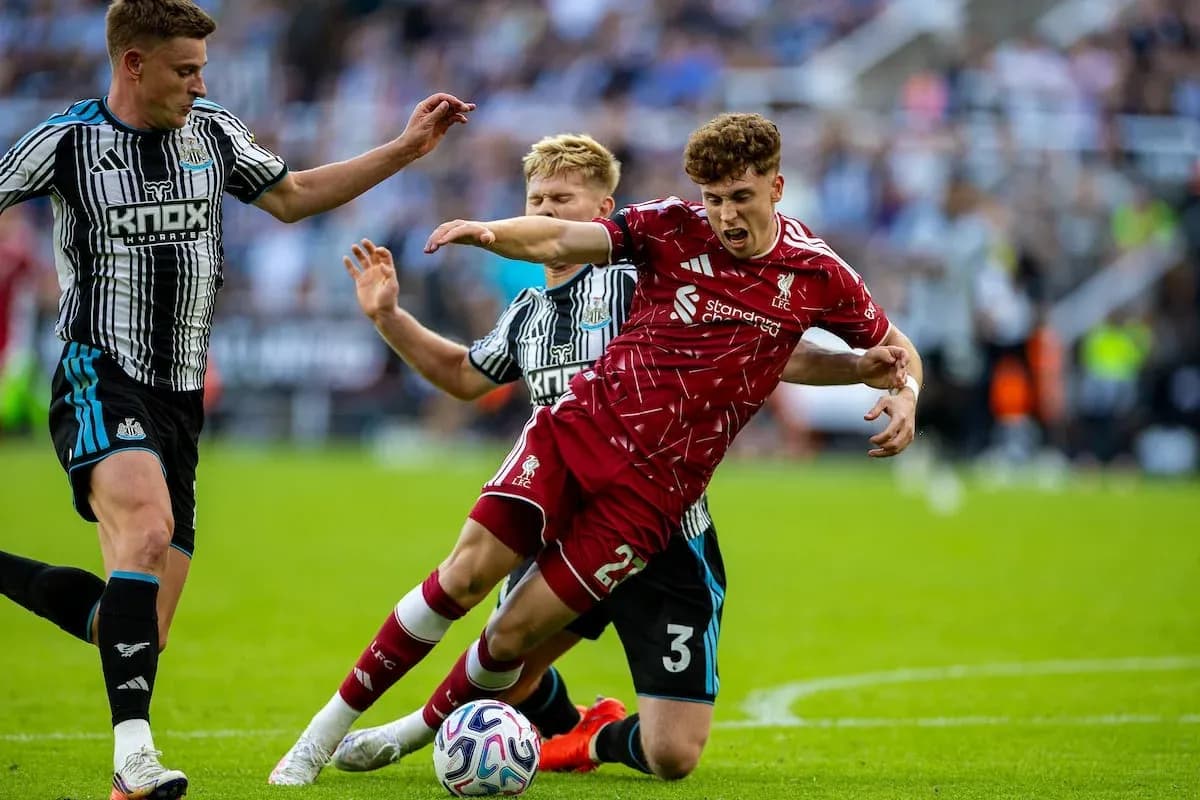
St James’ Park felt less like an opening-day stage and more like a laboratory: two new-era projects, Newcastle under Matthias Jaissle and Liverpool under Andoni Iraola, thrown straight into a tactical stress test that finished level at 2–2 but revealed plenty about where these squads are headed.
I. The Big Picture – Two 4‑2‑3‑1s, one shared identity crisis
Both sides arrive in the 2026 Premier League season committed to the same base shape. Newcastle and Liverpool each lined up in a 4‑2‑3‑1 and, tellingly, both have already used that structure in all of their league minutes so far. Following this result, Newcastle sit 11th and Liverpool 10th, each with 1 point, a goal difference of 0 (2 scored, 2 conceded overall), and a form line of D.
For Newcastle, the early-season profile is simple but revealing: at home they have played 1, drawn 1, scoring 2 and conceding 2, with an average of 2.0 goals both for and against at St James’ Park. They have yet to keep a clean sheet but have also yet to fail to score. Liverpool mirror that symmetry on their travels: away they have played 1, drawn 1, scoring 2 and conceding 2, with an away average of 2.0 goals for and 2.0 against. Neither side has yet produced a clean sheet or a blank in attack.
The draw fits the numbers: two teams whose attacking talent is already ahead of their defensive cohesion.
II. Tactical Voids – Absences that shape the chessboard
The absentees list quietly framed the tactical story. Newcastle were without Joelinton and V. Livramento, both listed as missing through injury. Joelinton’s absence strips Jaissle of a physically dominant, press-resistant presence between the lines and in the half-spaces – exactly the kind of player who could help Newcastle manage Liverpool’s central counter-press. Without him, the double pivot of S. Steur and L. Miley had to shoulder more progression and protection, while Y. Wissa and H. Barnes were asked to do heavier work in transition.
Livramento’s hamstring problem limited full-back rotation and forced Jaissle to lean on A. Dedic and L. Hall as orthodox, positionally disciplined full-backs. That reduced the scope for asymmetrical build-up patterns and meant Newcastle’s width had to come primarily from the wide band of A. Elanga, Wissa and Barnes.
Liverpool’s injury list was longer and more structural. C. Bradley, H. Ekitike, J. Gomez and G. Leoni all missed out. The absence of Bradley and Gomez narrowed Iraola’s right-sided defensive options, making J. Frimpong’s role even more attacking but also more exposed. Without a natural alternative profile behind him, Liverpool were almost obliged to commit to an aggressive right flank, trusting V. van Dijk and J. Jacquet to cover space.
Ekitike’s Achilles tendon injury removed a potential alternative to A. Isak as a central reference; instead, Iraola started Isak himself as the number nine, reconfiguring Liverpool’s front four into a technically rich, interchanging line of R. Ngumoha, F. Wirtz and C. Gakpo behind him. That choice tilted Liverpool’s identity toward fluidity rather than pure penalty-box presence.
Discipline-wise, both squads showed early-season edges. Newcastle’s season card map is spread across the middle of games: 20.00% of their yellow cards have come in each of the 16–30, 31–45, 61–75 and 76–90 windows, plus another 20.00% in 91–105 – a sign of persistent, phase-by-phase aggression rather than one chaotic spell. Liverpool’s yellows, by contrast, have been front-loaded: 66.67% between 16–30 and 33.33% between 76–90, hinting at early over-commitment in the press and late-game fatigue or desperation.
III. Key Matchups – Hunter vs Shield, Engine Room vs Engine Room
Hunter vs Shield
For Newcastle, the early-season “hunters” are emerging from the wide and second-line roles. A. Elanga and J. Willock both have 1 goal in total this campaign, and W. Osula already has 1 assist. Elanga’s profile is particularly instructive: in his 76 minutes he scored once, hit both of his shots on target and won 5 of 9 duels. His direct running from the right or left flank is the cutting edge of Newcastle’s transition game.
Behind him, Wissa operates as the hybrid connector. He has not scored yet but has 1 assist and 4 tackles in 89 minutes, winning 11 of 19 duels and drawing 4 fouls. He is both out-ball and first presser, the player who turns Newcastle’s regains into attacks and their attacks into territorial pressure.
Liverpool’s creative spear is more centralised. R. Gravenberch has already recorded 1 assist, completing 47 passes at 91% accuracy and adding 1 tackle and 2 interceptions. He is the tempo-setter in Iraola’s double pivot, responsible for threading the first vertical pass into Wirtz or Gakpo. Around him, D. Szoboszlai adds a more vertical, ball-carrying threat, while Wirtz’s positioning between the lines is designed to pull defenders out of the back four.
Defensively, neither shield has fully convinced. Newcastle’s back line of A. Dedic, M. Thiaw, S. Botman and L. Hall conceded 2 at home and have yet to produce a clean sheet. Liverpool’s unit of Frimpong, Jacquet, van Dijk and M. Kerkez has conceded 2 away, also without a clean sheet. The “shield” for both sides is more collective pressing than pure penalty-box defending at this stage.
Engine Room vs Engine Room
The true tactical duel lies in midfield. For Newcastle, L. Miley is already a quiet metronome. Across his 76 minutes, he completed 36 passes at 83% accuracy, created 2 key passes, and contributed 1 tackle, 1 block and 1 interception. He also picked up a yellow card, emblematic of his willingness to step into duels (7 total, 5 won) to break rhythm.
Alongside him, Steur is the more conservative pivot, allowing Wissa and Barnes to push higher. When Jaissle turns to the bench, the profile shifts: J. Ramsey and J. Murphy bring a more vertical, risk-taking energy. Ramsey’s 16 passes at 93% accuracy plus 2 tackles and 1 block show a player who can both tidy and bite. Murphy, with his 1 yellow card in just 14 minutes, underlines the edge Newcastle inject late on.
Liverpool’s engine is built differently. Gravenberch is the passer and presser in one, while Szoboszlai offers line-breaking runs and shots from distance. The bench options – A. Mac Allister and W. Endo – give Iraola the choice between a more positional, possession-focused controller and a pure destroyer. That flexibility could become crucial in managing games where Liverpool’s early yellow-card spikes threaten to destabilise their press.
IV. Statistical Prognosis – Two volatile projects, one shared ceiling
Following this result, both teams carry the same statistical fingerprint: 1 draw from 1 match, 2 goals scored, 2 conceded, no penalties missed (Newcastle have not taken one; Liverpool have scored their only penalty of the season for a 100.00% conversion so far). The lack of clean sheets, combined with consistent scoring, points towards high-variance football in the early weeks.
Newcastle’s card distribution – yellows spread evenly across the middle and late phases – suggests a team whose aggression is systemic, not situational. Liverpool’s concentration of yellows between 16–30 and 76–90 hints at a press that still needs calibration: too hot early, too stretched late.
In xG terms, the raw numbers are not provided, but the shot and chance-creation data around the key individuals is telling. Newcastle’s wide threats (Elanga, Wissa, Barnes) and second-line runners (Willock, Osula) are already generating shots on target and key passes. Liverpool’s central axis of Gravenberch, Szoboszlai and Wirtz is built to control volume and territory rather than pure shot flurries.
The prognosis is of two sides whose attacking structures are already dangerous enough to maintain an average of 2.0 goals for per match, but whose defensive organisation is lagging just enough to concede at the same 2.0 rate. If either coach tightens the midfield distances and refines the pressing triggers, the balance of these squads suggests a quick swing towards positive goal difference.
For now, this 2–2 stands as a fair reflection: two ambitious, tactically bold teams at the start of their arcs, mirroring each other in structure, flaws and potential – and promising a season where neither will be dull.