Nottingham Forest and Tottenham's Goalless Stalemate: A Tactical Analysis
The City Ground has seen enough tension already this season; this 0-0 between Nottingham Forest and Tottenham felt less like a stalemate and more like two fragile projects staring into a mirror. Following this result, Forest sit 16th with 2 points from 3 matches, Tottenham 18th with 1 point, both still without a league win and both still searching for an attacking identity that matches their managers’ ambitions.
I. The Big Picture – Structures Without a Cutting Edge
Forest stayed loyal to their seasonal blueprint: a 3-4-2-1 that has started all three league games. Matz Sels anchored a back three of Jair, Nikola Milenković and Murillo, with Neco Williams and Ola Aina as the wide outlets. In front of them, Xaver Schlager and James McAtee formed a technical double pivot, while Dan Ndoye and Morgan Gibbs-White operated between the lines behind lone forward Liam Delap.
The shape fits Forest’s season profile. Heading into this game they had played 3 league matches, drawing 2 and losing 1, with 2 goals scored in total and 3 conceded overall. The contrast between their home and away production is stark: at home they had yet to score in 2 games, averaging 0.0 home goals for and 0.5 home goals against per match, while on their travels they averaged 2.0 away goals for and 2.0 away goals against. At the City Ground, Glasner’s side have been compact but creatively inhibited; this match did little to change that narrative.
Tottenham, meanwhile, arrived with Roberto De Zerbi’s preferred 4-2-3-1, also used in all 3 league fixtures so far. A. Kinský started in goal behind a back four of Pedro Porro, Jan Paul van Hecke, Micky van de Ven and Destiny Udogie. Sandro Tonali and Rodrigo Bentancur formed the double pivot, with Sávio, Conor Gallagher and Mathys Tel supporting Omar Marmoush up front.
Their statistical profile is even more extreme. Heading into this game Tottenham had 0 goals scored in total across 3 matches, with 5 conceded overall. At home they averaged 0.0 home goals for and 2.0 home goals against; away, 0.0 away goals for and 1.5 away goals against. The goalless draw extends that drought: structurally, the team can progress the ball, but the penalty box remains a desert.
II. Tactical Voids – Absences and Discipline
Both managers were forced into significant rethinks by absences. For Forest, N. Savona was ruled out with a knee injury, trimming depth in central areas but not disrupting the core XI that Glasner clearly trusts.
Tottenham’s list was more brutal and directly shaped their attacking plan. Dejan Kulusevski (knee injury), James Maddison (knock), W. Odobert (knee injury) and Xavi Simons (knee injury) were all missing this fixture. That stripped De Zerbi of his natural right-sided creator, his primary central playmaker, and two dynamic attacking options who could have varied the threat between lines. It explains why Gallagher was pushed high as a No.10 and why so much creative burden fell on Sávio and Tel from wide positions.
Disciplinary trends framed the tone. Forest’s season card map shows a clear spike in aggression immediately after half-time: 50.00% of their yellow cards have arrived between 46-60 minutes, with additional bookings spread evenly in the 16-30, 31-45 and 76-90 ranges (each 16.67%). Tottenham, by contrast, distribute their yellows almost perfectly across the game: 25.00% in each of 0-15, 31-45, 46-60 and 76-90. That pattern held in spirit here: Forest’s wing-backs and midfielders were again on the edge in transitions, while Spurs’ back line and pivots had to foul to stop the few direct counters that broke their press.
Individually, Aina’s disciplinary profile loomed large over Forest’s right flank. With 2 yellow cards in 3 appearances this season, he walks a constant tightrope. On the Tottenham side, Udogie and Mateus Fernandes each carry 1 yellow in 3 games, both inclined to engage aggressively in duels – a factor that informed how Forest targeted their counters down the channels.
III. Key Matchups – Hunter vs Shield, Engine Room vs Engine Room
If this match had a “Hunter vs Shield” duel, it was conceptual rather than statistical. Forest’s most productive attacker this season is Gibbs-White: heading into this game he had 1 goal and 1 assist in 3 league appearances, with 7 shots (2 on target) and 81 passes at 82% accuracy. He is the side’s creative compass, attempting 8 dribbles with 4 successful, and winning 12 of 25 duels. Against a Tottenham defence that had conceded 5 goals overall in 3 matches, he was the one player capable of exploiting their hesitancy between lines.
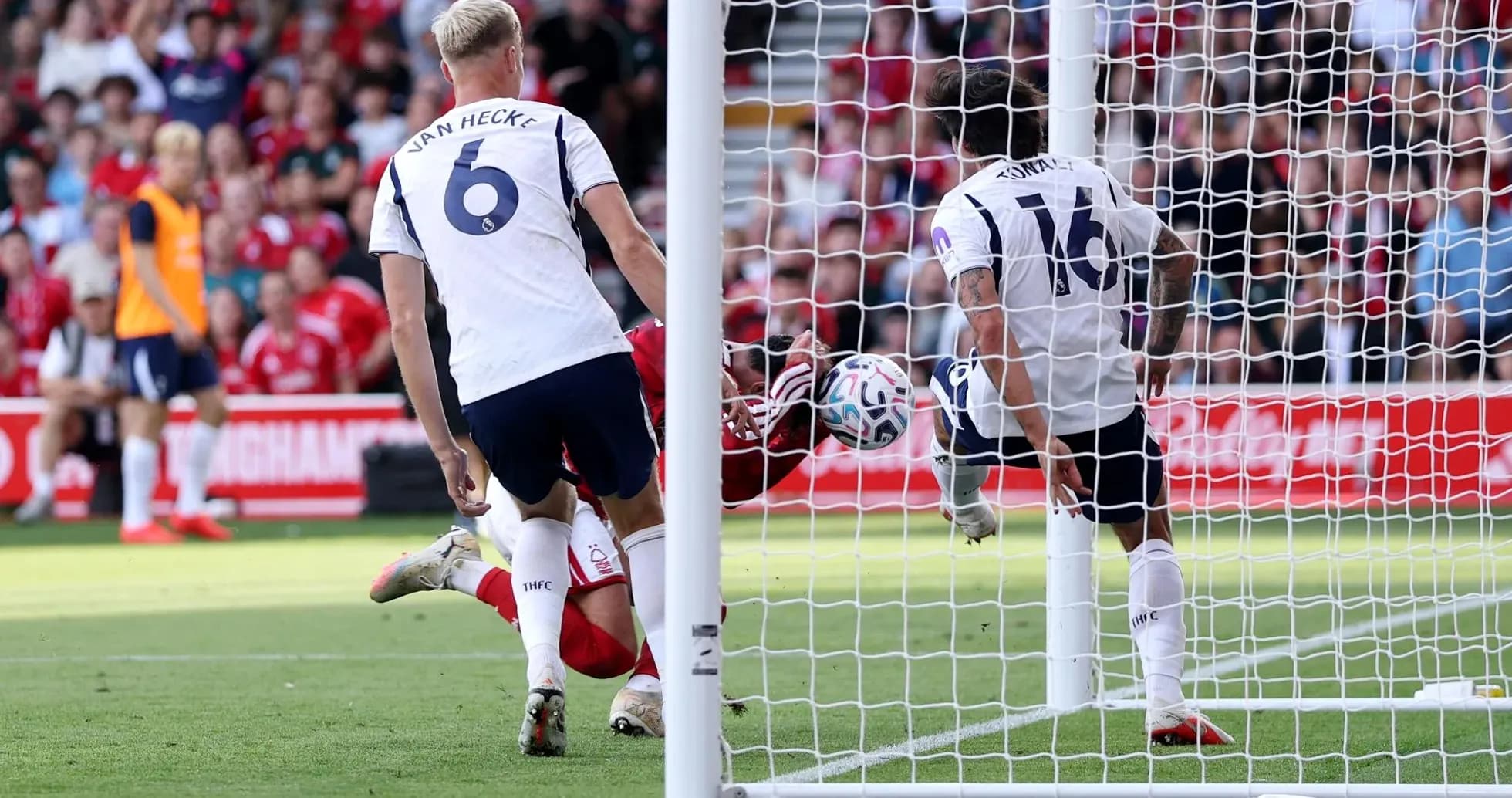
Yet Tottenham’s “shield” is more systemic than individual. Van de Ven’s pace covering depth, van Hecke’s front-foot defending and Tonali’s positional discipline in front of them combined to choke central spaces where Gibbs-White thrives. Marmoush’s defensive work from the front also helped block passes into Forest’s No.10 pockets, forcing them wide to Williams and Aina, where Spurs were more comfortable defending crosses.
In the “engine room” battle, Schlager and McAtee against Tonali and Bentancur was the game’s true axis. Forest’s pair looked to build patiently, but their risk threshold was limited by the knowledge that Tottenham’s counter-press could punish any loose touch. Tonali’s passing range and Bentancur’s press-resistance allowed Spurs to control large spells of possession, but without Maddison or Kulusevski, the vertical pass that breaks the last line was often missing.
Wide, Aina against Sávio and Udogie against Ndoye were constant tactical puzzles. Aina, who has attempted 7 dribbles and won 17 of 35 duels this season, tried to drive Forest forward but had to balance that with the risk of leaving Jair exposed to Sávio’s 1v1 ability. On the opposite side, Udogie’s natural urge to overlap was tempered by Ndoye’s direct running, which threatened to exploit any space left behind.
IV. Statistical Prognosis – Two Projects Still in Construction
From a statistical and tactical lens, this 0-0 feels less like a one-off and more like a continuation of both teams’ seasonal arcs.
Forest’s overall goal difference stands at -1, with 2 goals for and 3 against across 3 matches (2 draws, 1 defeat). They have kept 1 clean sheet in total and failed to score in 2 games overall, both at home. The pattern is clear: away from home they are more expansive and effective; at the City Ground they are risk-averse, prioritising structure over incision. Their penalty record underlines their potential ruthlessness when the chance is clear: 1 penalty taken, 1 scored, 0 missed, a perfect return when the opportunity finally arises.
Tottenham’s situation is more alarming. Their overall goal difference is -5, with 0 goals for and 5 against in 3 matches. They have 1 clean sheet in total but have failed to score in all 3 games overall. The defensive averages – 2.0 goals conceded per home match and 1.5 away – suggest a unit that is not yet fully synchronised with De Zerbi’s high-possession, high-risk model. Yet here, the clean sheet and the relative control of territory hint that the defensive structure is slowly stabilising; it is the attack that remains starved of final-third clarity, particularly with so many creative players missing.
In xG terms, this had the profile of a low-to-medium chance game: Forest’s conservative home approach and Tottenham’s sterile dominance tend to produce more shots from distance and half-spaces than clear one-on-ones. The statistical prognosis is that Forest will continue to grind at home, relying on narrow margins and set plays, while Tottenham’s ceiling is far higher once Kulusevski, Maddison and Simons return – but until then, their xG may outstrip their actual goals by a frustrating margin.
Both squads leave the City Ground with clean sheets and a point, but also with the same fundamental question: who, within these carefully constructed structures, will actually finish the chances when the patterns finally click?