Tottenham Hotspur vs Everton: A Goalless Draw Analysis
Under a grey north London sky, the Tottenham Hotspur Stadium staged a goalless draw that said far more about structure and fragility than the 0-0 scoreline ever could. Tottenham, rooted in 17th with 2 points from 4 matches and a goal difference of -5 (0 scored, 5 conceded overall), came into this as a side searching for identity. Everton, by contrast, arrived in 8th with 6 points, unbeaten with 1 win and 3 draws and a positive goal difference of 2 (5 scored, 3 conceded overall).
Both coaches leaned into familiarity: Roberto De Zerbi and David Moyes mirrored each other with 4-2-3-1 systems, but the same formation produced very different personalities.
I. The Big Picture – Two 4-2-3-1s, Two Stories
Tottenham’s season to this point has been defined by sterility in the final third. Heading into this game they had failed to score in all 4 league fixtures, with an overall scoring average of 0.0 goals per match and 0.0 at home. The defensive numbers were merely serviceable: 5 conceded overall, split as 2 at home and 3 on their travels, for an overall average of 1.3 goals against (1.0 at home, 1.5 away). Clean sheets – 2 in total – hinted at a side that could lock games down but not tilt them.
Everton’s profile was the mirror image. They carried a modest attacking punch – 5 goals overall, averaging 1.3 per match, with a striking split between 2.0 at home and just 0.5 away – but were built on defensive solidity: only 3 conceded overall, 0.8 per match, and just 0.5 away. They arrived as a team comfortable in low-scoring contests, especially on their travels.
Within that frame, a 0-0 feels less like a surprise and more like an inevitable intersection of two trajectories: a home side that cannot find the net and a visiting side that specialises in denying space.
II. Tactical Voids – Who Was Missing, and What That Meant
Tottenham’s attacking absences were as loud as any chant in the stands. Dejan Kulusevski (knee injury), Mykhaylo Mudryk (ankle injury), W. Odobert (knee injury), Richarlison (transfer negotiations) and Xavi Simons (knee injury) were all ruled out. That is an entire creative and goalscoring layer stripped away, forcing De Zerbi to construct a new front four almost from scratch.
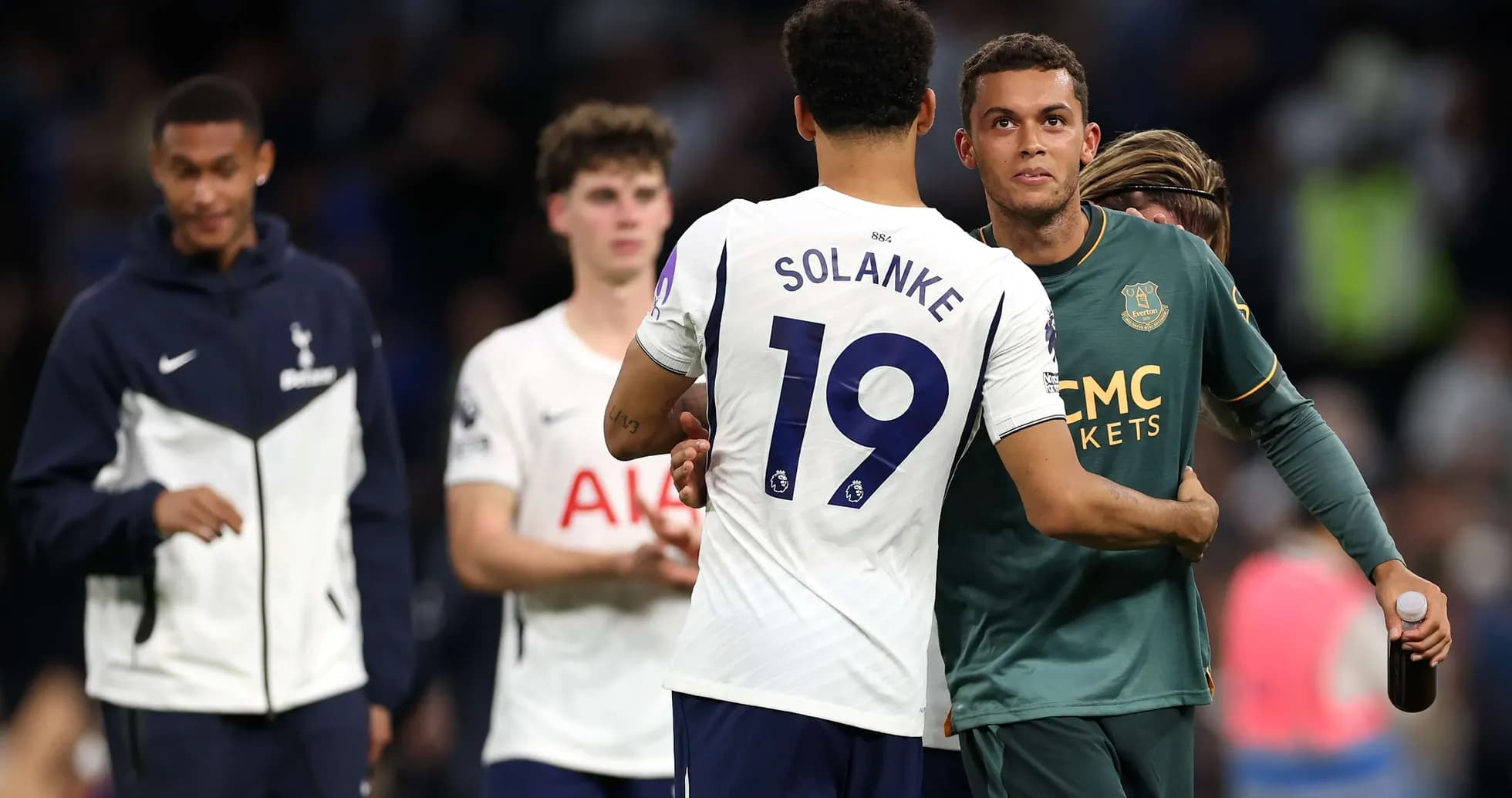
In their place, he fielded Omar Marmoush, Sávio and Mateus Fernandes behind Dominic Solanke, with Rodrigo Bentancur and Sandro Tonali anchoring the double pivot. It is a technically gifted unit, but one lacking the proven Premier League end product of Kulusevski or Richarlison. The result was a lot of structured possession, not much incision.
Everton’s key absentee was Christian Norgaard, out injured. His absence removed a natural organiser in midfield, but Moyes compensated by trusting James Garner and H. Armstrong as the double pivot. Given Everton’s defensive record heading into this match – just 1 goal conceded away from home – the plan was clear: keep the central lane narrow, trust the back four, and live with a little less composure in buildup.
Disciplinary trends also framed the contest. Tottenham’s yellow-card distribution this season shows a clear late-game spike: 40.00% of their cautions have arrived between 76-90 minutes, with evenly spread earlier bookings (20.00% each in 0-15, 31-45 and 46-60). Everton’s bookings are more evenly scattered but still rise after the hour, with 28.57% between 61-75 and further cards in the final quarter of an hour and stoppage time. This is a fixture where fatigue and frustration typically sharpen tackles late on, and both coaches would have been wary of that pattern.
III. Key Matchups – Hunter vs Shield, Engine Room vs Enforcer
The “Hunter vs Shield” duel here was not a classic clash of a prolific striker against a fragile defence. Solanke led the line for a Tottenham side that had not scored all season; Everton’s shield was a unit that had conceded only once on their travels. James Tarkowski and Jarrad Branthwaite, flanked by Ainsley Maitland-Niles and Vitaliy Mykolenko, formed a back four built to defend the box rather than chase high.
With Tottenham’s average goals for at home stuck at 0.0 and Everton’s away goals against at 0.5, the contest tilted towards the visitors’ comfort zone: compact, low-margin football. Solanke’s role became less about finishing a stream of chances and more about occupying centre-backs, creating half-spaces for Marmoush drifting inside and Sávio attacking the right channel.
In the “Engine Room”, Tonali and Bentancur faced Garner and Armstrong. Garner’s season so far has been quietly influential: 128 passes completed with 3 key passes, 11 tackles and 2 interceptions, plus the disciplinary edge of 2 yellow cards and a place among the league’s leading card collectors. He is both Everton’s metronome and its enforcer, a player who can break up play and then recycle the ball with 90% passing accuracy.
Against Tottenham’s double pivot, this was a battle for tempo. Tonali and Bentancur sought to accelerate circulation and pull Everton’s block out of shape; Garner and Armstrong focused on screening the space between the lines, denying Fernandes and Marmoush the pockets they crave. With both sides using a 4-2-3-1, whoever controlled that central square would dictate whether the match became stretched or stayed suffocatingly tight. The final 0-0 suggests the latter: Everton’s shield held, and Tottenham’s structure never quite broke it.
IV. Statistical Prognosis – What the Numbers Say About the Future
Even without explicit xG values, the season trends sketch a clear tactical prognosis.
Tottenham’s overall attacking output – 0 goals from 4 matches, 0.0 per game – is unsustainable for a side with top-half ambitions. Their defensive averages (1.3 conceded overall, 1.0 at home) are respectable enough to keep them in games, but without the missing creativity of Kulusevski, Mudryk, Odobert and Xavi Simons, De Zerbi’s 4-2-3-1 risks becoming sterile possession in front of set blocks. The late yellow-card spike (40.00% between 76-90) hints at frustration and chasing games rather than controlling them.
Everton, meanwhile, look built for incremental gains. An overall scoring average of 1.3 and a defensive record of 0.8 conceded per match, especially the 0.5 away from home, underpin Moyes’ preference for control and risk management. Their single away goal so far shows they are not expansive travellers, but their unbeaten record and two clean sheets suggest they will grind out points consistently.
Projecting forward, Tottenham’s ceiling will rise only when their missing forwards return or when the current front four develops sharper automatisms. Until then, their best route is to lean into the defensive platform that has already produced 2 clean sheets and accept tight margins.
Everton, by contrast, will continue to be a difficult out: structurally sound, disciplined, and anchored by a midfield where Garner’s blend of tackling, passing and controlled aggression sets the tone. In fixtures like this, the numbers and the narrative converge: a stalemate that flatters Everton’s plan and exposes Tottenham’s ongoing search for a cutting edge.