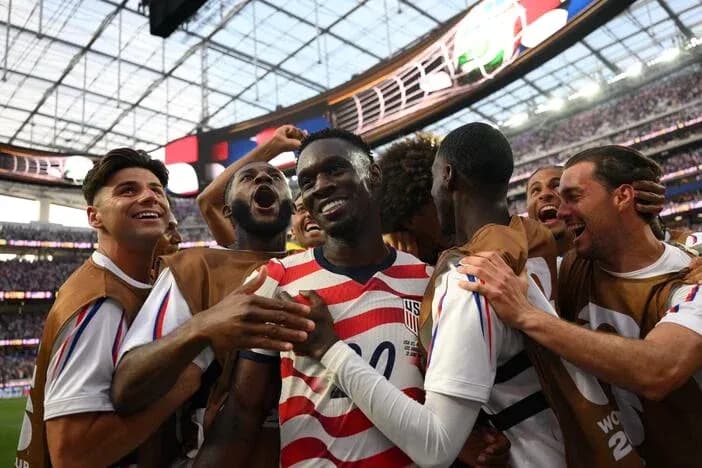
USA Dominates Paraguay in World Cup Opener
LOS ANGELES — For weeks, the World Cup felt like a storm brewing off the coast: politics, protests, eye-watering ticket prices, immigration snags, transit headaches. Then the whistle blew, the ball rolled across fresh grass in Mexico, Canada and the United States, and the noise around the tournament faded into the background.
The football has taken over. And it has started with a jolt.
A Statement Night in Los Angeles
For a U.S.-based audience, there’s only one place to begin: Los Angeles Stadium, Friday night, under lights that felt a little brighter than usual.
USA 4, Paraguay 1.
On paper, it’s a scoreline. In context, it’s a marker. The most goals the U.S. men have ever scored in a World Cup match, and arguably the most complete World Cup performance in the program’s history.
Folarin Balogun led the charge. The striker delivered two goals, becoming the first American man to score multiple times in a World Cup game since the inaugural tournament in 1930. Ninety-four years between those benchmarks tells you how rare a night like this has been for the U.S. on the biggest stage.
Behind him, the platform was flawless. Chris Richards, only just back from an injury that kept him out of both pre-tournament warm-up matches, stepped into the back line and produced a passing clinic. Eighty-three passes attempted. Eighty-three completed. No player has completed more passes in a World Cup match since records began in 1966.
Every build-out seemed to start with him. Every surge forward felt controlled, intentional. From back to front, the U.S. moved with a swagger that has so often been missing at this level.
There was, however, a note of concern. Christian Pulisic, the star around whom much of this team’s attacking identity orbits, came off at halftime with a calf problem. He walked gingerly toward the team bus after the match, his status still unclear. One game into a five-week grind, the U.S. has its first major fitness question.
The performance dazzled. The scoreline impressed. But this is the World Cup. One night does not define a tournament.
Australia Crash the Party in Group D
The next clues about Group D arrived 24 hours later.
Turkey, stacked with top-tier European talent — Real Madrid’s Arda Güler, Juventus attacker Kenan Yildiz, and a supporting cast used to Champions League nights — walked into its opener against Australia as the group’s technical heavyweight.
Australia tore up the script.
A 2-0 win for the underdog turned the group on its head and changed the tone of the U.S. campaign overnight. The result means Friday’s USA–Australia clash already carries serious weight. If the Americans beat the Socceroos, they seize control of the group and put themselves in a commanding position for the knockout rounds.
Slip, and the landscape shifts again.
Scotland’s Surprise and Brazil’s Stutter
The shocks haven’t stopped at Group D.
Scotland, back at a World Cup for the first time in 28 years, returned to the stage and immediately disrupted the hierarchy. A win over Haiti put the Scots on top of Group C after the opening round of matches.
That alone would be a feel-good story. The context makes it more than that.
Sharing the group with Brazil — five-time world champions — and Morocco, one of the powerhouses of the global game, Scotland were supposed to be scrapping for survival. Instead, Brazil and Morocco cancelled each other out in a 1-1 draw, leaving Scotland looking down at royalty. For now, at least, the underdog leads the aristocrats.
Group C has a long way to run, but the tone has been set: nobody gets a free pass.
Qatar’s First Point, Heavyweights Trade Blows
Elsewhere, the smaller stories carried their own weight.
Qatar, in just its second World Cup, finally has a point. A 1-1 draw with Switzerland on Saturday delivered the country’s first-ever World Cup point, a modest but meaningful milestone after losing all three matches as hosts in 2022. The tie may not alter the tournament’s balance of power, but it changes Qatar’s history.
In Group F, the stakes and quality both rose. The Netherlands and Japan, two of the group’s leading contenders, went at each other and refused to back down, finishing in a 2-2 draw that felt more like a warning shot to the rest of the field. Neither side blinked; neither side pulled clear.
The early rounds are often about separating contenders from passengers. In Group F, both look ready to stay for the long haul.
Curaçao’s Seventeen Minutes
Then there was Curaçao.
Population: 158,000. The smallest nation ever to play in a World Cup. On Sunday, the Caribbean island walked out to face Germany, a country whose name alone carries decades of tournament muscle.
Germany scored first. Expected. Inevitable, even.
Curaçao hit back.
For 17 minutes, the scoreboard read 1-1 and belief spread across the tiny nation’s fan base. Those were the minutes that justify qualifying campaigns, that turn kids into lifelong supporters and players into local legends.
Then Germany did what Germany so often does. Ruthless, relentless, they pulled away and won 7-1 — a scoreline that echoes one of their most famous World Cup nights. The romance faded, but those 17 minutes will live a long time in Curaçao’s memory.
Politics in the Background, Iran on the Pitch
The week ahead carries a different kind of tension.
On Monday, Iran opens its World Cup against New Zealand at Los Angeles Stadium, a match shaped not only by tactics and form but by geopolitics. After the U.S. and Israel attacked Iran in February, questions lingered over whether Iran would even participate in this tournament.
The team had initially planned to base its training camp in Tucson, Arizona. Instead, citing ongoing hostilities and security concerns, Iran shifted operations to Tijuana, Mexico. U.S. authorities are allowing the squad into the country only on the day before each of its three group matches.
The restrictions hang over the football, but once the whistle goes, Iran and New Zealand will have 90 minutes to talk in the sport’s own language.
Mbappé, Messi and the Weight of History
Tuesday belongs to the stars.
France, powered by Kylian Mbappé, begin their campaign against Senegal in a Group I clash that already feels like a knockout tie in disguise. Mbappé steps into another World Cup as the face of a generation, carrying the expectations of a nation that now measures success in trophies, not appearances.
On the same day, Argentina and Lionel Messi start their defense of the title in Group J against Algeria. Messi, who finally lifted the World Cup in 2022, now chases something even rarer: back-to-back crowns. Only two nations have ever defended a World Cup title — Italy in 1938 and Brazil in 1962.
Argentina’s quest to join that company begins with a single step, a single game, a single Messi touch that could tilt the entire narrative of this tournament.
The politics, the logistics, the noise around this World Cup will not disappear. But as the second week dawns, one question cuts through it all: with records already falling, giants wobbling, and underdogs swinging hard, who will still be standing when the chaos settles?