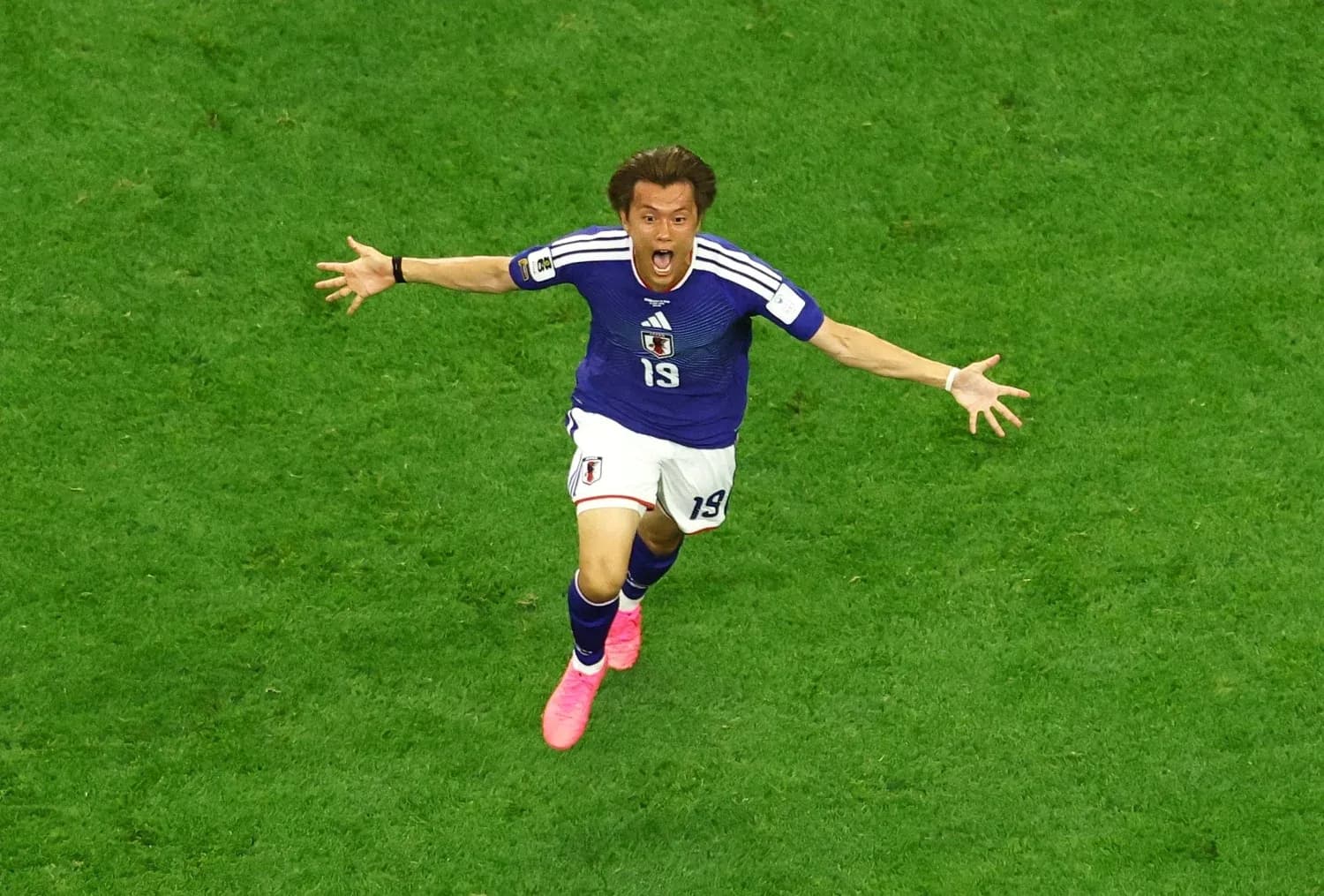
Netherlands and Japan's Tactical Battle Ends in 2-2 Draw
Netherlands and Japan opened their World Cup Group Stage - 1 campaigns at AT&T Stadium with a tactically rich 2-2 draw that showcased contrasting structures and phases of control. Ronald Koeman’s Netherlands imposed themselves for long spells with a 4-3-3 focused on ball circulation and territorial dominance, while Hajime Moriyasu’s Japan used a 3-4-2-1 to threaten in transition and late-arriving runs, ultimately turning limited possession into clinical, well-timed strikes.
Netherlands’ 60% possession, 525 passes and 88% passing accuracy underline a game plan built on methodical progression. The back four of Denzel Dumfries, Jan Paul van Hecke, Virgil van Dijk and Micky van de Ven formed a broad platform, with Frenkie de Jong as the central reference in the first phase. De Jong dropped between or alongside the centre-backs to connect with Ryan Gravenberch and Tijjani Reijnders, creating a 3+1 or 2+2 structure that consistently outnumbered Japan’s first pressing line of Daizen Maeda and Ayase Ueda.
High up, the 4-3-3 morphed into a 2-3-5 in settled attack: full-backs advanced to pin Japan’s wing-backs, while Crysencio Summerville and Cody Gakpo held wide positions to stretch the back three. This stretch was decisive for the first goal at 51', when Virgil van Dijk attacked a situation created from sustained pressure and a Ryan Gravenberch delivery; the midfielder’s role as a half-space connector and set-piece supplier was central to Netherlands’ threat despite their relatively modest xG of 0.79 from 10 total shots.
Japan’s 3-4-2-1, with Tsuyoshi Watanabe, Shogo Taniguchi and Hiroki Itō at the back, was initially conservative. The wing-backs and double pivot of Kaishu Sano and Daichi Kamada were tasked with screening central lanes rather than chasing the ball. Japan accepted the territorial deficit, focusing on compressing the middle and waiting for turnovers to launch Takefusa Kubo and Keito Nakamura into space. Their 40% possession and 342 passes at 84% accuracy reflect a more vertical, risk-aware approach.
The equaliser at 57' encapsulated that plan. After weathering Dutch pressure, Japan broke through Kubo in a right-sided pocket; his assist to Nakamura exploited the space behind Netherlands’ advanced full-backs. The 0.54 xG from 10 shots shows Japan did not flood the box but instead picked moments to attack with precision, especially via their attacking midfield line.
Koeman’s in-game management aimed to maintain tempo and control rather than radically alter structure. At 70', a triple substitution reshaped the midfield and front line without changing the 4-3-3 skeleton: Teun Koopmeiners (IN) came on for Tijjani Reijnders (OUT), Quinten Timber (IN) came on for Crysencio Summerville (OUT), and Memphis Depay (IN) came on for Donyell Malen (OUT). Koopmeiners offered more positional discipline and distribution from deeper zones, while Depay became a central reference point to receive between lines. Before that reshuffle, Summerville had already justified his starting role, scoring at 64' after another Gravenberch assist, a direct reward for Netherlands’ wide overloads and rotations.
Japan’s response from the bench was more structural. At 66', Junya Ito (IN) came on for Daizen Maeda (OUT), adding direct running and width on the right. The triple change at 75' — Koki Ogawa (IN) for Takefusa Kubo (OUT), Takehiro Tomiyasu (IN) for Ritsu Doan (OUT), and Yukinari Sugawara (IN) for Tsuyoshi Watanabe (OUT) — subtly rebalanced the 3-4-2-1. Tomiyasu’s introduction increased ball progression from the back, while Ogawa provided a more penalty-box-oriented presence. This paid off late: at 89', Kamada, now pushing higher from midfield, arrived to finish from an Ogawa assist, a classic example of a late runner exploiting a tiring Dutch block.
The final substitution cycles further underlined intent. At 81', Nathan Aké (IN) came on for Ryan Gravenberch (OUT), adding defensive security on the left side as Netherlands sought to protect their lead. Japan, chasing the game, introduced Kento Shiogai (IN) for Ayase Ueda (OUT) at 84', while Netherlands added Brian Brobbey (IN) for Cody Gakpo (OUT) at 85', trading technical wide play for a more physical outlet.
Discipline and game management were tilted towards Netherlands, who collected all three yellow cards. The sequence was: 61' Crysencio Summerville (Netherlands) — Foul; 83' Memphis Depay (Netherlands) — Foul; 90+1' Micky van de Ven (Netherlands) — Professional foul. Japan, by contrast, managed to avoid bookings despite matching Netherlands with 7 fouls each, suggesting their challenges were better timed or in less dangerous zones.
In goal, Bart Verbruggen (Netherlands) faced 3 shots on target and made 1 save according to the statistics, with goals prevented at 0.62, indicating that Japan’s finishing slightly outstripped the quality of chances conceded. At the other end, Zion Suzuki (Japan) made 4 saves from 6 Dutch shots on goal, also with 0.62 goals prevented, a strong return in a match where his side spent long periods under pressure. The near-identical goals prevented figures underscore that both goalkeepers were exposed to similar shot quality, even if the volume and context differed.
Statistically, Netherlands’ 5 corner kicks to Japan’s 4 and a 1–0 edge in offsides align with their territorial dominance and higher line. Both sides registered 1 blocked shot, showing that while the game was tactically tense, it was not defined by massed last-ditch defending inside the box. Instead, the key tactical story was one of structural contrast: Netherlands’ structured possession and wing-based patterns versus Japan’s compact mid-block and sharp, well-timed surges through their attacking midfielders.
The 2-2 scoreline, with Netherlands leading twice and Japan equalising each time, reflects a balance between control and punch. Netherlands dictated where the game was played; Japan dictated when it hurt most.